Blue


The breath of the breeze on my face ,
a whisper through the trees,
its fingers on the water.
Pale blue sky with soft translucent clouds,
fading sunlight on the leaves.
Blue below and above

the thin blue line where water meets sky
for an arm wrestling match,
the unending versus the infinite,

while the breeze laughs, knowing it can easily
tip either’s arm.
Even the sun will set
and darkness will own the sky and sea for a while,

but the breeze, despite its soft caress, is stronger than them all,
stronger than day or night,
sky or sea,
rising or setting sun.
You can hear it laughing
as it moves, making leaves tremble,
imposing its will on the helpless sky and sea.

Strength and Defiance


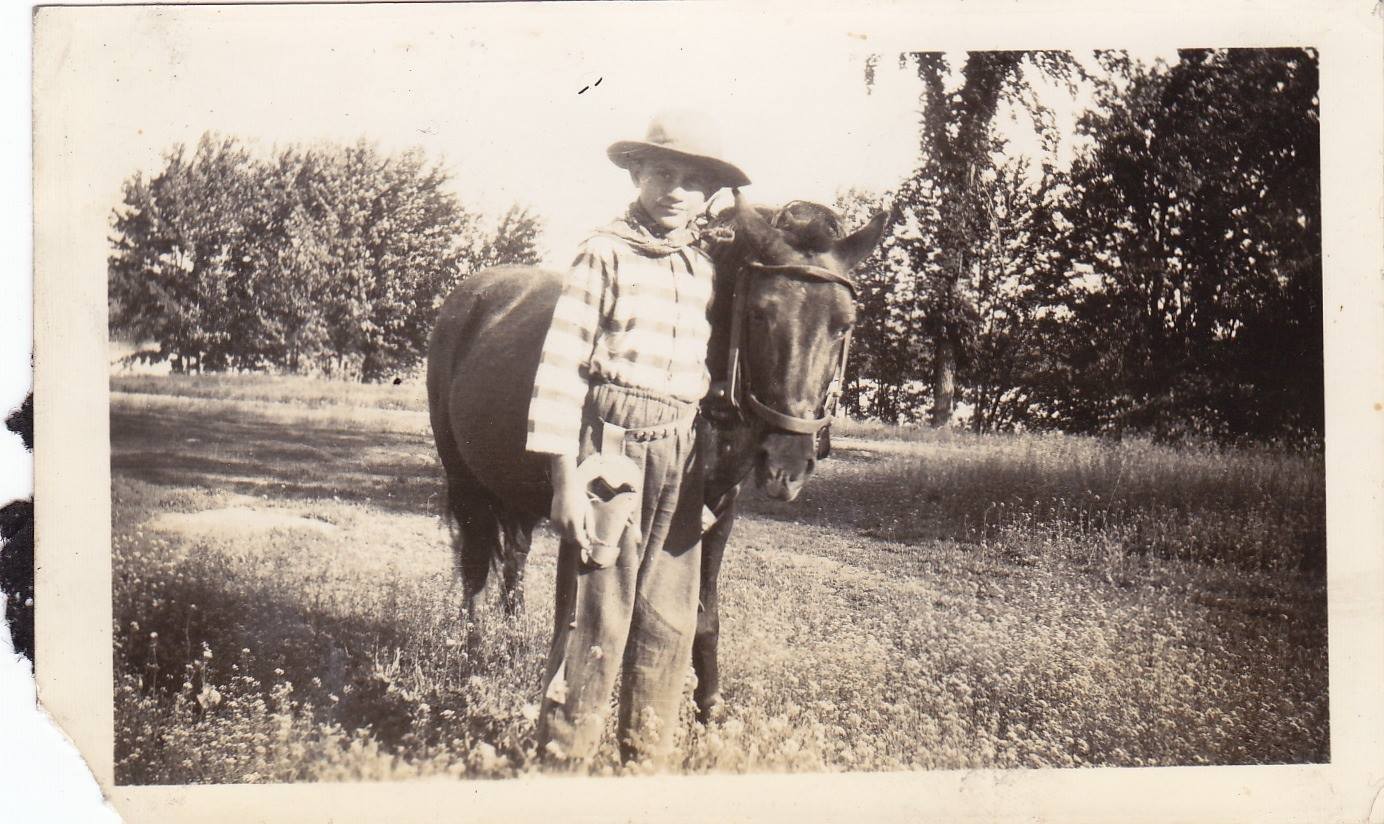
Yesterday was Father’s Day.  My sister posted a photograph of our dad, 10 or 12 years old or so, on Facebook.   My dad was born in 1926, so the photo had to be taken some time in the late thirties.  I haven’t seen many photos of my dad as a child, and I hadn’t seen this one before.

In the photo he’s with his horse and dressed as a cowboy, complete with a hat, kerchief, and a holstered pistol on his belt.  I remember him telling stories about his horse and the time and adventures they spent together.  I recognize where he is standing, in the driveway to the old farm house he grew up in, with the Chippewa River flowing behind him.  And when I look close I can recognize him, my dad, the same slight smile, a hint of sadness coupled with an unshakable and almost defiant  confidence, and the same dark eyes through which he saw a world where wonder and humor always trumped grief and sorrow.

What I know about my father’s childhood is that it wasn’t easy.   At some point, he was seriously ill.  He was the only boy with three sisters, and his relationship with his father was complex and difficult, and he was the victim of physical and psychological abuse.  He also saw his share of tragic and unexpected death close up, death by fire, by motor vehicle accidents, and by drowning.

dad and horse

But my Dad was strong.  That’s what is remarkable and revealing about this photo. Despite the harshness of the reality he was exposed to at so young an age, he was strong and defiant enough to believe in cowboys and horses and adventure, and he was strong enough to emerge from all of this a good and happy and funny man.  He was a great father to his children and a devoted husband to my mom.  The photo shows the same strength and sensitivity that would define him as a man was always there inside him.  It was what made him such a rare and special and unique human being, and it’s what I loved so much about him.

Sentencing


On Facebook last night, I was presented with yet another link to one of those lists, this one the “greatest sentences in all of literature.” It was interesting, and lead me to compile a list of some of my personal favorite sentences or passages from literature.  I’m not as well read as I should be, as you will be able to tell from my selections, and these aren’t all the greatest sentences, some of them are just cool opening lines that have stuck with me, and others were passages I remembered liking that I had to look up to get right, while a handful of them I remembered verbatim. Anyway, this should make for a pleasant diversion from the usual drivel I post here.  I’d be interested in some favorite sentences or passages anyone reading this might have, so feel free to leave comments.   Here goes:

All this happened, more or less.  – Kurt Vonnegut, Slaughterhouse Five

I’ve wanted life to be easy for you. Easier’n ’twas for me. A man’s heart aches, seein’ his young uns face the world. Knowin’ they got to git their guts tore out, the way his was tore. I wanted to spare you, long as I could. I wanted you to frolic with your yearlin’. I knowed the lonesomeness he eased for you. But ever’ man’s lonesome. What’s he to do then? What’s he to do when he gits knocked down? Why, take it for his share and go on.   – Marjorie Kinan Rawlings, The Yearling (this passage was so important to me I built a key scene in my novel Ojibway Valley around it) 

I give you the mausoleum of all hope and desire…I give it to you not that you may remember time, but that you might forget it now and then for a moment and not spend all of your breath trying to conquer it. Because no battle is ever won he said. They are not even fought. The field only reveals to man his own folly and despair, and victory is an illusion of philosophers and fools. –  William Faulkner, The Sound and the Fury

“She would have been a good woman,” The Misfit said, “if it had been somebody there to shoot her every minute of her life”  – Flannery O’Connor, A Good Man is Hard to Find

Nick’s heart tightened as the trout moved.  He felt all the old feeling.  – Ernest Hemingway, Big Two Hearted River

 And as the moon rose higher the inessential houses began to melt away until gradually I became aware of the old island here that flowered once for Dutch sailors’ eyes—a fresh, green breast of the new world. Its vanished trees, the trees that had made way for Gatsby’s house, had once pandered in whispers to the last and greatest of all human dreams; for a transitory enchanted moment man must have held his breath in the presence of this continent, compelled into an æsthetic contemplation he neither understood nor desired, face to face for the last time in history with something commensurate to his capacity for wonder.

Gatsby believed in the green light, the orgastic future that year by year recedes before us. It eluded us then, but that’s no matter—tomorrow we will run faster, stretch out our arms farther. . . . And one fine morning——

So we beat on, boats against the current, borne back ceaselessly into the past.  – F.Scott Fitzgerald, The Great Gatsby

I was a-trembling, because I’d got to decide, forever, betwixt two things, and I knowed it. I studied a minute, sort of holding my breath, and then says to myself: “All right then, I’ll go to hell”—and tore it up.   – Mark Twain, The Adventures of Huckleberry Finn

But we could hear her, because she began just after we came up out of the ditch, the sound that was not singing and not unsinging. “Who will do our washing now, Father?” I said.   –  William Faulkner, That Evening Sun

Rented a tent, rented a tent, rented a rented a rented a tent.  – Kurt Vonnegut, The Sirens of Titan

I stood by and held the door for him, and my best friend walked right past me, just like that, leading the way out and into the wet, wrecked night. – Patricia Ann McNair, Just Like That, from The Temple of Air

The light of a firefly is the size of a teardrop.  We cannot defeat the cosmic wind.  We are not magnificent.  But, by God, we try. – Michael Perry, Visiting Tom

I get the willies when I see closed doors.  – Joseph Heller, Something Happened

This was her, Mick Kelly, walking in the daytime and by herself at night. In the hot sun and in the dark with all the plans and feelings. This music was her—the real plain her. This music did not take a long time or a short time. It did not have anything to do with time going by at all. She sat with her arms around her legs, biting her salty knee very hard. The whole world was this symphony, and there was not enough of her to listen… Now that it was over there was only her heart beating like a rabbit and this terrible hurt. – Carson McCullers, The Heart is a Lonely Hunter 

It was a quiet morning, the town covered over with darkness and at ease in bed.  Summer gathered in the weather, the wind had the proper touch, the breathing of the world was long and warm and slow. You had only to rise, lean from your window, and know that this indeed was the first real time of freedom and living, this was the first morning of summer.  – Ray Bradbury, Dandelion Wine

There is an ecstasy that marks the summit of life, and beyond which life cannot rise. And such is the paradox of living, this ecstasy comes when one is most alive, and it comes as a complete forgetfulness that one is alive.
This ecstasy, this forgetfulness of living, comes to the artist, caught up and out of himself in a sheet of flame; it comes to the soldier, war-mad in a stricken field and refusing quarter; and it came to Buck, leading the pack, sounding the old wolf-cry, straining after the food that was alive and that fled swiftly before him through the moonlight.  – Jack London, The Call of the Wild

How wrong Emily Dickinson was!   Hope is not “the thing with feathers.”  The thing with feathers has turned out to be my nephew.  I must take him to a specialist in Zurich  –  Woody Allen, Selections From the Allen Notebooks
 

55


There’s going to be a new edition of the television series “24,” with Kiefer Sutherland reprising his iconic role of Counter Terrorist Unit agent Jack Bauer.   Sutherland first appeared as Jack Bauer in 2001, thirteen years ago now.  Now, in 2014, he is forty eight years old, barely younger than myself at fifty five years old.  Some may suggest that he is approaching the end of his window as an adventure/suspense hero, but I know differently.  There are more episodes of heart pounding suspense that confront me as a fifty five year old than one would ever imagine, episodes that should make damn good television.  I imagine Sutherland might not be up for this assignment, and my imagination runs away with me, until I nod off and have the following dream:

The opening credits roll.  “55 – Starring Dave Gourdoux as Jack Bauer.”  The scene opens with the camera panning a dark bedroom.  All we can clearly see is the light from a clock radio on the headboard that says “2:41”  As our eyes adjust to the dark, we suddenly see sheets and blankets moving from one side of the bed, being kicked off.  Suspenseful music begins softly playing as the movement begins.)

JACK BAUER:  Damnit!

(A leg appears as he kicks the blankets off of his side of the bed.  Then we see the silhouette of Bauer sitting on the edge of his bed, his legs now dangling over the side.  We see him rocking back and forth, trying to gain enough momentum to get up and out of bed.  The music swells, pulsating harder and faster.  He finally gets up and stands upright next to the side of the bed.  Then he starts shuffling in the dark.  Before he gets to the end of the bed, just as the music crescendos, we hear a loud crashing noise as Bauer stubs his toe on the dresser cabinet.)

BAUER:  Ow!

(The music begins again as Bauer grabs his left foot and hops about in pain, and falls over in the dark, falling into the clothes hamper with an even louder crashing sound.  From off screen we hear the voice of his wife:)

MRS. BAUER:  Again?

(Bauer gets himself upright and makes his way into the bathroom.  He turns the light on and we can see him, from the back, standing at the toilet.)

MRS. BAUER:  (from off screen) That’s the third time tonight!  (The music abruptly stops as the sound of Bauer urinating into the toilet is heard.)

BAUER:  Fourth!  You didn’t wake up last time.

MRS. BAUER:  Did you make it this time?

BAUER:  (Sarcastically, mimicking Mrs. Bauer’s voice) Yes, I made it this time.  (The sound of the urine stream ends, and we hear the sound of the toilet flushing.  Bauer turns the bathroom light off, we can see only the darkened outline of him as he begins to make his way back to bed. The music begins again, building, dramatic and suspenseful)

MRS. BAUER:  Did you remember to wait for the dribble?

BAUER:  (The music suddenly stops just as Bauer stops.) Oh, crap.  You know, if you’re going to remind me, you could remind me a just a tad sooner.

I’d write more, but I have to pee.

My Point and I Do Have One Is …


If I were to teach a class about writing, here’s how I’d open:  When it comes to writing, it doesn’t matter what kind of writing you’re doing, there is only one rule that has to be obeyed:  make your point.  Whether it’s a novel or a poem or a short story or an essay or a technical procedure, understand the point you‘re trying to make and make it as best you can.   That’s it.

Things like grammar and punctuation and characterization and description and plot are all tools available to you.  The more you learn about how to use them the better you’ll be able to make your point.  For some jobs, some of the tools are more important than for other jobs.  For example, if you’re writing a procedure on how to successfully diffuse a bomb, where a misplaced or omitted comma may blow the readers’ arm off, grammar and punctuation are going to be more important than if you are writing a play about two drunken high school dropouts from the rural south.

There are almost as many reasons people write as there are people writing, and they are all valid.  You might be writing because you dream of being on the New York Times bestseller list or you might be writing a poem for only your spouse or lover to see.  You might be writing historical nonfiction about an event or people that interest you, you might be writing to express a political or philosophical point of view, you might be writing because you have nothing else to do.  Whatever the reason, it’s legitimate, and my one rule applies – just try and get your point across.

It strikes me that people are often moved to write for the same reasons they are moved to draw a picture, or play music.   It’s the need to express something we feel strongly about.  It’s also the absence of rules – when we draw, for example, we are free to draw whatever the hell we want to; using whatever materials and colors and shapes we feel like using or are available to us.  There are no rules  to what we draw or how we draw it, just like there should be no rules when we write – well, maybe my one rule.

But it’s driving me nuts lately – all the “rules” out there that people are saying “good” writing must follow.  They may have good intentions, and their “rules” might make sense most of the time, but they are not “rules,” they are not absolutes.   A writer friend of mine who I have a great deal of respect for was recently bemoaning the glut of self published crap that is out there, and that to minimize it, maybe a writer should have to pass a certification before being allowed to publish.   This strikes me as so wrong on so many levels that I don’t know where to begin.  Suffice to say that for me, creating art (which a lot of but not all writing aspires to) has always been about freedom, that there are no rules, that Jackson Pollack and Andrew Wyeth can both be considered “modern artists.”  Art is where we turn when we feel the need to break free of the rules that dominate the rest of our lives.  There is a certification for public accounting, let’s leave it out of art.

It seems that the “gatekeepers,” those who control who and what get published, are  imposing  more and more rules on writers and writing now days, especially when writing short or long fiction.  It’s becoming something of a cottage industry.  There are an endless supply of books, web sites, webinars, seminars, conferences and retreats where you can study all of the rules for good writing.  And don’t get me wrong, most of them are sincere, and many of them are helpful.  But I think the best approach, no matter how impassioned or emphatically the “rule” is expressed, is to take them as advice but not gospel.  I think there are few if any hard fast rules that are absolute.

Some examples of popular “rules:”

The “show, don’t tell” rule – good advice, to a point.  But if you take it as absolute, and show everything, your story will never go anywhere.  After all, they don’t call it “story showing,” it’s “story telling.”  You should show what’s important to show and tell what’s important to tell.  How do you decide what to show and what to tell?  Whatever helps you make your point best.

The “less is more” rule – again, a good idea generally, but there are times when “more is more.”

“Always write with an active voice” – avoid things like “to be” and “had not.” Sorry, Hamlet, your soliloquy from now on is going to start “Be or not?  That is the question.”

“All stories must have a clear antagonist” – Tell me, in Faulkner’s “As I Lay Dying” or “The Sound and the Fury”, or Vonnegut’s “Slaughterhouse Five,” who the clear antagonist is.    In Hemmingway’s classic short story “Big Two Hearted River,” is time the antagonist?  Is it the war that has damaged Nick? Or the swamp?   Whatever answer you come up with, it’s not obvious or clear who the antagonist is, or if there even is one.  (“Antagonist” shouldn’t be confused with “conflict,” which I think is the one thing, in addition to a point, that every piece of fiction absolutely needs.)

“Every novel has to have a beginning that pulls you in immediately” – This is good advice, but is too often misinterpreted that every story has to start with some dramatic event or action packed cliffhanger.  There are multiple ways of drawing a reader in.  You can gently and simply introduce the main character (“Call me Ishmael”), or poetically describe the setting (“Cannery Row in Monterey in California is a poem, a stink, a grating noise, a quality of light, a tone, a habit, a nostalgia, a dream,” or “Summer here comes on like a zaftig hippie chick, jazzed on chlorophyll and flinging fistfuls of butterflies to the sun.”) , or briefly summarize the plot (“This is a tale of a meeting of two lonesome, skinny, fairly old white men on a planet which was dying fast.”)  These beginnings all draw the reader in; note that there is no breathless description of pulse stopping suspense, nobody tied to the railroad tracks with an approaching freight engine rumbling loudly.

So back to my one hard rule – I don’t mean to imply obeying only one rule makes things easy.  It’s still work, getting your point across, and even when you do, you can be assured that you always could have done it better, more concisely or completely.  The tools matter and you’re better off mastering as many of them as you can.  It’s easier to build a doghouse with a full toolbox than with just a hammer.

When you’re building a doghouse you need not only tools but materials.  In writing, the materials come from inside you.  They are how you view the world and your place in it, your experiences and what you’ve learned to be true.  They are the things important to you.  No matter what kind of writing you do, it’s going to be framed by how you process things.  Even journalists trying to write the most objective report of a news event  are affected by their experience, because writing isn’t only about what you write, what you put in the story, it’s also about what you leave out.  By better understanding yourself, you are given access to stronger and better tools.   You can build a much better doghouse with some two by fours and a couple of sheets of plywood than with cardboard, and you can write a much better story if you’re clear on why it’s important enough to you to spend the time and effort putting it down.

Whatever your reason for writing, remember that it is just as valid and legitimate as any other reason.  And if you are serious about writing, keep at it – the more you write, the better you get at it, no matter which rules you choose to follow.

So that’s it.  I’m done pontificating for now. I’ve made my point.

I think.

Thieves


I watched him through the window, my second son, a little bit more than a year old, on a sunny and mild afternoon in late winter.  He was wearing his blue overcoat and red rubber boots. I was watching as he discovered his shadow for the first time.  He moved from side to side, then lifted his leg up high and brought it back down, his eyes wide with wonder at the darkened shape on the ground that followed his precise movement as he stomped around.  I was careful not to interrupt this moment of discovery, not to let him know I was watching.  It was magic, a stolen moment, and I was the thief, hanging on to it all these years.

I watched out that same window, only a moment later, his six foot five and twenty four year old frame towering over his car in the driveway, as he finished loading the last of his things.  Then the car was backing out and on the road, and he was on his way to the rest of his life.

Ladies Auxiliary Salad Luncheon


ladies auxiliary salad luncheon

(Today’s guest contributor is Sally Manders, presidentof the Ladies Auxiliary)

My, my, these are festive and fun days!  So much joy and anticipation!  What’s that, with the holidays ahead?  Screw the holidays!  I’m talking about the Ladies Auxiliary Salad Luncheon!  It’s less than ten months away!

Yes, it’s back, after we had to cancel the 2013 event.  We’ve found a new home, the back room at Artie’s Muffler shop on 35th Street.  My nephew, Artie Nelson, was kind enough to offer up his place of business for the 2014 event.   We appreciate it so much!   Especially after the disaster that was the 2012 event, when Gertrude Binglehoff set fire to our old location, the old high school gymnasium.  Things got a little out of hand when Esther Jorgenson was the surprise winner in the best salad tossing competition, breaking Gertrude’s string of eleven consecutive years running.  Some say Esther’s victory was politically motivated, but I don’t believe it, just like I don’t believe rumors of foul play in regards to her subsequent fatal sky diving accident.   Everyone knows that every time you get up there there’s a chance your chute won’t open, and while some may question the wisdom of sky diving with an oxygen tank, I think it’s perfectly natural.   Besides, you have to wonder about someone who puts raisins in a salad.

By the way, all rumors about Gertrude and tossing enhancement substances have been proven false.  The fact she is now sporting a mustache and goatee is merely coincidence, and has more to do with being 94 years old than any chemical abuse.

Now it’s time to remind everyone of the rules.  The Ladies Auxiliary Luncheon accepts only green, garden variety of salads.  In other words, all salads shall have leafy green lettuce as their core ingredient.  NO EGG OR POTATO SALADS WILL BE ACCEPTED.   Our security staff has been trained on how to identify such salads and instructed to remove any individuals violating this rule immediately, by force if required.  Eggs are an accepted topping, so long as they are hard boiled and the shell is peeled.

Which reminds me of another item:  this year, our security team, headed up by Nancy Wilkenson, will be armed, and trained to use deadly force if required.  With the popularity of concealed carry weapons amongst our demographic, we are taking a shoot first, ask questions later approach.  We don’t want a repeat of the Northside Bridge Club tragedy.

Another change:  This year, we will have a new category for non-traditional salads.   By creating this category, we hope to quiet the controversy and clamor over the use of croutons.  Those who feel that croutons are a satanic bastardization of the pure and holy essence of the leafy green salad can enjoy their lunch unencumbered by the evil toasties, while those who still have strong enough teeth to withstand their crunch will be free to do so, even if it means handing their soul to Satan.    Also, the past practices of sabotaging salads by slipping stale croutons or moldy cheese on top when no one is looking will not be tolerated this year.  Suffice to say, we’ve studied the surveillance film from the 2012 event, and we know who you are.  We will act swiftly and severely if any such behavior is observed.

I have appointed this year’s judges, and they are currently undergoing extensive and in depth training at the Salad Institute in Rhode Island on the elements of evaluating green lettuce based salads.  Among the criteria they are learning are:

–           Freshness of lettuce (as measured by color and crispness)

–          Tangy, sweet, and sour dressings

–          Tomato effectiveness (evaluation based upon ripeness and slice size.  Cherry tomatoes will be evaluated separately)

–          History of the Roman Empire (for those judges who will evaluate Caesar salads)

The identity of the judges shall remain undisclosed so as to prevent tampering.

We expect a full turnout, so buy your tickets today!   Remember, the date is October 14, 2014, and the event is the Ladies Auxiliary Salad Luncheon!  Don’t miss it!

Untitled


(I wrote this on a cold and rainy day in 1994 on a train from Chicago to Kenosha – for some reason it’s stayed with me all these years)
 
Great white wilderness
I want to walk into your misty morning
never to return
I want to lie on the banks of your forbidden river
and taste your cool, clear waters
I want to breathe in deep and fill myself
with your warm breezes, your gentle winds
I want to walk and continue walking
deeper and deeper inside you
until I come to the place under the shadow of your clouds
where we both were born
my destination, my destiny
your glowing heart
and there forever I will sleep
my arms wrapped around your soul
 

Labor Day


I first posted this two years ago today, in honor of my oldest son’s birthday – I remain immensley proud of him – he’s taught me so much over the years, and I treasure the time we get to spend together. Happy birthday, Jon, with all my love and respect.

djgourdoux's avatarDrivel by Dave

On September 5th, 1985, at about 8:30 P.M., I became a father.   Our first child, our son Jon, was born.

Talk about “Labor Day” – my wife was in labor in the hospital for more than 36 hours before Jon was finally born.  Even then, the doctor had to use forceps, a device that resembled a giant salad tong, to get him out.  But the moment when he finally said “It’s a boy” made it all worth the wait.

I thought I was well prepared and ready to be a father.  I had everything figured out – what rules I’d enforce, what beliefs and principles I’d instill, how fair and balanced I’d be.  Little did I know that you can never be adequately prepared, because, once born,  it turns out that this thing you’ve been obsessing over and reading and theorizing about is alive, and as unpredictable as any…

View original post 478 more words

Scenes From a Dull Marriage


(This is my tribute to the great Swedish film director Ingmar Bergman and his 1973 film, “Scenes From a Marriage”)

(It is early in the morning.  HUSBAND comes downstairs to the kitchen, where WIFE is sitting at the table, sipping coffee)

WIFE:   Did you  (pause) …. take the garbage out?

HUSBAND:  No, why, is today …

WIFE:  Yes, it’s Tuesday.   Garbage pick up day.  I would think you’d remember a thing like that.

HUSBAND:  It’s not that I didn’t remember …

WIFE:    No?  What is it, then?

HUSBAND:  (beads of sweat breaking out on his brow) I … I…  okay, I admit it.  I forgot that today was garbage day.   (begins sobbing).  Can you …  can you … can you ever forgive me?

WIFE:  Oh, Harold, Harold.   After all we’ve been through together.  The time you spilled your beer on the kitchen floor … the time you wore mismatched socks … the time that bird in the front yard frightened me so … we’ve come so far.  And now this.  Our garbage can sits full in the garage, and in only two more hours, the garbage man will come.

HUSBAND:  I’m so sorry.   I didn’t mean to make you so unhappy.

WIFE:  Maybe mother was right.  Maybe I should have married Leonard.

HUSBAND:  Don’t say that!

WIFE:  Well, I’m sure that Leonard’s garbage can is out on the curb by now!

HUSBAND:  Stop it!

WIFE:  Yes, Leonard, he’s a real man.  When he shaves, there aren’t any tiny little hairs left in the sink!   I’ll bet he even squeezes the toothpaste from the bottom of the tube!

HUSBAND:   If that’s the way you want it, maybe I should just leave!

WIFE:  Then leave!  Be gone!  And don’t come back until you’re ready to put your glasses on a coaster!

HUSBAND:  I will leave!  I will! (patting his pants pockets) Have you seen my car keys?

WIFE:  Do you mean ….they aren’t hanging on the little plastic hook where they’re supposed to be?

HUSBAND:   No, the little plastic hook … the very same plastic hook I purchased for you on our tenth anniversary … the little plastic hook sits empty … empty and barren, like our marriage.

WIFE:  I remember when you gave me that little plastic hook.

HUSBAND:  Yes, I spent a great portion of our savings on it … seventy nine cents.  But it’s been worth every penny.

WIFE:  Yes, and the car keys have hung there for six glorious years.

HUSBAND:  Until this morning.

WIFE:  Yes, (suddenly remembering)…  but wait!  I suddenly remember!   I had the car last night!  I filled the tank with regular unleaded at the neighborhood Citgo!

HUSBAND:  Why?   Why are you telling me this?

WIFE:  Don’t you see?

HUSBAND:  See what, Gladys?

WIFE:  That it was I, I who failed to return the car keys to the little plastic hook!  The keys are in my purse!   Can you ever forgive me?  (weeping, on her knees, pleading with her husband)  Please!  Oh, please!  Please find it in your heart to forgive me!  Please!

HUSBAND:  (Dropping to his knees and holding his wife)  I forgive you!   I do!  If only you could forgive my forgetting to take the garbage out!   We can save this marriage!  Please!   Forgive me!

WIFE:  (rising)  Geez, Harold, it’s just a garbage can.  Get a grip.