Great Moments in Culinary History


Brought to you by the Dinnertime Dramatists

 Episode 37 – “Patriotic Pasta”

(The scene:  1776, a colonial tavern.  Sam Adams and Benedict Arnold are dining together)

BENEDICT ARNOLD:  (to the waitress) I’ll have a plate of spaghetti, with a broiled chicken breast on top.  (The waitress takes the order and leaves.)

SAM ADAMS:  As I was saying, we must round up those who are still loyal to the British throne.

ARNOLD.:   But those ruffians!   They are so crude – I might get hurt.

ADAMS:  Ben, don’t be a coward! Help us capture the opposition! 

ARNOLD.:  But such unpleasantness!  Why don’t you get Nathan Hale instead.  I hear that he has like seven lives to give to his country!   (The waitress arrives with Arnold’s order, placing the dish on the table in front of him)

ADAMS:   (disgusted) You chicken!  Catch a Tory!

ARNOLD:    Hey!  That’s a great name for this dish!   Chicken Catch-a-Tory!

(Tune in next week for episode 38, where the Dinnertime Dramatists present part one of “The Egg Salad Story”)

Time After Time


OK, I know it’s not very manly of me to admit this, and some may say it points to a certain lack of sophistication, but I am a Cyndi Lauper fan, especially the song “Time After Time.”   I think that it is simply one of the best songs written in the last 30 years, and even though it has been covered by a variety of other artists, I still like Lauper’s version the best.

The thing that has me thinking about “Time After Time” tonight is that today, my wife and I attended my daughter Hannah’s graduation from high school.  Hannah is the youngest of our three children, following her brothers, Jon and Nick, who graduated in 2004 and 2007.   So as emotionally charged such an event is anyways, when it’s your youngest, when it’s the last time, it’s even more bittersweet.

“Sometimes you’ll picture me …”

Hannah posted a photo of herself in her pre-school graduation gown on Facebook this morning.  It was perfect because it is such a good photo and sums up what a wonderful little girl she was (and is).   The thing is, that picture was taken in 1999, which the calendar says is thirteen years ago.  I know that in my mind, it was taken only yesterday, and it frightens me how fast time really moves.

I have so many images running around in my head tonight, like when I tucked her in on September 11, 2001, after the World Trade Centers fell, when she said to me, “Leave a light on tonight.  That way if something happens, they’ll know there was a little girl in here.”

Or, after learning about fire safety in kindergarten, her obsessive fear of things suddenly combusting into flames, resulting in my realization some five uneventful minutes after putting slices of bread in it that the toaster had been once again unplugged.  “Do you have any idea how many house fires start from toasters?” she’d lecture if I dared to complain.

There was the vacation to Kentucky when she was almost four years old, when we were on our way to see the house where Abraham Lincoln was born.  “How much longer,” she asked, “until we get to thinkin’ Lincoln?”

When she was little, she had more energy than anything my wife and I had ever seen.  “Hurricane Hannah” we called her.  From the moment she woke up in the morning, there’d be only one speed, overdrive, and she’d speed and collide and crash her way through the day.  And then, suddenly, like a switch had been turned off, she’d be asleep.  It always amazed Deb and I.  There were times when she’d be talking and she’d stop in mid sentence and not finish.  We’d turn around and look and, whether it was in her car seat in the back of the car or the sofa in the living room or a chair at the dinner table, she’d be out, sound asleep, and I’d carry her up to her bed and she wouldn’t wake up until the next morning when the hurricane would strike again.

There were the driving tests I took her for, and there was the first time she drove by herself, to the corner store, my eyes nervously fixed on the driveway until her return.

There were the nights she was out with friends, and the phone calls she always made to her mom and I, telling us where she was, asking if she could stay out an extra half hour and, surprisingly, not complaining if we said no.   If we told her she had to be home by ten o’clock, she was home by ten o’clock.

She was always headstrong and stubborn.  She was never afraid to argue with her parents, particularly her mother.  She could be manipulative and a master at melodramatically changing the point and shifting the blame if she was ever caught doing something wrong.  But even when she’d get right in our faces and tell us how wrong we were about whatever, she somehow always remained respectful.   She knew which buttons to push, but she also knew which lines not to cross.

Suitcase of memories”

There are so many moments of inspired nuttiness that we have shared over the years.  Like the time we were Christmas shopping in the Casio store at the old, original outlet Mall.  She couldn’t have been more than four years old.  Standing beside me, Hannah had discovered the electronic drum machine when she said, “Daddy, tell a joke.”

“I just flew in from California,” I said, “and boy, are my arms tired.”

No sooner had I delivered the punch line, Hannah produced a perfectly timed rim shot.

Then there was the time a couple of weeks ago.   I was home, working late in my office, when she wordlessly appeared in my doorway, her face white from a new moisturizing crème, and proceeded to do mime routines including being stuck in a glass cage and walking against the wind.    When she mimed casting a fishing line in my direction, I knew enough to mime getting hooked, and let her reel me in.

There are the bad puns she forwards to me all the time, the random text messages she sends, including vivid photos of whatever grisly animal they were dissecting in biology class.  Whatever, nothing ever consistently brightens my day as much as these isolated moments of silliness.   That we share the same sense of humor is a small part of it, that she was thinking of me if for only a moment in her busy day is the bigger part.

If you’re lost you can look and you will find me / time after time / if you fall I will catch you I’ll be waiting / time after time

When a father’s little girl grows up, and when he looks at his reflection in the mirror, or at that photograph of himself bald headed and potbellied standing beside her in her graduation gown, he can’t help but wonder if she needs him anymore.  Especially when she has turned into such a strong and smart and good person as my Hannah has.  But if she ever does, if she’s ever lost or if she ever falls, I will be there for her, and she’ll find me.  Time after time.

Bon Appétit


Cottage cheese.   To me, it is repulsive in every way imaginable.   “You should try it with some fruit,” my wife says.  I have, and it’s still cottage cheese.  It’s essentially milk that is way past the expiration date.  The taste and the texture are plain awful.  And its name – “cottage cheese” – what the hell does that mean?  “Cottage” suggests a pleasant cabin in a lovely wooded setting – and the refrigerator was left unplugged all winter, and cottage cheese is the stuff that grew in it.

“Curds and whey” – also conjures up unpleasant images, and I suspect that it wasn’t the spider that frightened Little Miss Muffett away.   What the nursery rhyme fails to mention is the rest of the story, which concludes with a lactose-intolerant Miss Muffett being rushed to the emergency room and having her stomach pumped.

There are many foods which by name alone are revolting.   A few examples:

Wax beans –  I don’t eat plastic fruit, so why would I eat wax beans?

Grape nuts – What the hell are Grape Nuts anyway?   Are they crazy grapes?  Or are they a part of the anatomy of a male grape?  Neither one sounds particularly appetizing to me.

Boysenberries – Sounds too much like “poison” berries, or an item on a breakfast menu for sexual deviants

Crab apple – Before you take a bite, you have to listen to it gripe:  “Oh, great, like I don’t have enough problems, now you’re going to eat me.”

Rutabaga – If it were a polite-a- baga, maybe I’d eat it, but one thing I will not tolerate is bad manners (get it?  A “rude” – a-baga?   If I have to explain …)

French Dip – having a name like “Gourdoux” and being an idiot most of my life, this hits too close to home.

Au Jus – French for “with [its own] juice “ –  I don’t care how fancy you sound saying it, it’s still a disgusting concept.

Chowder – I actually like clam chowder, but in any other context, the word is repulsive – example:  squirrel chowder

Broth – over at dictionary.com, one of its definitions is “a liquid medium containing nutrients suitable for culturing microorganisms.”  Enough said.

Any cut of meat with the word “loin” in it – again, enough said.

Popcorn chicken – Always conjures up the image of the old “Jiffy Pop”, with bits of a dead chicken popping on the stovetop under the tin foil cover

Chop Suey – sounds more like a low budget horror movie than a dinner entrée.

Potato Wedges – “Potato” isn’t the problem here.

Blood Sausage and Head Cheese – let’s not go there.

Poached Eggs:  Eggs illegally taken out of season – I will have no part of such ill-gotten bounty.

Shrimp cocktail:  Conjures up images of liquefied crustaceans –  yechhh

Round steak vs cube steak:  Geometry and algebra have their place, it just isn’t on the plate with a baked potato

Refried Beans and Twice Baked potatoes – I’m all for recycling, but I just don’t like how these sound

Shepherd’s pie:  If blueberry pie is filled with blueberries, and cherry pie is filled with cherries, then what is shepherd’s pie filled with?


Sorry, but I am out of time.   I have to go – dinner’s ready and I am starved.   Let’s see, what should I have tonight – fish sticks or chicken nuggets?   Decisions, decisions …


Schtick Shift


The Dictionary of American Slang and Colloquial Expressions defines the word “schtick” as: “a routine or act that is the trademark of an entertainer, especially in vaudeville. (Yiddish.) : His schtick was a trained dog and cat act.”

Examples of this would include the late comedian Henny Youngman, and his trademark joke:  “Who was that lady I saw you with last night?”  (“That was no lady – that was my wife.”)  Or the late great Rodney Dangerfield and his “I don’t get no respect” act.

The thing implied in schtick, in becoming the “trademark of an entertainer”, is that it has to be repeated over and over.   It’s the humor of repetition.  Plus it helps if it is corny.

I learned to love schtick not from the trademarks of famous entertainers, but rather from the routines my own father would perform over and over.   The amazing thing about them was that the more he did them and the more predictable they became, the more I loved them.   For some reason, they were funnier the thousandth time than they were the first.

Some examples of my dad’s schtick:

–    Christmas or birthdays, when pressed, he’d always tell us that we were getting a “galloping gopher,” without ever explaining what that was.

–     When the school year would begin, we’d tell him we needed money to buy art supplies and gym shoes.  “Let Art get his own supplies, and let Jim get his own shoes” would be his response.

–    Whenever he’d argue with us and make a point, he’d add, “Us kids are good and you kids are bad, ha ha hee.”

–    His routines when answering the phone:  “French embassy, DeGaulle speaking”, or “Sherwood Forest, Robin Hood speaking,” or “Sam’s Meat Market, Sam’s not in, this is Bill,” or one of my favorites that he used not long before he died, “Sam’s Taxi Service:  Our rates are so low we pay you to ride with us.  Sam’s not in, this is Bill.  How may I help you?”  (Sam was never in, and if you asked “where’s Sam?” he always gave a long and detailed answer so that by the time he was done, you had forgotten why you called him in the first place.)

–  Perhaps his strangest (and funniest) – when we’d be going on family trips and he was driving, if he ever saw a pine tree standing by itself, he’d say “Look!  There’s a lonesome piiiiiiiiiine tree.”  He’d gasp out and prolong the pronunciation of the word “pine.”  None of us were ever able to ascertain where this routine came from, and what the significance of a lonesome pine tree was, and he never explained any of that.   The fact that it made no sense at all was what we loved about it.

I was so taken by my Dad’s schtick that when I became a father, it was inevitable that I would develop schtick of my own.  This is perhaps the best reason to have kids – they are captive audiences.  Among the routines my children have had to endure:

–     If someone says that I’m weird, or strange, I reply, “I’m perfectly normal.    And”, here comes the part they have heard so often they help me finish, “normally perfect.”

–      If we are leaving for somewhere, I ask, “Are we ready to hit the road?” to which they answer, “Why, what did the road ever do to us“?

–       If, while out for a drive we see a policeman,  in my best James Cagney imitation I say, “You’ll never get me alive, copper”, and they join me in the punch line, “you either, aluminum.”

–    “Every night when I get home from work I do a magic trick – I turn into our driveway”

–    If someone asks me how much something costs, I’ll give one of these pat answers:  “More than a little but less than a lot,” or “half as much as it’d cost if it’d cost twice as much as it does.”

My personal favorite, because it made absolutely no sense, was the routine I’d break into when coaching my son Nick’s softball team.  I had just purchased a plain green hat in St. Louis.  For a while, during every practice or game, somebody from the team would ask me about the cap.

“There’s an interesting story behind this cap”, I’d offer.

“Oh, really?  Let’s hear it.”

“O.K.  I bought this cap at A DOLLAR STORE IN ST. LOUIS”, I’d reply, loudly emphasizing the “a dollar store in St. Louis” part for some strange and unexplained reason.

“What were you doing in St. Louis?”, they’d logically ask.

“That’s not important”, I’d reply, acting annoyed, and I’d quickly change the subject.

It doesn’t make sense, but then again, neither did a lonesome pine tree.

It’s not really schtick, but for some reason, I’m reminded of the time when I was 12 years old and my Dad and I were in the car, he was driving, I was in the passenger seat, when we saw a deer in the roadside field.   A little while later, as we discussed the sighting, an argument began, with each of us claiming to have been the first to see it.  Things escalated for about a week, neither one of us backing down, until my Dad asked me, “how big would you say that deer was?”

“Oh, it was pretty big, probably bigger than average,” I replied.

“Ha!”  He pounded the table triumphantly.  “That proves I saw the deer first.”

“How does that prove anything?” I replied.

“Because when I saw it,” my Dad said, “it was just an itty bitty fawn.”

Some nine months after his death, thinking about my Dad still makes me laugh, and I realize how much I miss him.   Without him, I suspect that the lonesome pine trees are a little more lonesome.  I know I am.

Rejected But Not Dejected


Rejection – you never really get used to it, no matter how often you have to deal with it.  I’ve been lucky enough to be married to the same woman now for over 30 years.  And although I was very young at the time, my single years were not pretty.  In the process of trying to get young women to notice me, I struck out more frequently than Sammy Sosa with runners in scoring position.  Fortunately, I developed a pretty thick skin.

Lately I’ve been submitting some pieces of fiction to various literary journals, all with the same result.  Rejection.   I’m beginning to understand why alcoholism is so prevalent among writers.  It’s the same reason that a single male drinks – the conventional wisdom is that it is to get his courage up to approach that girl he’d never approach sober – the real reason is that only when he’s drunk can he deal with the rejection that he knows is inevitable.

I’ve submitted enough stuff now to appropriately lower my expectations.   I’m certainly not surprised when I receive the e-mail thanking me for but rejecting my submission.  But I’d be lying if I said it didn’t hurt, at least a little bit.  The thing about writing is, it is intensely personal, and to have somebody, not just anybody, but somebody who makes their living judging these things, tell you that your work isn’t good enough, it can’t help but sting.

The people who are doing the rejection, the editors of the publication, understand this, and they try their best to ease the sting, to soften the blow.  They are also tremendously overworked, reviewing ridiculous numbers of submissions for every one they accept, so they have no choice but to be formulaic in their responses.  It’s gotten so that when I see a note in my in-box from someone I’ve submitted to, I know essentially what it says before I open it.   I often think back to my bachelor days and imagine, what if the women who spurned me had used the same language in their rejection of me?  It might sound something like this:

“While I appreciate the offer to go back to your place, after careful consideration, I feel that your piece isn’t right for me.”

“I considered your request for my phone number very carefully, and have decided to pass.  I really did like your style, though, and hope you’ll ask me again in the future.”

“Thank you for the invitation to dinner.  I appreciate the offer but after careful consideration will have to decline.  This one was really close, David, but you didn’t quite grab me the way I hoped, but your style and voice are clearly top notch.  I hope you consider asking me again in the future.”

These are variations on actual rejection letters I’ve received from various literary journals over the past couple of months.  Compared to the “get lost, creep” I normally received from the fairer sex, I’m not sure which is worse.

So then the defense mechanisms, the rationalizations, begin.  “Oh, they don’t know what they’re talking about,” “[insert famous author here] submitted [insert famous work here][insert large number here] times before he was accepted ,” or  “I’m not that big of a fan of that publication anyway.”  This works for a little while until you accept the truth:  you are not [insert famous author here] and your work is not [insert famous work here].  Eventually, you come to the realization that maybe, just maybe, the editor reviewing your work was right!  The work wasn’t good enough.  I don’t know why this should come as such an epiphany – after all, they are professionals who do this for a living, who are trying to put out the best publication they can – and you are the amateur.  It’s shocking to think that they might be right and you might be wrong.

You come to accept these facts, and that fame and fortune and that NPR interview aren’t going to happen, at least not yet, and you get down for a little bit.  But then something hits you, an idea, an experience, whatever, and you just have to write about it, and you do, and you read it, and you think, hey, this isn’t bad, and then you think, this is actually kind of good.  And you start the whole process over again, only this time, what you’ve written is better than what you wrote before, because you’ve kept at it, you’ve learned, you’ve honed your craft just a little bit, and the cycle repeats until one day, if you’ve gotten good enough and you’re lucky enough and all the stars are aligned perfectly at the exact perfect time, it’s not a rejection that shows up in your e-mail, it’s something else.

I can only imagine what that might be, of course, because I haven’t seen it yet.

But imagination is a key attribute of a writer.   And hey, at least I’ve got that going for me.

The Ballad of the Sick Raccoon


I’ve lived in the same house on the same 2 ½ acre parcel of land in Pleasant Prairie, Wisconsin, for nearly 28 years.  Since we moved in, with the housing boom of the 90s, our little village has transformed from a bucolic and hidden rural gem to a network of subdivisions and development.   The street we live on has seen significant development, as the open meadow across the street that was the entrance to 30 acres of old growth oaks is now lawn and houses, and while most of the oaks are still there, they now give cover to a subdivision of castles and roads that were built for those “one percenters” you keep reading about.

Despite all the development and change, my street remains a dead end street and is still pretty quiet.  There are enough trees and enough open space to make it feel like we still live in the country.    Wildlife is still surprisingly abundant, having learned how to inhabit the suburban landscape and co-exist with us wacky humans.

It’s rare that we see deer anymore.  When we first moved in, sightings were quite frequent.  Coyotes still howl at night, and on two occasions, we’ve seen them in my back yard.   There is a family of foxes that lives on our street, appearing every year with new pups right about now; they usually make their den in the culvert under a driveway down the street, and I think some years they used the thick hedgerow that surrounds the southern half of my property.  We’ve had snapping turtles and pine and garter snakes in our yards, and, in the tall hardwood trees in my backyard, we’ve had nesting great horned owls.   We’ve had skunks we’ve never seen but thanks to our late, great golden retriever, Sid, we know existed because every year he’d manage to get sprayed.  And we’ve had raccoons, which reminds me of our most memorable encounter with nature.

It was about twenty years ago, a Saturday, a bright summer morning.  I remember I had to run to Menards in Racine to pick something up.  Before I left, I noticed, in the lot across the street from us, a raccoon sitting in the yard, not moving, and not looking right.  I knew raccoons are nocturnal creatures, and I also knew they can be carriers of disease, including rabies.   I went inside and told my wife to keep an eye on it and make sure the kids and dogs didn’t go too close to it.  Then I said, “I should just get my .22 and shoot it.”

“Don’t be ridiculous,” she said.  “This is a residential neighborhood.  We don’t want to upset the neighbors.”

I ran my errands, and when I got back, about an hour and a half later, the raccoon was still there, in the same spot, looking sick.  I went inside and told my wife I was going to get my .22 and put it out of its misery.

“Are you crazy?  You’ll upset the neighbors.  There are people who deal with these things.”   She got the phone book out and I began dialing.

The first thing we tried was the humane society.  They said, sorry, they only deal with dogs and cats and domestic pets.

Then we tried something called animal control.  They replied there was nothing they could do for potential dangerous animals, and suggested we try the humane society.

Then we called the village police department, and they said, sorry, as it is a Saturday morning they only had one detective on duty and that he had more important calls to deal with.  They suggested we try animal control.

For some reason that still eludes me, I tried animal control again, telling them that the police department referred me to them.   That didn’t matter; they still didn’t deal with dangerous animals.

Finally I called the police department back, and got put in the queue for the lone officer on duty.   They gave no promise on how long it would take to respond.

Frustrated, I went out and talked to my neighbor at the time, Sam, one of my all time favorite people.   He was one of the nicest and most generous guys I’ve ever met, a perfect neighbor, always willing to help, and he was smart and strong in that no nonsense, unassuming manner that I admired so much.   He was a retired factory worker, at the time about 70 years old.  He always reminded me, in terms of how he looked and spoke and acted, of the famous test pilot, Chuck Yeager.   As I told him about my misadventures on the phone and that a detective was finally on the way, I looked out across the street and I noticed the raccoon wasn’t there anymore.

“Yeah, he got up and moved into that brush,” Sam said, pointing to the little thicket that divided the property lines across the street.  “Moved real slow and clumsy.  That thing is definitely sick.”

We went across the street to see if we could see it, so if the cop ever came, we could tell him where it is.   Sure enough, it was sitting in a little clearing in the shade in the thicket, breathing heavy.  It silently glared at us as we peeked thru the brush at it.

A little while later, a squad car pulled up to our house, its lights flashing.  I went out and met the detective, dressed in his brown uniform, with a walky-talky holstered on one hip and his service revolver holstered on the other.  I told him where the raccoon was, and that it was definitely sick.  He told me to stay back.  He pulled his revolver out of his holster and carefully approached the thicket.  He slowly crept to the right side, aimed his revolver, and fired – boom! – so much for not disturbing the neighborhood.  Then he moved to the front of the thicket, revolver still drawn, and aimed, and boom! – he fired a second shot.  Then he stalked to the left of the thicket, again took careful aim, and boom! – fired a third shot.   He put his revolver back in the holster, took the walky-talky out and took the call, and approached Sam and I from where we watched in my front yard.

“Well, I got him,” he said.  “I”ve got another call I have to respond to, somebody will be out in a little bit to dispose of the carcass.”  And then he was back in his squad car, lights flashing, and drove away, down the street, putting the final exclamation mark on the commotion that only a squad car with flashing lights and the sound of three gunshots could arouse in a quiet neighborhood.

Sam and I had no choice but to go over and check on the crime scene.  Peering through the brush, we could see the raccoon, but it wasn’t still and quiet this time.  It was loudly hissing, spinning in circles, with one of its back paws broken and bleeding, it couldn’t move.   As far as we could tell, the three shots the detective fired, all from a range no greater than 10 yards, had resulted in one hit, to one of the raccoon’s back paws.

“For cripes sake,” Sam said.  “This has gone on about long enough.”

He went to his garage and got a shovel, a spade.  He came back and stepped into the thicket and put the point of it at the raccoon’s neck.   The raccoon hissed, angry and loud, and with its front paws grabbed at the shovel, but Sam was quick and decisive, he took his right foot and applied it to the spade and in one clean motion decapitated the raccoon.   It may have been gruesome, but it was the quickest and most effective and most humane solution.   That was Sam – he always knew what to do to get a job done, and he was always willing to do it.

With that, after several hours, about five phone calls, one police squad car, three shots from a detective’s service revolver, and one decisive shovel to its neck, the ballad of the sick raccoon was complete.    Thank goodness I listened to my wife and didn’t shoot the poor thing – that might have upset the neighborhood.

Roy and Eric and I


It was 1983, and I was working nights as a computer operator for a Credit Union in Racine.  It was the end of the month, and I had to run the jobs that created the monthly statements and babysit the printer.  It was essentially several hours of sitting around alone making sure nothing failed or broke and that we had enough paper in the printer.

I’d been married for two years, and was going to school in the days.   The big economic recovery of the 1980s was still a year away and the country was still in the throes of a great recession, with both interest and unemployment rates in the double digits.   My wife and I were both working part time jobs, the only jobs we could find, scratching out a living.   The outlook seemed grim.

The night was moving at a snail’s pace.   I’d brought a book with me but didn’t feel like reading.  At 1:00 A.M. , I was sitting alone in my boss’s office with his old clock radio tuned in to an oldies station, tired and bored, feeling depressed and defeated, when, from out of the radio, came a strange little voice singing:

                                Dum dum dum dumdy- do ah
                                Whoa, yeah, yeah, yeah-yaa
                                Oh, whoa, whoa, whoa-oow, ah-ah
                                Only the lonely.  Only the lonely.
 

I’d just started thinking, what is this crap, when the music stopped, and another voice, pure and clean and strong, cut through the cheap radio speaker and sang:

                                Only the lonely
                                Know the way I feel tonight
                                Only the lonely
                                Know this feeling ain’t right
 

It was, of course, the great Roy Orbison.  At the time, I didn’t know that, I didn’t know anything about Roy Orbison.  Whoever it was, I was amazed at how good that voice sounded through the tinny speaker of the clock radio.  More than that, I was stunned at how perfectly and eloquently that voice and those simple lyrics expressed exactly what I was feeling at that precise moment, and as I looked around, the building didn’t seem quite as empty and the night didn’t seem as dark.  I was still alone, but no longer by myself.  Someone else knew the way I was feeling, and that that feeling ain’t right. 

A few minutes later, the radio played the old Eric Burdon and the Animals Song “It’s My Life”, with the opening lyrics:

                                It’s a hard world to get a break in
                                All the good things have been taken


I was familiar with this one, and I’d always admired the lyrics, but they really resonated, they really spoke to me that night.  It was as if Roy Orbison and Eric Burdon had been in my head, and were playing back what they’d heard me thinking.   I suspect that for a brief time, the clock radio was tuned to a frequency that only I could hear, and that Roy and Eric were speaking directly to me.

That was nearly thirty years ago, but those songs and that clock radio remain stamped in my memory.   This is, I think, what art is all about.  It’s about reflection and recognition.   When art, in whatever form, connects with us, it’s an intensely personal experience.  It holds a mirror up to our soul, and enables us to see our shared humanity, our common experience, our joy and pain, our love and despair, and beauty and truth.   Most importantly, it lets us know that we are not alone.

When we connect with art, we connect with the artist, and a relationship is made. That night Roy and Eric picked me up when I was down, and though we’ve never met, we’ve  remained good friends ever since.


List-O-Mania: Films of the 1980s


The 1980s were anything but boring.  It seemed like everything was, for better or worse, constantly changing.

The 1980s was the fall of the Berlin Wall and the acceleration of the collapse of the Soviet Union, it was Ronald Reagan and Mikhail Gorbachev and Iran hostages and Nicaraguan freedom fighters and arms for hostages.  It was Margaret Thatcher and the Falkland Islands.  It was Atari and Nintendo.   It was the AIDS epidemic.  It was the middle class beginning to erode, it was a “service economy” and supply side economics, it was two income households, it was millionaires and homeless people.  It was the decade of mass culture merging with big business.  It was Michael Jordan and Nike.    It was yuppies and nerds.  It was MTV and music video bands and techno pop and non conformity, it was Duran Duran and Flock of Seagulls and Cyndi Lauper, it was Michael Jackson and Prince and Madonna, it was Bruce Springsteen and U2, it was REM and The Smiths, it was Siouxsie and the Banshees and the Pixies, it was Run DMC and the Beastie Boys.   It was “Monkey Gone to Heaven” and apocalyptic be-bop.  It was “Thriller” and “Born in the USA” and “Graceland.”   It was “Mash” and “Cheers,” it was “Dallas” and “Dynasty”,  it was “The Day After”,  it was “Hill Street Blues” and “Saint Elsewhere.”

Personally, it was the decade I went back to school, met and married my wife, started my career in I.T., bought a house, fathered two sons, and lost my hair.  I began the decade a 21 year old single man in peak physical condition with a full head of lush and thick brown hair; I ended it a 31 year old bald married man with a mortgage and a pot belly and a cheesy moustache.   And  it all went by too fast.

In film, the trend of big special effects blockbusters that began in the 70s with Star Wars and Close Encounters of the Third Kind continued, with the studios getting more and more conservative on how they spent their money.   If a movie was a box office success, not only was a sequel likely, so too were imitations likely to be made.   An example was Steven Spielberg’s  Raiders of the Lost Ark, which not only spun off several sequels, but other attempts to cash in on the formula like Romancing the Stone and its sequel Jewel of the Nile, and the inept King Solomon’s Mines as well as others.

The result of all of this is that fewer movies were being made, and more and more, those that were made were becoming increasingly formulaic.  The personal and independent movies that were so prevalent in the late 60s and early 70s were becoming rarer and rarer.

Advances in technology and special effects were having a major impact in how movies were made.  The visual wizardry of Spielberg and George Lucas bred a whole new generation of filmmakers (like Ron Howard and Robert Zemeckis and Lawrence Kasdan) for whom visual style and gimmicks were paramount, often times at the expense of character development and depth of story telling.   The result was often visually stunning but ultimately inane blockbusters like Top Gun.

Teen movies, previously most popular in the 50s, experienced a revival in the 80s, primarily in the films of director-producer John Hughes.  Films like The Breakfast Club and Pretty in Pink found huge audiences; these films tended to be formulaic and light, but they seemed to resonate with their audiences.

The 1980s were a terrible decade for westerns.   There was Lawrence Kasdan’s sad attempt to revive the genre, the terrible Silverado, and the Young Guns films, which became a mediocre franchise for many of the “brat pack” stars of the Hughes films.  Probably the best western of the decade was Walter Hill’s homage to Sam Peckinpah, 1980’s The Long Riders.

It was a big decade for blockbuster comedies, with talented casts dumbing down their skills for the masses in films like Ghostbusters and Caddyshack.   The puns and sight gags of Airplane and the one-joke (Dustin Hoffman in drag) comedy Tootsie were also enormously popular.

As bad as most of this was, there were still a number of great directors making fascinating movies, and the emergence of some new and unique talents.  The 1980s saw Woody Allen and Martin Scorsese and Spielberg at the peak of their powers, while David Lynch and Tim Burton and David Cronenberg made fascinating movies that looked and behaved like nothing that had preceded them.

Here’s my list of favorite movies from the 80s:

22.  The Fly (1986), directed by David Cronenberg

21.  E.T. The Extra Terrestrial (1982), Steven Spielberg

20.  Zelig (1983), Woody Allen

19.  Pee Wee’s Big Adventure (1985), Tim Burton

18.  Do the Right Thing (1989), Spike Lee

17.  The Emerald Forest (1985), John Boorman

16.  Atlantic City (1980), Louis Malle

15.  Raging Bull (1981), Martin Scorsese

14. King of Comedy (1983), Scorsese

13.  Out of Africa (1986), Sydney Pollack

12.  Raiders of the Lost Ark (1981), Spielberg

11.  Radio Days (1986), Allen

10.  Crimes and Misdemeanors (1989), Allen

9.    Hannah and her Sisters (1986), Allen

8.    Platoon (1987), Oliver Stone

7.    The Elephant Man (1980), David Lynch

6.    Edward Scissorhands (1988), Burton

5.   Something Wild (1986), Jonathan Demme

4.   Indiana Jones and the Temple of Doom (1984), Spielberg

3.   The Purple Rose of Cairo (1984), Allen

2.   Hope and Glory (1987), Boorman

1.  Blue Velvet (1986), Lynch

Still Drivel After All of One Year


If we mark the birth of this site as the date and time of the first posting, then at 22:37:55 on May 5th, “Drivel by Dave” will officially be one year old.

How best to commemorate this momentous event?  My first thought was to go Hollywood and hold a glamorous award show.  I bought some red carpet and a stunning, low cut gown (not unlike the one Angelina Jolie wore at the Oscars this year) designed by Armani (or by an Armenian, the label was faded).  I spread the carpet down my driveway, put the evening gown on, and no sooner had I started my stroll through the paparazzi that the Police showed up.  They had received two calls, one from one of my unenlightened neighbors who called to complain that there was a bald headed man in the street wearing an evening gown, and one from an Armenian who called to complain that there was a bald headed man in the street wearing an evening gown that he had designed.

Here are some of the vital statistics from my first year:

77 posts

4,223 page views

47 different countries

389 views on my busiest day (February 26, 2012)

The 5 Most Viewed Posts:

1.  “Bring on Your Wrecking Ball”  (Springsteen fans are scary – I thought I was a fanatic!)

2.   “Clint Eastwood and the Mythology of the American West”  (This one keeps being googled by what appears to be students writing term papers – if they are citing my essay, I would sure hate to see what kind of grades they get!)

3.  “The Mathematics of Loss”  (A tribute to how well liked my Dad was, and how many lives he touched)

4.  “Parkinson’s and Grief vs Self Pity”  (I hope this was helpful in some way to some people)

5.  “It Was Thirty Years Ago Today”  (Probably people who know my wife and are still wondering, all these years later,  just what in the Hell does she see in him?)

I’ve posted 77 pieces in 52 weeks, or an average of about 1.5 per week.  If you’re into quantity, you might think that is a pretty impressive pace.  If you are into quality, then that pace may explain a lot.  The subject matter has varied, the amount of effort put into the posts has been inconsistent.  My goals remain the same:  for the reader, not to waste too much of the your time and maybe even entertain you a little bit, for me, to keep me writing and to help me continue learning and polishing craft.   I think I did pretty good in following my rules of 1) avoiding politics and 2) being as honest as I can.

All told, after a year of doing this, I think I have a little bit better idea of who I am (and who I am not)

I’d be interested in whatever comments anybody might have, likes or dislikes, things I might want to do differently, plastic surgery I may want to consider, whatever comes to mind.

Now, drum roll please, the moment you’ve all been waiting for:  The first annual Drivvies, where I pick my favorite posting in each category.  I’d be interested in what you, all three of my dedicated readers, have to say:

Favorite Fiction – “That Would Be Nice”

This is probably the weakest category, and paradoxically, the one I am currently spending almost all of my time in (after several starts and stops, I’m hard at work on a novel these days).  I still have a tremendous amount to learn about fiction writing, and feel that I am just now really learning how to tell a story.  The fiction I’ve posted so far is weak on story development (among other things) – a perfect example being “That Would Be Nice”, which is really a character sketch and not so much a “story.”  As such, it’s probably a little bit better and more efficiently written than the other postings in this category.

Favorite General Essays – “Vulture”

This is another weak category, and I lumped a whole lot of crap into it.  I am going to pick “Vulture” because I think it is pretty tight and honest.

Favorite Humor – “My New Year’s Resolutions for 2012”

If only because number 3 (“Learn the proper way to fold a map of the cities Portland and Eugene and their surrounding areas (also known as the art of “Oregoni”)”) and numbers 17 (“Remember to always go the extra mile”)  and 18 (“(Related to #17) Always carry a GPS with me, so I can find my way back after going the extra mile”) for some reason still make me laugh

Favorite Memoir – “The Mathematics of Loss”

Some of my best writing has been about my Dad, because he was such a wonderful man, and I always loved him so.  I still can’t believe that the day he died, I went home and wrote this one.   There isn’t a day that goes by that I don’t think of him.

Favorite Parkinson’s Disease essay – “Parkinson’s and Grief vs. Self Pity”

It was between this one and “Heaven and Hell.”  I chose this one because I think it pretty accurately sums up my experiences in the early phases of the disease, when the emotional and psychological aspects of knowing there is something wrong with you are more prevalent than any physical challenge.

Favorite Review – “My Favorite Movie”

Much of what I put in this category aren’t really reviews, but just lists of things that have had an effect on me.   “My Favorite Movie” is probably as close to a real review as I’ve posted, so it gets my vote.

The DBD Lifetime Achievement Award for Most Dedicated Devotee to Drivel: 

Who else but my Aunt, Phyllis Mae Stevenson, the retired school teacher who I can always depend upon for a comment, and who has been unwavering in her support.   All the more impressive when take into consideration the fact that I have always been her least favorite nephew.


Forgotten Carnival


I post on this site, from time to time, some of my experiments with short fiction.  I recognize that they aren’t very good, certainly not good enough for publication (I have written a couple of pieces I haven’t posted to this site yet that I hope are worthy of publication and submitted them to various literary journals, so far, to no avail).  I do find some value in them, however, as exercises in trying to learn the craft of short fiction writing.  I am vain enough to aspire to writing something memorable, and humble enough to know that I still have much to learn.
As a neophyte, and as a devoted fan of the art form, I am sensitive to when I am making use of tired clichés and a lack of originality.   Two of the short stories I’ve posted on this site (“Highway Q”, of which I’m quite embarrassed, and “Night Watchman”, which is if nothing else better than “Highway Q”) rely upon that tired old plot device of the main character not knowing he is dead.   When I wrote these stories, I thought I was ripping off things like Ambrose Bierce’s great short story “An Occurrence at Owl Creek Bridge” (which, in “Highway Q”, I was) and movies like “The Sixth Sense” or “The Others.”  In all honesty, this wasn’t my intent when writing either story, and I remained somewhat mystified at why this was an attractive plot device to me.   Last night, something triggered a memory for me, and I think now I know where my fascination with this cliché came from.

I was 12 or 13 years old, and it was the last day of school, the best day of the year.  School being out meant summer and baseball and sleeping in and, best of all, it meant staying up late at night.  That year, on the first night of summer vacation, a Friday night, I vowed to stay awake for Nightmare Theatre, with Dr. Cadavarino, on channel six, sometime after midnight.   I didn’t quite make it, falling asleep on the couch, but I woke up in time to see black and white footage of a strange woman wandering through a deserted carnival.  I had missed the beginning and the name of the movie, but I saw enough to realize, by the end, that the woman was dead and didn’t know it, and I saw enough to be genuinely creeped out.

I never saw the movie again until last night, when I stumbled upon a title and read the synopsis.  Intrigued, I found that the movie in its entirety is on You Tube, and I watched it, and I am pleased to announce that the movie remains as creepy to me now as it did then.  The movie is the original, 1962 Carnival of Souls, a low budget ($33,000) horror film directed by someone named Herk Harvey.

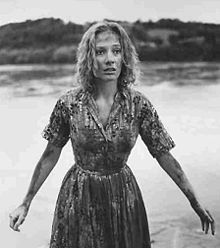
Carnival of Souls begins (the part I was asleep for all those years ago) with a drag race between a car full of young men against a car full of young women.  The cars end up on a rickety old bridge over a river, and the car with the women goes off and crashes into the water below.  While authorities dredge the river to no avail, a little ways downriver one of the women emerges, shocked and soaked.  She has no memory of how she survived the crash.

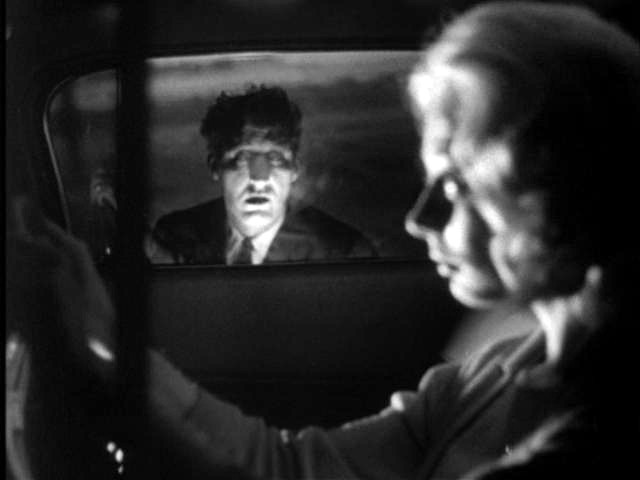
In a great plot device, we learn that the woman’s occupation is a church organist, and she’s been hired by a church in Utah to play their enormous, creepy pipe organ.  She leaves her hometown, vowing to never come back, only a couple of days after the accident.  Driving at night on her way to Utah, strange things begin to happen.    First, her car radio starts to play strange organ music.  She tries to change the channel and shut the radio off, but the same music continues to play.   Then she has her first encounter with a strange ghoulish-faced man, this time replacing her reflection in the passenger window and staring at her.    She passes by an abandoned amusement park and is strangely attracted to it.

She gets to town and rents an upstairs room in a small boarding house.  Just as she hopes to settle in and start a new life, things start unraveling, and she appears to be going mad.  Aside from additional visits from the ghoulish man, she experiences periods where she is seemingly shut off from the world, where there is no sound and nobody can see or hear her.   She ends up at the deserted amusement park, and sees dead people dancing to the organ music in a dance hall.  She tries to flee from them, but they chase her, and she collapses on a beach with them closing in on her.  Then the movie cuts back to the river, the dredgers have found the car, and her dead body is in the front seat.

Prior to the 1970s, before advances in visual effects, before The Exorcist, horror movies had to rely primarily upon atmosphere to frighten audiences.   The notable exception to this was Alfred Hitchock’s Psycho, which included graphic violence (the famous shower scene, which is brutal despite the fact that the camera never shows the knife touching Janet Leigh’s body) and explicit shock (the shot of Mother’s rotted corpse at the end).  But these exceptions were rare, and even bigger budget horror movies of the time (like Jack Clayton’s “The Innocents” and Robert Wise’s “The Haunting”) were rich in mood and atmosphere.  The only advantage these big budget films had over the low budget films was that they could pay for better writers and directors and actors.   The result is that occasionally, low budget horror films were able to compete with and often times surpass their big budget rivals.

And there were certainly enough horror films being made in the 1960s.  There were the famous William Castle and Roger Corman B-movie products, as well as the Hammer studio films starring Christopher Lee and Peter Cushing.  Possibly the greatest horror film of the time, George Romero’s “Night of the Living Dead”, was a low budget, independent film made in Pittsburgh.  Romero’s genius was in that he let the lack of a budget work in his favor, the grainy black and white footage and the straight forward story telling approach and the use of amateur actors all resulted in a  heightened realism, making the attack of flesh eating zombies more urgent and realistic.

Carnival of Souls is similar in that the low budget cinematography, the amateurish acting (although the actress playing the lead, a Candace Hilligoss, is actually quite good, and brings a surprising range to her performance) and the simple but tight script and direction work and result in a whole that is greater than the sum of its parts.   Harvey’s direction is top notch, as he uses the camera efficiently but creatively to convey the woman’s psychological state and maintain a consistent eerie atmosphere.   He brings a level of storytelling and sophistication that is unexpected in a low budget production.

The thing I find interesting in all this is that I had seen this movie once, about 40 years ago, and never knew the title, and never thought that much about it, until last night.  Yet it stayed with me, buried in my subconscious,  influencing what I’ve been writing.   It makes me wonder what else is buried in there.