Feet on the Ground, Heart in the Clouds


I’m a Midwesterner, born and raised in the working class of the great state of Wisconsin.  My dad was an over the road semi driver, and my Mom was what is now considered an ancient artifact, a stay at home housewife.   Like a lot of middle class Midwesterners, our feet remained firmly on the ground.   Other than a couple of car excursions to California when I was very young, vacation was always “up north,” near where my dad was raised, a six hours plus drive on State Highway 12 through an endless parade of small towns until they finished I-94, after which we were able to make it in about five hours.  Jet airplanes were observed from below, their fluffy white trails carving up blue skies.

In 1997, after working more than eleven years for an electrical utility, I took a job as an I.T. manager at a small advertising company.   One of the job requirements was “some travel.”  The corporate I.T. office where I worked was in Milwaukee, but their headquarters were in New York, in Manhattan, right next to the Ed Sullivan theatre where “The Late Show with David Letterman” was and still is staged.  Their billing department, which would be one of my major clients, was located in Hoboken, New Jersey, and they had satellite offices throughout the country.

My prior business travel experience, with the electrical utility in northeastern Illinois, consisted of two or three car trips to the training center outside of Joliet, where the company put us up in a dirty and dank hotel that someone in the corporate office undoubtedly scored big points in the budget process.  I’ve never been able to figure out exactly what a “frill” is, but I can guarantee I didn’t see any in the Shorewood Inn.  Cinder block walls and stained carpeting is all I remember about the place now, almost thirty years later.

So it was, shortly after taking my new job, my new company sent me on my first business trip to New York.   I’d been on a plane only once in my life, in 1979, eighteen years earlier, with my Mom and Dad for a rare trip to visit my aunt and uncle in California.  As I checked in and found my gate, I tried my best to act worldly and sophisticated, watching other business travelers closely and trying to act natural and confident as I imitated their behavior and followed their leads.

I somehow made it on the plane without incident.  I had a window seat, and I nervously waited for take-off, not knowing how I’d respond, nervous because when I was a kid I had an acute fear of heights.  Soon we were speeding down the runway, then the nose of the plane was pointing up, and we were off the ground.  My stomach was in my chest as I watched out the window, and then we were above the clouds and cruising, and I calmed down, and I loved it.   I spent every second of the flight gawking out the window, looking down at the tops of cloud formations and the earth below, the cities and the farm fields and the woods.  It occurred to me that I was experiencing something that all of the great men and women who’d ever lived before say 1900, before the Wright Brothers and Kitty Hawk, never experienced.  I was seeing a view that Socrates or Abraham Lincoln or Gengis Kahn had only been able to imagine.   I looked around the crowded plane at the other, veteran air travelers, and they were all either asleep or reading something.   I felt like screaming, “How can you sleep?  Look out your windows!  That’s our world down there!  It’s amazing!”

It was dark when we landed in the Newark airport.   My hotel reservation was in the town of Weehawken, New Jersey, in the Ramada Inn, from where I’d be visiting the New York office the next day and the Hoboken office the day after.  I was told to find a cab and have it take me to wherever Weehawken was.  I took my one bag and found the taxi station, where fortunately there was a guy whose job it was to call cabs for the lines of arrivals.   After a couple of minutes I was in a cab, giving the driver the address, and we sped off into the New Jersey night.

Although I grew up and had spent virtually all my days in the heart of the Midwest, two of my cultural heroes happened to be Bruce Springsteen and Woody Allen.  Their over the top romanticism with their home turf framed my understanding and expectations of New Jersey and New York.  As we drove through the Jersey night, I saw nothing exceptional, nothing romantic, just a lot of pavement and traffic.

I finally made it to the Ramada Inn, and by this time I was tired, my first foray into the business travel world having left me exhausted and drained.  I checked in and was given a card to a room on the 12th floor.  Bleary eyed, I opened the door, my expectations framed by the flea bag hotel in Joliet that had been my previous business travel experience.  Instead of the four cement block walls, I opened the door to an expansive suite, with a full and spectacular and living color view of the Manhattan skyline, all lit up, the lights reflecting and mirrored in the water of the Hudson River.  The view was amazing, and I walked into the room in the dark, not turning the lights on, because I didn’t want to spoil the moment.   I immediately recognized the skyline as a full color version of the opening montage in Allen’s “Manhattan.”  As beautiful as that sequence in the film was, it didn’t compare to what I was seeing.  I remember two thoughts entering my mind, the first, “Wow,” the second that there must be some kind of mistake, I must have gotten the wrong room, I’m only a low level manager, I’m not important enough for a room and a view like this.  This is a typical Midwest reaction – it’s not false modesty or humility – it’s just that we know with a lifetime of certainty that we aren’t very important.

The next day, I made it to Manhattan, and to Hoboken the next, and then back home to Wisconsin.  In the months that followed, there’d be a lot of return trips to New York, as well as trips to San Jose, Boston, Montreal and Miami.  Soon I’d be fast asleep before take-off, just like all of those other experienced, travel-weary passengers.

That’s the way the world operates.  We become jaded, pre-occupied, indifferent.  “Experienced.”  It occurs to me that it would be exhausting if we experienced everything in life with the same intensity we experience it the first time.  But it also occurs to me that everything I felt on that first trip to New York remains real and honest and heartfelt, and I long to feel that wonder and awe again.   I wonder how many of those moments I’ve missed, how many I’ve slept through.  I guess I’ll never know.

All I can do is to try and be awake for the next one.
Yes, but Can a Diamond Ring Do This?


At tonight’s meeting of the Kenosha Writers Guild, Darleen Coleman (who is a terrifically talented writer) shared a wonderful short story about a young woman coming  to terms with the fact that the real world bears little semblance to the world she imagined for herself.  In the story, the woman’s young boyfriend is excited about the gift he has purchased for her birthday, which makes her apprehensive:

She worries how disappointed she may be when she opens the real gift tonight. She recalls the look on Hoff’s face as he swung the bag. Men were always getting excited about the wrong stuff;

This instantly reminded me of the Christmas, twenty some years ago, when I was convinced that I had found the perfect gift for my wife.  We always spent liberally on our children, and skimped on spending for each other.  So Christmas shopping for my wife every year became a quest for the holy grail:  a simple but meaningful gift.   My wife, maybe because of who she married, has historically low expectations for gifts.   She is genuinely happy with whatever I give her, usually books or cooking ware or some other unimaginative offering.  She is more concerned that I stay within budget.  Meanwhile, she always manages to find something nice and unexpected for me.

That year, either in the late 80s or early 90s, I decided was going to be different.  I wasn’t going to wait until December 24th to find a gift for her.  I started looking two weeks earlier, determined to maximize the fifty dollar investment our gift budget allotted for each other.  I hit mall after mall, inevitably ending up in the book or the record store, absent mindedly browsing titles that interested me until closing time approached.

So it was that on December 23rd, with no progress in the search for the perfect gift having been made, I entered the old Original Outlet Mall out on I-94 near Highway 50.   Desperation was already setting in when I stopped in some hobby store.  Nothing piqued my interest until I found, stowed away high on the shelf above the check-out counter, with the other  items that there was no room for amongst the various Christmas displays, the perfect gift.  I pointed at it and asked the cashier if she could get it down.

“This one?” she asked, pointing.  She was young, late twenties, kind of cute.

I could barely contain myself.  “Yes, that’s it.”

“Really?”

“Yup, that looks to be about perfect.”

She looked at me and smiled, my enthusiasm for the item apparently infectious, and got out the little step ladder they kept on the floor under the cash register and, reaching high up over her head, brought it down for my inspection.

It was perfect.  I was beaming.  I asked her how much it cost.  She turned it over and read the price tag on the bottom.  “Thirty nine ninety five,” she said.

“I’ll take it,” I blurted out.  I couldn’t believe it.  It was under budget.  I asked her to gift wrap it, and she did, and I walked out of the store, the perfect gift under my arm.   I remember waving to the girl as I walked out, grinning, and again, my enthusiasm had to be infectious, because she was grinning as she waved back to me.

I took it home and put it under the tree, pointing the package out to my wife, and bragging, “You won’t believe what I got for you.”

She looked up from the book she was reading and said, “I won’t?”

“No way,” I replied.

She  put her nose back in her book and continued reading.

“ Nope, there’s no way you’re going to be prepared for this gift,” I continued.

“Is that so?” she said, without looking up from her book.

“Because it just so happens to be the most perfect gift ever,” I boasted.

“I can hardly wait,” she mumbled.  She continued reading her book.

Two days later, Christmas morning, the kids ripped through their packages, and one by one, my wife and I opened the gifts the kids had gotten for us.  I played it cool, waiting until the absolute perfect time to present her with the perfect present.    I handed the package to her.

“So this is the one you couldn’t wait to give me?”

I vigorously nodded yes, grinning the same grin that I grinned in the outlet mall when I found it, unable to speak.  I was giddy with anticipation and secure in the knowledge that finally, after all these years, I had found the perfect gift.

She slowly opened it, and somehow restrained the gasp that I’d expected to hear.   She was silent for a moment, then she asked:  “What is it?”

What is it?   Are you kidding me?

“It’s a cookie jar!”  I could barely contain myself.  She started laughing.   Laughing!  Then the kids joined in, they started laughing too.  I was crestfallen.  My face must have revealed my disappointment, because my wife started apologizing.  “I’m sorry,” she said, “it’s very …” and before she could finish the sentence, she started laughing again.

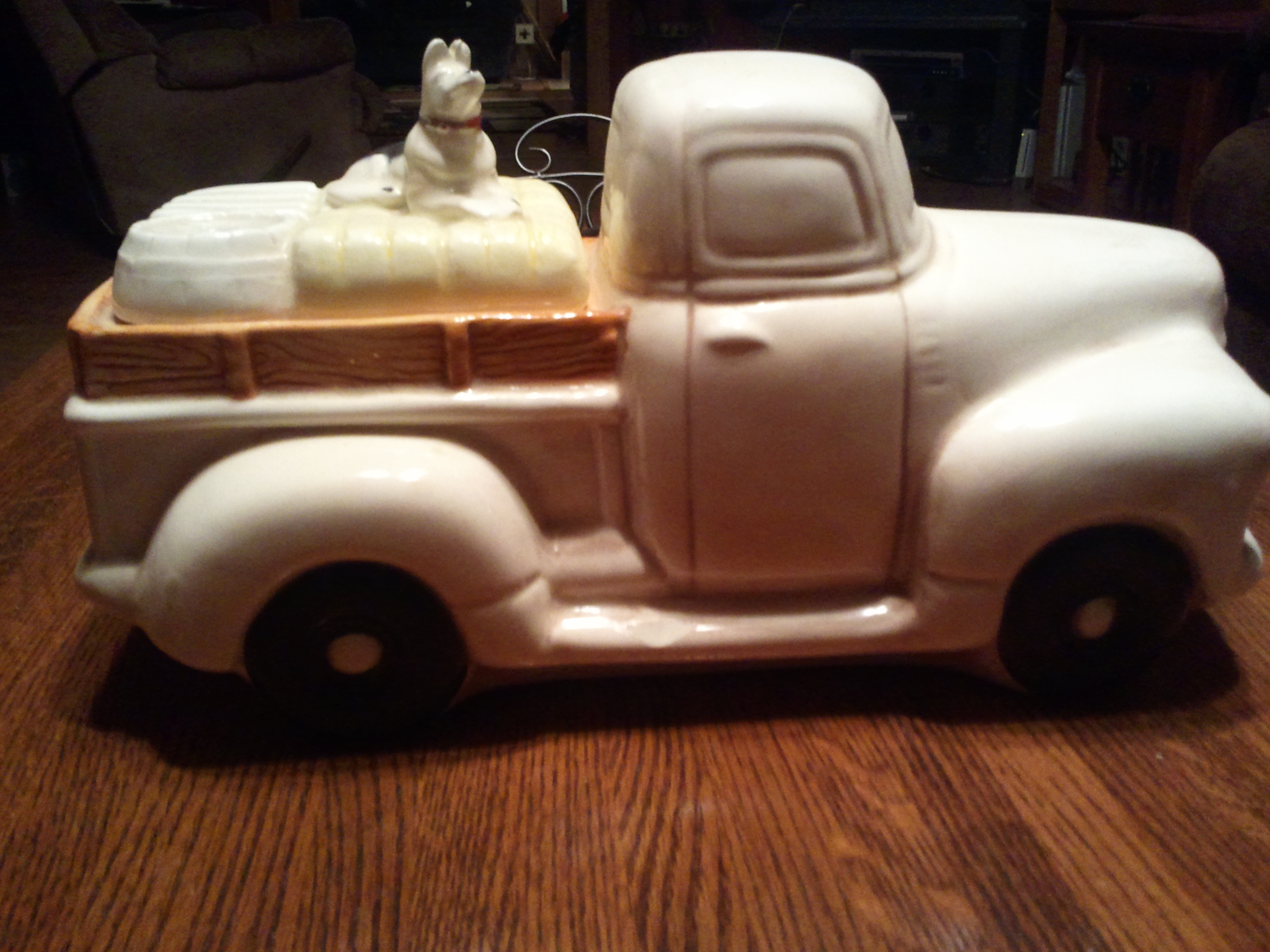
So let me describe the gift and why I thought it was perfect and see if you agree.   It was a ceramic cookie jar, in the shape of an old pickup truck, with ceramic bales of hay in the back, and a ceramic black and white dog lying on top of the hay.  To open it, you lifted the dog’s head, and the dog and the bales of hay came off, the cover to where the cookies would be stored.   The reasons I thought it’d be perfect included:

SAMSUNG

The perfect gift!

1)       Nostalgia – my wife grew up on a farm.   Nothing says “farm” like an old pickup truck.

2)      At the time, we had horses that we stalled in our barn out in back.  We always had a supply of bales of hay to feed the horses with, so the hay in the back of the truck struck home.

3)      We had a dog.  The cookie jar had a dog.  Who doesn’t love a dog?

4)    My wife frequently bakes cookies.  I love cookies.

For some reason, the gift didn’t go over as well as I’d hoped.  It never made it to the kitchen, my wife instead preferring the old plain white cylinder for a cookie jar to my finely detailed ceramic work of art.

Today, the piece sits proudly on display in my office, where from time to time I stop and admire the fine craftsmanship and detail that went into its creation.

SAMSUNG

Lift the dog to get to the cookies within

One thing I did get right, though.  I always thought it’d be an unforgettable gift, and that it has been, as almost every Christmas my wife and kids tell the story of the “perfect gift.”    And here’s the good news:  it has become the standard that all subsequent gifts have been measured against.  More than once, through the years, I’ve heard:  “At least it isn’t that ugly cookie jar.”

I adjust well.

Thirty Two and Counting


(This Thursday will mark my 32nd wedding anniversary)

You are everything to me, the sunshine that lights my days and the lighthouse light that guides me through the windswept seas and rocky shorelines of night.   You are strong as a rock and frail as a leaf.  You are heart and you are soul, you are passion and comfort.  You are astonishingly beautiful.  Your eyes, lit by the incandescent flame of your glowing soul, see and understand everything, everything that matters.    You are the love of my life; you know all of my secrets, my triumphs and failures.  You’ve inspired me to do things I didn’t think I was capable of.  You’ve stood by me when I’ve come up short.  You’ve given me reasons when all reason seemed lost.

I find myself lost in the dark, adrift in the unending night, and I reach out to you, and you’re there, warm and still, and even now, after all this time, after fate and circumstance and disease, our breaths rise and fall in time together, the rhythm to dreams that still come to me, dreams that are dreamt within the dream we’ve been living for thirty two years now.

Saturday, August, 1968


It’s strange sometimes, the things you remember.  I know that in my fifty plus years on the planet there have been any number of life-changing events that I’ve completely forgotten about, and still others that are murky at best.  At the same time, there are also random snippets of innocuous day to day and seemingly unexceptional moments that remain vividly etched in my memory forever, moments that I can recall with perfect clarity whenever I want.

It was a Saturday in August of 1968.  I was nine years old.  The television in the living room was on, channel four, the major league baseball “Game of the Week” on NBC, with Joe Garagiola and Tony Kubek doing  play by play. The Detroit Tigers were playing the Baltimore Orioles.   I was watching.  I remember Don Wert, third baseman for the Tigers, hitting a home run.

My dad was home, wearing a plain white t-shirt, cleaning the garage.  I don’t know where everybody else was.  I just remember being by myself in the living room and every now and then going out to the garage and “helping” my dad.   I remember he was in an especially good mood, and I remember at one point he had the garden hose out and was rinsing down the garage floor.  I’d come out, hang around with him for a while, and then I’d go back in and watch the game for a while.  And I remember being keenly aware of how happy I was, I didn’t understand why, but I felt completely free and good and happy, with baseball on television and my dad in the garage.

That’s about it – I wish I could tell you that something exciting happened.  I wish I could even tell you who won the baseball game.

But there is one thing I can add – it remains what it’s always been, one of my favorite memories of all.  I’ve often wondered why, with no definitive explanation, but I think it has to do with the vividness the memory presents itself to me.  I see my dad how he looked back then, with what hair he had on his head still dark, his face unwrinkled.  I see that the television was our old black and white console in the living room.  I see the grey cement floor of the clean and empty garage, I see the dust rise from my dad’s sweeping with the big push broom, then later the water spraying out of the hose.  I see my dad smiling that contented home on a Saturday afternoon smile.   And I remember feeling free, free to watch baseball or hang out with my dad, two of my favorite things to do.

That’s all it is – just an ordinary moment in an ordinary day in an ordinary life.  And I think that’s why I love the memory so much.  What makes it feel so extraordinary is that my dad was with me, home from work on a Saturday afternoon.  I had no concept then that our Saturday afternoons together were finite.  I had no concept of aging and death and time and space.  I was nine years old, and all I understood was baseball and my dad, and on that Saturday afternoon in August of 1968, they were everything.

Dead End Street


There are the late nights, after long days or nights working or returning exhausted from a long trip, when the street light marking the turn off onto my dead end road comes into view, and it’s always the warmest light in the world.   Beneath its glow I turn onto my street, and in a minute I’m home.

I’ve lived in the same house on the same dead end street since November 1, 1984.  That’s going on 29 years now.  In that time, among other things, I’ve completed a career in I.T., raised my children, gained about 40 pounds, and lost most of my hair.   I’ve done the math, and just driving to and home from the various jobs I’ve had over that time, I’ve driven down that same dead end street to my driveway over 14,000 times.   Add in another 30,000 to 40,000 times running to town to get groceries or running kids to softball or basketball practice or whatever, and I’ve pounded the same narrow half mile or so of pavement in excess of 50,000 times.   I know the road’s imperfections, its nooks and crannies, its bumps and manhole covers, so well that I could probably drive it with my eyes closed.  I know where the little valleys in the pavement are, and where, after a rain, the deepest puddles form.  For years, if I had one or more of my kids with me, I’d always accelerate through them, making as big a splash as I could.

I had endless routines I’d use to entertain my kids with when driving them down the street.   One of my favorites was, years before talking GPS devices or Suri or whatever her name is, I had Hank the engine man.  Hank was a small man who lived in the engine of my 1989 Ford F150 pickup truck, and whenever we embarked on a trip, as we pulled out of the driveway, I’d ask Hank for a systems report.  I’d say, “Hank, how’s the oil pressure,” and Hank, forever loyal and faithful, would answer, in his high pitched voice “Oil pressure is fine and steady.”    I remember one time, I hurt Hank’s feelings when I yelled at him for failing to report that there was a puddle just past our driveway, and normally cheerful, Hank turned sad and depressed when I asked him, “Hank, what’s the fuel level?”

He answered glumly, “um, it’s not bad, I guess.”

“Do we have enough gas to get to Milwaukee?”

“What do I know?” he replied.  “Apparently I don’t know what a puddle is.”

My kids thought it was funny when I had to apologize to Hank for hurting his feelings.

The years passed and my kids grew up and the laughs my routines used to draw turned into impatient sighs and rolling eyes, and I realized that I performed them as much for my own entertainment as theirs’.   Whatever, they were fun while they lasted, and they were part of the universe that a family creates.  The center of that universe is the house the family calls home, and for the past 29 years, the pathway to home has been our little dead end street.

Now, when the kids come back to visit, they approach that same streetlight, and I hope it is just as warm a sight for them as it’s been for me all these years.  I hope they breathe the same sigh of contented relief and, no matter what stresses or worries occupy their minds, for the stretch of that dead end street to our driveway, they melt away.

They’re home.


Melting Diamonds and the Great Blue Bus in the Sky


(Going through some old files tonight and I found this -it’s one of the first things I wrote upon joining the Kenosha Writer’s Guild a few years ago, and one of the few things I wrote back then I can still read now without invoking the gag reflex …)

There used to be an old blue school bus that ran from the parking lot of the A&P grocery store in Ladysmith to the Norco Window factory in Hawkins every day.  I’d walk the four blocks from my apartment on the third floor of the Gerard Hotel to the bus, and for a while, I’d be joined by Jack Anderson, a big burly man of about 6o years old with a scraggly white beard, who worked in the same department at Norco that I worked in.  Jack worked alongside the slightly older and famously cantankerous Conrad Stonkey, one of the great characters I’ve had the pleasure of having known.  Conrad was at the time in his early 60s, a rather short man of medium build, whose thinning hair had turned pure white with age. Every day Conrad wore the same olive green work uniform, work pants and shirts, and had an olive green colored cap that covered the thinning white hair on top of his head.  He also sported a little pure white goatee, that for special occasions he would dye an appropriate color.  To celebrate his Irish ancestry, every year on St. Patrick’s Day he’d show up with this white goatee colored green. On the fourth of July, streaks of red and blue would be added to the natural white for a stirring patriotic salute.  He was ornery and complained about everything, but he also had a sense of humor, and when he laughed, he would clench both of his fists and hold them at his thighs, stand on his tippy toes, and emit a high-pitched “tee-hee-hee” sound.  It never failed, you’d get a laugh out of him and his automatic, reflexive action would be to clench his fists, stand on his tippy toes, and make “tee-hee-hee” sounds.

Conrad and Jack would take panes of glass and stack them on top of the aluminum frames I and my work partner, the 45 year old confirmed bachelor Lew Reed, were responsible for.  Lew would fill the individual aluminum spacers with silicate, I would snap them together into wobbly rectangles and store them in groups of about 30 of the same dimensions in the hot room, where Conrad and Jack would take them and stack them on the tables we had covered and taped with construction paper earlier that morning, inserting the freshly cut and clean pieces of glass that they’d take off of rollers that were fed from outside the room by another member of our crew, Roger Arndt.  Finally the stacks of glass and aluminum spacers that were so carefully prepared by Conrad and Jack would be wheeled to the middle of the room, where their sides would be covered by a fresh coat of “goop”, which was some form of thick adhesive material that the worker, for a period of time my friend Jeff Severson, would whip up from the strange goop-making machine that stood in the center of our small room and apply to the stacks of windows with a cardboard grovel.  When finished, Jeff would wheel the table with the gooped up stacks of glass outside of our temperature controlled room to the larger factory that sat outside, where the goop would dry and someone would later come by with a utility knife and cut through the goop, revealing the separate insulated aluminum spacer bound panes of glass that would be incorporated into wooden sashes to complete the transformation of raw material to window.

We worked in this small room, me and Lew, Conrad and Jack, and Jeff, with Roger popping in between loads to see what size of glass panes to pick up for washing and feeding through to Conrad and Jack next, together for 8 or 9 hours a day,  and during peak times, an additional 5 hours on Saturdays.   So we got to know each other pretty well.  I, being the youngest and by far the most immature of the group, settled easily into the role of clown.   I quickly mastered my job of snapping together the aluminum frames so that I could stay comfortably ahead of my work, leaving my mind free to explore ideas to convince the others, especially grumpy, cantankerous old Conrad, that I was one sandwich short of a picnic.  Amongst my favorite routines were:  1)  getting “angry” at the stored boxes of metal spacers and going a few rounds with them, showing off my boxing skills, quickly throwing left jabs and lethal combinations and punching them until my knuckles literally bled, 2) standing on top of the papered  tables, flapping my arms, and cawing like a crow at the top of my lungs, and 3) with Jeff and a visitor from an outside department starting out with the bass vocals of the Beach Boys’ “Barbara Ann” ,  jumping up on top of one of the wheeled tables and singing the high pitched falsetto lead as loudly as I could, all the while using the wheeled table as my surf board,  pretending to ride a big wave.  I’d get puzzled smiles and head shakes from Lew Reed, and when I’d get the involuntary tippy-toed, clenched fisted “tee-hees” from that old mule Conrad Stonkey, I knew I’d accomplished something.  Exactly what, nobody knew, but it was undeniably something.

I’d spent enough time with these guys that I had gotten comfortable – maybe, too comfortable – with them, and wasn’t afraid of showing off for them.  I was living alone, very much alone, at the time, and work provided on many days the only real contact I had with other human beings.

After the misery that was high school, I had no desire to attend college and subject myself to more of the same.  I was eager to experience a life without school, and make money, and buy things.  After graduating high school, I got a job where everyone who couldn’t get a job anywhere else got a job, the C & D Duck Processing plant in Franksville, Wisconsin, where I worked my way up to the illustrious position of lung sucker, and with my handsome $4.33 per hour salary was able to buy my first car, a 1974 A.M.C. Hornet, a green hatchback with yellow racing stripes down the side.  I was also able to make enough money to purchase a stereo system, and get a pretty impressive start to a record album collection.

But it didn’t take long for the job of sucking the lungs out of ducks (to be clear, we sucked them into these big vacuum guns, not our own lungs) to lose its luster, and in mid 1977, a year after starting work at C&D, I grew restless.  I was still living at home, still lonely, still not meeting any girls.  I decided it was time for the next chapter in my life – I decided it was time to go out on my own.  The only choice there was for such an adventure was for me to return to my ancestral homeland of northern Wisconsin.  So it was that I moved into the Gerard Hotel in Ladysmith, Wisconsin, high on the banks of the Flambeau River.

I had lived there, on my own, and worked at Norco, for about a year by the time Jack Anderson came to join our little department, and we hit it off right away.  Whereas Conrad was an ornery old fart who found reason to complain in just about everything, Jack had a much more philosophical view of life.  He was well read and had a fast mind, and he had his own way of viewing things.  He had raised two sons who were older than me and, in 1978, had a young daughter about four or five years old.  At the end of the work day, his wife, who was a bit younger than Jack, probably late 40s, would walk with his young daughter to meet the blue bus that we returned to Ladysmith on, and together the three of them would walk home.  I remember that it never failed, every day, the eyes of both his wife and young daughter would light up when Jack got off that bus, and they’d walk home together, the three of them, Jack walking that distinctive, lumbering walk of his, a picture of domestic bliss that never failed to put a smile on my face.

Jack kind of took me under his wing.  I may have been wearing my plight as a lonely young bachelor on my sleeve a little bit more than I’d like to admit, because I think Jack saw through the façade my clowning around all day tried to project and saw the loneliness underneath.  He’d always take the time to have serious discussions with me, and we’d discuss current events and old movies and philosophy, as I had picked up every now and then some of my brother Mike’s college books and liked to pass myself off as knowing something about the subject.  It turned out Jack had read many of the same books, and was able, in his simple terms, to make me understand for example what Kant’s categorical imperative was all about, on a morning when the blue bus chugged down highway 8 to the Norco plant.

Jack also took enough pity on me to help me out on occasion.  One morning, he handed me two army fatigue jackets that used to belong to his sons plus an old black and white checkered winter coat, saying he had no further use for any of them and would like to see them come to some good.  They were great; I wore them until they fell apart.  I still have one of the army fatigue jackets to this day.  I did find in one of the pockets a letter from Jack’s oldest son to his second son, saying how he was coming home on leave from the army soon, and how he was looking forward to seeing his little brother, and how he knew a guy in Eau Claire they could get some good weed from.  I never showed this letter to Jack.

My favorite memory of Jack Anderson took place on a very dark morning in late November. We had to be on the blue bus by 6:00 A.M.  About an hour earlier it had started to snow, one of the first snowfalls of the season.  It was cold out, no wind to speak of.  It started with a few big snowflakes slowly and silently drifting from the sky, and then it started snowing heavier, still big flakes, silently dropping out of the low ceiling of night and into the halo of the Miner Avenue streetlights like an invasion of miniature white paratroopers.  The ground was just cold enough that the snowflakes started to stick, and they’d lie there on the sidewalks, glittering in the glow of the streetlights.

I had gotten to the bus first that morning, and when Jack joined me a few minutes later, his eyes were wide with excitement.

“Did you see that?” he asked.

“What, the snow?” I replied.

“Did you ever see such a beautiful sight?”

“Yeah, those were big and pretty flakes, weren’t they?”

“They were diamonds, is what they were.  They were diamonds, thousands of them, at my feet, shining.  And they were mine.”

I thought, that’s exactly what they looked like, illuminated in the glow of the street lights.  They glittered and sparkled just like diamonds.

“I was a wealthy man, there, for a while,” he said.  “I was a wealthy man.”

I don’t remember much else about the ride to work that morning, but I remember, a couple of times throughout the day, he’d remind me, “I was a wealthy man, there, this morning, with all of those diamonds shining at my feet.”

Jack was right.  He was a wealthy man that morning.  I understood even then how rare a diamond Jack Anderson himself was.  To see and appreciate the beauty that was there at that moment, on display just for him, as he lumbered his way up Miner Avenue, his lunch box in his hand and his head at his feet, counting the diamonds that were his and his alone.  Conrad Stonkey was roughly the same age, and I can guarantee he wouldn’t have seen the diamonds.  Nor would Jeff Severson or other kids my age.  The question was, and remains, would I see them?

With Jack having shared his poetic vision of the miracle that was present in that moment with me, I liked to think that I would see them, and I’ve at least tried to look for the diamonds at my feet throughout the years, but no doubt I’ve missed most of the miracles that are constantly occurring every day.   I know I have all too frequently worn the blinders of preoccupation as I made my way through the journey of each day, preoccupied with family issues, work issues, or lately, disease and fear.  But through the years, I have revisited that early snowy morning hundreds of times, and heard Jack describe what a wealthy man he was, and each time I think how lucky I was to have been there and been the one he shared his wealth with.

I have no idea whatever became of Jack Anderson.  I have not seen or talked to him since I left Norco on Halloween, 1979, more than thirty years ago.  If he is still alive, he would now be in his 90s.  I’m sure that he has long since forgotten about the goofy 19 year old who he shared a bus seat with for a few months.  I’m sure he has long forgotten about the army fatigue jackets and winter coat and wisdom he shared with me.  But that doesn’t change the fact that I’ll never forget him and his lumbering walk, and if he has gone on to the great blue bus in the sky, I like to imagine that every year, when the first snowfall hits the early morning street lights of Miner Avenue in Ladysmith, his ghost can be seen lumbering along with his lunch box in his hand, counting the diamonds as they accumulate around his feet.

Pie Story


This is such a stupid story that it’s hard to believe it’s been told and retold in my family for over 30 years now.

I was 18 years old and living on my own for the first time, in a small efficiency apartment on the third floor of the Gerard Hotel in Ladysmith, working in the Norco Windows factory 20 miles away in Hawkins.  Being new to independence, there was much I didn’t know, but I knew this much:  I liked pie.

I’d discovered, in the frozen foods section of the local IGA, frozen chocolate crème pies.   You just took them home, thawed them out, cut a slice or two and ate, returning the rest to the refrigerator to be consumed later.  They were delicious, and as they required no cooking or preparation, they were perfect.

In early November, I turned 19, and the IGA started stocking Thanksgiving specialties.   Among the seasonal foods were boxes of pumpkin pies, right next to the chocolate crème pies in the frozen food sections.   Being the pie fan I was and remain pumpkin pie is right up there at the top of my list of favorites.   Having had such a rewarding experience with the chocolate crème pies, I didn’t hesitate to pick up a box.

I got home, let it thaw out a little, and dug in, removing a spoonful from the pie’s center.  It looked delicious.  However, shortly after that first spoonful, I realized something was horribly wrong.  Looking at the box, I discovered directions for heating and baking the pie.   Turns out you had to put it in the oven!   Disgusted by the false and misleading packaging (it looked just like the packaging for the chocolate crème pies, and they didn’t require an oven), I put the pie in the center of my spacious refrigerator, where it sat next to a couple cans of soda and a jar of jelly.

A couple of days later, with deer hunting season beginning, my dad and my brother stopped by to pick me up and take a look at how this neophyte was adjusting to bachelorhood, how he was getting by in his first apartment.  It didn’t take long for my Dad to open the refrigerator and see the raw pumpkin pie with one bite taken out of the middle.   I explained that I didn’t know you had to bake it, and they got a big laugh at my expense, confirming their suspicions that I was too much of an idiot to adequately manage independent living.

A few weeks later, back home in southeast Wisconsin at Christmas, with the larger family gathered together, my Dad told the story of me and the pumpkin pie for the first time, explaining how he opened the refrigerator and there was nothing but a pumpkin pie with a hole out of the middle in it.  Everybody had a good laugh, including me, excusing the slight exaggeration of the empty refrigerator (there were a couple of other items in it, but it was a small point, and made for a better story, so I excused his embellishment).

Sometime later, my Dad told the story again.  This time there were two pies, each with a hole in the middle.  Then, the next time, there were three pies.  Years later, when telling my children, his grandchildren the story, the number continued to rise, until, shortly before his passing last year, it was a “refrigerator full” of pies, all with a single hole eaten out of the center.

Debate has raged whether he deliberately exaggerated the number of pies for effect or if time and the act of telling the story so many times actually modified his memory, and he really thought there was a refrigerator full of pies, if he came to actually believe his own story.  It was hard to tell, because he always told the story with a straight face.

So some perspective is required.  I remember the refrigerator being of your average, run of the mill, full-sized model.  I have no idea what the capacity of the typical empty full sized refrigerator would be for storing nothing but pies.  Lets for the sake of argument say the refrigerator could have held 15 pies.   That means, if he really believed his own story, that I did one of two things:  I either went to the IGA one time and bought 15 pies, or I made 15 separate trips, buying one pie each time.  Either way, I opened 15 packages, took a single bite out of the center, and returned them to the fridge.  To believe his story as told he’d have to believe that his son was engaging in behavior that at best was extremely quirky but more likely psychotic.

I think I tried pointing this out to him more than once, but it never got through, and sure enough, at the next family get together, we’d hear him start telling the story again, knowing it all by heart except for how many pies there would be this time.

Of all the stories my dad told, and re-told, the mysterious pies with the center eaten out of them may be the stupidest, but we couldn’t wait to hear it, and I of course loved being the butt of the joke.  When my wife and now grown children gather together, we still retell the story, and we all speculate how many pies my Dad would be up to if he were still alive.

As many times as I heard it, I’d give anything to have him here right now and hear it one more time.  No one could tell a story, especially a stupid story without much of a point, like my Dad.

The Death of Davey


“Dave-ee!   Dave-ee!”

From our back porch, my mom’s voice echoed thru the warm darkness, calling me home.   I was 12 years old.  It was one of those perfect long summer evenings that had turned into a warm summer night, and all the kids in the neighborhood who were approximately my age had been outside playing for hours.

I was a few backyards away when I heard the calls.  I headed for home.   As I approached the corner of our backyard, I could make out the silhouettes of three or four kids gathered together.

“Better get yourself home, Davey.”   I recognized the voice as belonging to the neighborhood smart-ass.  In the dark, I didn’t recognize the shapes or the voices of the snickering that came from the other silhouettes.  I kept walking. 

“Dave-ee!” 

By now I was in our backyard.  In the yellow glow of the back porch light, I could see my mom, standing in the open doorway.

“There you are,” she said, as I passed her and entered the house.

“Don’t you ever,” I said as she shut the door, “call me Davey again.”

I glanced at her, standing in the back hallway with her mouth hanging open, just long enough to register the shocked hurt on her face. 

“I’m sorry,” she said. 

I instantly felt sorry, too, but I didn’t say it.  I was still too humiliated from the shadowy snickers I’d heard in the dark.  But I could read the bewildered disappointment on my mom’s face, and I recognized that while she felt bad about embarrassing me, she felt even worse about losing her Davey.

I knew with twelve year old certainty that I had forever outgrown the name.  After all, my mom was the only one still using it.  However, there was a part of me that wasn’t quite ready to let go of Davey, either. 

But we did let go.   After that night, my mom obeyed my order and never referred to me as Davey again.   I was Dave now.    Davey was dead and buried; a distant memory.

One afternoon, a couple of years later, I asked my mom what we were having for supper.

“Liver and onions,” she replied, knowing my distaste of the dish.

“You’ll never make mother of the year,” I told her.  

She laughed, and I’m confident that we both knew the truth, that she was the best mom her Davey could have ever asked for.

Time After Time


OK, I know it’s not very manly of me to admit this, and some may say it points to a certain lack of sophistication, but I am a Cyndi Lauper fan, especially the song “Time After Time.”   I think that it is simply one of the best songs written in the last 30 years, and even though it has been covered by a variety of other artists, I still like Lauper’s version the best.

The thing that has me thinking about “Time After Time” tonight is that today, my wife and I attended my daughter Hannah’s graduation from high school.  Hannah is the youngest of our three children, following her brothers, Jon and Nick, who graduated in 2004 and 2007.   So as emotionally charged such an event is anyways, when it’s your youngest, when it’s the last time, it’s even more bittersweet.

“Sometimes you’ll picture me …”

Hannah posted a photo of herself in her pre-school graduation gown on Facebook this morning.  It was perfect because it is such a good photo and sums up what a wonderful little girl she was (and is).   The thing is, that picture was taken in 1999, which the calendar says is thirteen years ago.  I know that in my mind, it was taken only yesterday, and it frightens me how fast time really moves.

I have so many images running around in my head tonight, like when I tucked her in on September 11, 2001, after the World Trade Centers fell, when she said to me, “Leave a light on tonight.  That way if something happens, they’ll know there was a little girl in here.”

Or, after learning about fire safety in kindergarten, her obsessive fear of things suddenly combusting into flames, resulting in my realization some five uneventful minutes after putting slices of bread in it that the toaster had been once again unplugged.  “Do you have any idea how many house fires start from toasters?” she’d lecture if I dared to complain.

There was the vacation to Kentucky when she was almost four years old, when we were on our way to see the house where Abraham Lincoln was born.  “How much longer,” she asked, “until we get to thinkin’ Lincoln?”

When she was little, she had more energy than anything my wife and I had ever seen.  “Hurricane Hannah” we called her.  From the moment she woke up in the morning, there’d be only one speed, overdrive, and she’d speed and collide and crash her way through the day.  And then, suddenly, like a switch had been turned off, she’d be asleep.  It always amazed Deb and I.  There were times when she’d be talking and she’d stop in mid sentence and not finish.  We’d turn around and look and, whether it was in her car seat in the back of the car or the sofa in the living room or a chair at the dinner table, she’d be out, sound asleep, and I’d carry her up to her bed and she wouldn’t wake up until the next morning when the hurricane would strike again.

There were the driving tests I took her for, and there was the first time she drove by herself, to the corner store, my eyes nervously fixed on the driveway until her return.

There were the nights she was out with friends, and the phone calls she always made to her mom and I, telling us where she was, asking if she could stay out an extra half hour and, surprisingly, not complaining if we said no.   If we told her she had to be home by ten o’clock, she was home by ten o’clock.

She was always headstrong and stubborn.  She was never afraid to argue with her parents, particularly her mother.  She could be manipulative and a master at melodramatically changing the point and shifting the blame if she was ever caught doing something wrong.  But even when she’d get right in our faces and tell us how wrong we were about whatever, she somehow always remained respectful.   She knew which buttons to push, but she also knew which lines not to cross.

Suitcase of memories”

There are so many moments of inspired nuttiness that we have shared over the years.  Like the time we were Christmas shopping in the Casio store at the old, original outlet Mall.  She couldn’t have been more than four years old.  Standing beside me, Hannah had discovered the electronic drum machine when she said, “Daddy, tell a joke.”

“I just flew in from California,” I said, “and boy, are my arms tired.”

No sooner had I delivered the punch line, Hannah produced a perfectly timed rim shot.

Then there was the time a couple of weeks ago.   I was home, working late in my office, when she wordlessly appeared in my doorway, her face white from a new moisturizing crème, and proceeded to do mime routines including being stuck in a glass cage and walking against the wind.    When she mimed casting a fishing line in my direction, I knew enough to mime getting hooked, and let her reel me in.

There are the bad puns she forwards to me all the time, the random text messages she sends, including vivid photos of whatever grisly animal they were dissecting in biology class.  Whatever, nothing ever consistently brightens my day as much as these isolated moments of silliness.   That we share the same sense of humor is a small part of it, that she was thinking of me if for only a moment in her busy day is the bigger part.

If you’re lost you can look and you will find me / time after time / if you fall I will catch you I’ll be waiting / time after time

When a father’s little girl grows up, and when he looks at his reflection in the mirror, or at that photograph of himself bald headed and potbellied standing beside her in her graduation gown, he can’t help but wonder if she needs him anymore.  Especially when she has turned into such a strong and smart and good person as my Hannah has.  But if she ever does, if she’s ever lost or if she ever falls, I will be there for her, and she’ll find me.  Time after time.

The Ballad of the Sick Raccoon


I’ve lived in the same house on the same 2 ½ acre parcel of land in Pleasant Prairie, Wisconsin, for nearly 28 years.  Since we moved in, with the housing boom of the 90s, our little village has transformed from a bucolic and hidden rural gem to a network of subdivisions and development.   The street we live on has seen significant development, as the open meadow across the street that was the entrance to 30 acres of old growth oaks is now lawn and houses, and while most of the oaks are still there, they now give cover to a subdivision of castles and roads that were built for those “one percenters” you keep reading about.

Despite all the development and change, my street remains a dead end street and is still pretty quiet.  There are enough trees and enough open space to make it feel like we still live in the country.    Wildlife is still surprisingly abundant, having learned how to inhabit the suburban landscape and co-exist with us wacky humans.

It’s rare that we see deer anymore.  When we first moved in, sightings were quite frequent.  Coyotes still howl at night, and on two occasions, we’ve seen them in my back yard.   There is a family of foxes that lives on our street, appearing every year with new pups right about now; they usually make their den in the culvert under a driveway down the street, and I think some years they used the thick hedgerow that surrounds the southern half of my property.  We’ve had snapping turtles and pine and garter snakes in our yards, and, in the tall hardwood trees in my backyard, we’ve had nesting great horned owls.   We’ve had skunks we’ve never seen but thanks to our late, great golden retriever, Sid, we know existed because every year he’d manage to get sprayed.  And we’ve had raccoons, which reminds me of our most memorable encounter with nature.

It was about twenty years ago, a Saturday, a bright summer morning.  I remember I had to run to Menards in Racine to pick something up.  Before I left, I noticed, in the lot across the street from us, a raccoon sitting in the yard, not moving, and not looking right.  I knew raccoons are nocturnal creatures, and I also knew they can be carriers of disease, including rabies.   I went inside and told my wife to keep an eye on it and make sure the kids and dogs didn’t go too close to it.  Then I said, “I should just get my .22 and shoot it.”

“Don’t be ridiculous,” she said.  “This is a residential neighborhood.  We don’t want to upset the neighbors.”

I ran my errands, and when I got back, about an hour and a half later, the raccoon was still there, in the same spot, looking sick.  I went inside and told my wife I was going to get my .22 and put it out of its misery.

“Are you crazy?  You’ll upset the neighbors.  There are people who deal with these things.”   She got the phone book out and I began dialing.

The first thing we tried was the humane society.  They said, sorry, they only deal with dogs and cats and domestic pets.

Then we tried something called animal control.  They replied there was nothing they could do for potential dangerous animals, and suggested we try the humane society.

Then we called the village police department, and they said, sorry, as it is a Saturday morning they only had one detective on duty and that he had more important calls to deal with.  They suggested we try animal control.

For some reason that still eludes me, I tried animal control again, telling them that the police department referred me to them.   That didn’t matter; they still didn’t deal with dangerous animals.

Finally I called the police department back, and got put in the queue for the lone officer on duty.   They gave no promise on how long it would take to respond.

Frustrated, I went out and talked to my neighbor at the time, Sam, one of my all time favorite people.   He was one of the nicest and most generous guys I’ve ever met, a perfect neighbor, always willing to help, and he was smart and strong in that no nonsense, unassuming manner that I admired so much.   He was a retired factory worker, at the time about 70 years old.  He always reminded me, in terms of how he looked and spoke and acted, of the famous test pilot, Chuck Yeager.   As I told him about my misadventures on the phone and that a detective was finally on the way, I looked out across the street and I noticed the raccoon wasn’t there anymore.

“Yeah, he got up and moved into that brush,” Sam said, pointing to the little thicket that divided the property lines across the street.  “Moved real slow and clumsy.  That thing is definitely sick.”

We went across the street to see if we could see it, so if the cop ever came, we could tell him where it is.   Sure enough, it was sitting in a little clearing in the shade in the thicket, breathing heavy.  It silently glared at us as we peeked thru the brush at it.

A little while later, a squad car pulled up to our house, its lights flashing.  I went out and met the detective, dressed in his brown uniform, with a walky-talky holstered on one hip and his service revolver holstered on the other.  I told him where the raccoon was, and that it was definitely sick.  He told me to stay back.  He pulled his revolver out of his holster and carefully approached the thicket.  He slowly crept to the right side, aimed his revolver, and fired – boom! – so much for not disturbing the neighborhood.  Then he moved to the front of the thicket, revolver still drawn, and aimed, and boom! – he fired a second shot.  Then he stalked to the left of the thicket, again took careful aim, and boom! – fired a third shot.   He put his revolver back in the holster, took the walky-talky out and took the call, and approached Sam and I from where we watched in my front yard.

“Well, I got him,” he said.  “I”ve got another call I have to respond to, somebody will be out in a little bit to dispose of the carcass.”  And then he was back in his squad car, lights flashing, and drove away, down the street, putting the final exclamation mark on the commotion that only a squad car with flashing lights and the sound of three gunshots could arouse in a quiet neighborhood.

Sam and I had no choice but to go over and check on the crime scene.  Peering through the brush, we could see the raccoon, but it wasn’t still and quiet this time.  It was loudly hissing, spinning in circles, with one of its back paws broken and bleeding, it couldn’t move.   As far as we could tell, the three shots the detective fired, all from a range no greater than 10 yards, had resulted in one hit, to one of the raccoon’s back paws.

“For cripes sake,” Sam said.  “This has gone on about long enough.”

He went to his garage and got a shovel, a spade.  He came back and stepped into the thicket and put the point of it at the raccoon’s neck.   The raccoon hissed, angry and loud, and with its front paws grabbed at the shovel, but Sam was quick and decisive, he took his right foot and applied it to the spade and in one clean motion decapitated the raccoon.   It may have been gruesome, but it was the quickest and most effective and most humane solution.   That was Sam – he always knew what to do to get a job done, and he was always willing to do it.

With that, after several hours, about five phone calls, one police squad car, three shots from a detective’s service revolver, and one decisive shovel to its neck, the ballad of the sick raccoon was complete.    Thank goodness I listened to my wife and didn’t shoot the poor thing – that might have upset the neighborhood.