Thank You


Just over two weeks ago, on April 7, my chest was cut open and blocked arteries were bypassed by sections of veins cut from and taken from my legs.  The day before, I experienced pains so severe that I thought this might be it, this might be the end.

Today, I had a follow up appointment with Dr. Stone, the heart surgeon who quite simply saved my life.  Nearly all of the incisions, the several cuts to my legs and the deep channel down the middle of my chest, have either healed or are well on their way to completely healing.  He told me that other than lifting or pulling or pushing ten pounds or more, all restrictions are lifted.

I still have some pain and tightness from the incision in my chest, but even that’s improved to the point that I’ve scrapped all the prescription pain pills in favor of the occasional Moltrin.   I still have ten weeks of cardiac rehab (I go three mornings a week, and am in the middle of my second week) to complete, so I am by no means a finished product just yet.

Still, it boggles my mind how far I’ve come in these fifteen days since I was sliced open.  It’s taken a team of nurses and doctors, led by Dr. Stone, as well as the kindness and support and aid of friends and family.  I owe these people everything, and intend to start the payback by taking the rest of my recovery as seriously as possible. I have no choice -it’s going to take a mighty strong heart to express the love and gratitude that these remarkable people have all earned.

Today is Earth Day, and my normal impulse is to rail against the selfish and thoughtless harm that humans, in their greed and self-absorption, have enacted on this amazing planet. But while those sentiments may be true, this year I’m also aware that I have benefited from the incredible capacity for kindness and caring and love that is the best of human nature, and I’m reminded that we’re all in this thing together. I am convinced more than ever that we can and we will fix this planet, and that we can overcome our petty differences and do what is right for each other.

Whatever I can do to help – well, sign me up.

Sunday Morning


Saturday was hustle and bustle, my daughter home from college for a short weekend, my sister driving down from Oshkosh to visit, my brother-in-law over and doing yard work for me, and my oldest son having flown in from the twin cities. It was a beautiful and warm spring day, the sun shining and the sky blue and cloudless.  In the late afternoon, my wife prepared a big dinner, and my mother-in-law joined us.  And there was laughter and smiles, the whole day was just about perfect, and it wound down into a quiet and comfortable night.

Sunday morning arrived with more sunshine pouring through bedroom window shades.  We woke up and my wife helped bathe me, patting down my sutures, and helping me get dressed.  We were up and about while my son and daughter slept in, and as I ate oatmeal for breakfast, I looked out to the living room to where my wife sat, in her reading chair, the morning sun bright behind her. She reflected and glowed, and it struck me how perfect everything –the oatmeal, the sun, my sleeping son and daughter, and my wife – is, and how grateful I am for this chance to still be among them.

Each day I’m getting stronger. The scars are healing and the pain is lessening. I’m being very careful not to overdo things, not to do anything that would jeopardize a full recovery. I am doing my breathing exercises and taking my medications and following all of the instructions I’ve been given.

I have to be very careful because there are such heavy demands on my heart, there is so much for it to love, so much perfection and beauty to appreciate, that not one beat can be wasted.

Coming Home


Last Thursday, I missed the first big spring storm of the season. It occurred without me, and it left behind a fresh layer of dark green on the grass, and gave birth to flowers that popped up from the softening earth and blossomed and bloomed. It’s an annual rite of passage, the announcement that spring is here to stay, and that the warm air and the music of songbirds will be the norm for a while.

I’d heard the rumble of its rolling thunder in the night, but I couldn’t look out my window to see its driving rain, the puddles that formed on the sidewalks, the sudden creation of backyard rivers and lakes. All I had was sound, the sound of tumult and violence, and the driving waves of rain against my window. Beyond the window was a foreign darkness that revealed nothing to me.

I was far from home, in a foreign place. According to Google Maps, the distance from the hospital bed I laid in and my home was only fourteen minutes by car.  But measured in terms of where I was and where I’d recently been, I may as well have been galaxies away from home.

Home is an apparition, a state of mind, a moment in time, longing, things lost. It’s familiarity and comfort, it’s the aggregation of all we care about and love. It’s illusory and tangible, both real and fabricated. It’s memories suppressed and exaggerated.  It’s sacred.  It’s the place we all hope we’ll return to at least one last time.

Last Tuesday, I had emergency triple bypass heart surgery, after checking myself into the ER on Easter Sunday with bad chest pains.  I came home yesterday after just over a week’s stay in the hospital. There was a period of time that I wondered if I’d ever see home again. In fact, on Monday morning, the pains were so severe that I actually had the conversation with myself, the conversation that asks the questions, what if I die, right here and now?  What if this is it?

During the operation, they cut about seven gashes in my legs, to harvest the vein segments they’d use to bypass the heart arteries that were as much as 99% clogged. The gashes in my legs look harsh and violent, but are nothing compared to the one that runs deep and wide from the top of my chest to my abdomen.  But as I began healing, it became clearer that I would recover and make it home again.

My wife took me home yesterday, in the middle of a bright and warm spring Monday afternoon.  I marveled at how, while I was away, the landscape had transformed from brown and dead winter grasses to the bright green and growing carpet that now covered the ground.  And it occurred to me that a storm that had taken place in my heart had transformed me, too, driving seeds of rebirth and regeneration deep into my moist soils.

Spring is birth and growth, promise and opportunity. Home is the place where these things are realized, where they come into fruition.  Home is the reason for spring, and the place where we rest our souls and nurture our beating hearts.

Running Away With Me


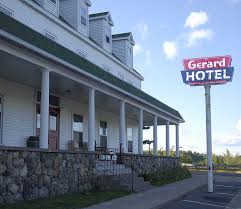
gerard hotel

The setting for much of my second novel, and for the recent short story I posted here called “The Silence,” is the fictional Mayflower Hotel in the fictional northern Wisconsin town of Neil.  While the events I’ve written about are completely made up, the Mayflower Hotel is based upon the very real Gerard Hotel in the town of Ladysmith, Wisconsin.  I lived in an efficiency apartment on the third floor of the Gerard from August 1977 until December of 1978.  I was eighteen years old when I moved in, and had just turned twenty when I moved out.

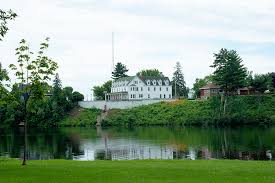
It’s a grand old building, rising high from the tall banks of the Flambeau River, and can be an imposing and eerie sight on mornings when mist rises from the river.

I’m not sure why I’ve been drawn to write about it so much lately, why I’ve set so much of my fiction there.  I have vivid memories of what the place looked like, and how the midday shadows hung in my apartment, and how I’d look out the dormer windows from my bed and see, every night before going to sleep, the red blinking of a radio relay tower on the other side of the river, and how when I opened my eyes in the morning, the same blinking red light would be the first thing I saw.

Last week, on Wednesday morning, while I was up at my cabin, I had to run to Ladysmith for some errands.  I had a little time to kill, so I thought I’d stop by the Gerard Hotel and check it out.  Maybe I could talk to the current manager and have a look around.  I parked in front of the hotel, the same place that thirty seven years ago I’d park my first car, a green 1974 AMC Hornet, and I walked up the steps past the little stonewall and the white columns and once again I stood on the immense front porch, and I put my hand on the doorknob and tried to open the front door.  It was locked, and there was a note taped on the door that tenants were to leave it locked.  I couldn’t remember if we left it locked when I lived there or not, but it made sense, at least in 2014, that they wouldn’t want people wandering in off the streets to bother the residents.  I peeked through the glass of the door, and I was surprised at how small it looked inside.  The lobby was hardly a lobby, the stairs that I always had to climb to get to my apartment were right behind the front door, and the front desk, where the manager sat and where I’d pick up my mail, was only a few feet to the right of the stairway, and was small and cluttered.  I looked to see if anyone was behind the desk, someone who I could ask to let me in, but there was nobody.   I looked inside for a while longer, and I wondered, did the hotel show its age as much when I lived there, or was it the additional thirty five years since then that had taken its toll?  I stepped back and off of the porch, and I could see on the side a hole had rotted out of the porch’s stone foundation.  The exterior looked like it could use a fresh coat of paint.

old gerard

I found this about the Gerard hotel in an article on the web about the history of Ladysmith:

Travelers arriving in Ladysmith by train in the early 1900s were met at the depot by representatives of the various hotels. Patrons looking for the finest hotel in town most certainly would have stayed at The Gerard.
 
When it opened in November of 1901, the Gerard was regarded as “the most modern and complete hotel between Minneapolis and Rhinelander,” according to the “Gates County Journal.” The hotel featured new furnishings and steam heat. Electric lights were added after the Ladysmith Light and Power Co. plant was completed in November of 1902.  
 
The hotel was piped for running water when it was constructed, and it had its own water system before the village had a water works. Aside from these “modern” conveniences and good food, the Gerard offered something no other hotel in town could equal – a beautiful location. Situated on the high bank of the river, the Gerard commanded a breathtaking view of the Flambeau. … 
 
The hotel, itself, is both charming and stately. The white clapboard exterior and third story dormers are characteristic of buildings from the colonial era. The hotel seems more imposing than it actually is because one normally approaches it from the south and sees the long view of the building and its expansive porch. The effect would not be the same if the building could be approached from the front. The Gerard’s most distinguished guest was Thomas Marshall, Vice President of the United States, who stayed there while in Ladysmith to give an Armistice Day speech in 1920. Governors and other notables, including James L. Gates (afterwhom Gates County was named) feasted there.

So the hotel was seventy six years old when I moved in, and now is one hundred and thirteen. I was eighteen in 1977, and now I’m fifty six.  I’m still a pup compared to the Gerard, but like the Gerard, I’ve weathered and rusted, and like the floorboards of her porch, I creak and ache.

I remember the Gerard of the late seventies for its cheap rent and the collection of oddballs and misfits (including me) who lived there.  Among the tenants I remember was a middle aged alcoholic disabled veteran, a recently divorced man in his early thirties, a humanities professor from the small, private liberal arts college that used to call Ladysmith home, and a pretty young girl who’d been thrown out of her family home and disowned by her parents.  I never got to know any of these people very well, just well enough to know their situations, and well enough to germinate seeds in my imagination that I’d use to breathe life into in my fiction writing. Aside from the unique characters the place attracted, it was also old and atmospheric and spooky, and just Gothic enough for me to use it as the setting for stories like “The Silence.”

gerard from the river

So while the place has become fertile ground for my imagination, the truth is that my time there was lonely and unexceptional.  Maybe that’s why I romanticize it so much; nothing much of real interest happened to me there. Maybe I’m trying to recreate that time and make it more substantive than it was.  Maybe I’m creating my own personal mythology.

Maybe it’s because I was young and healthy then, and I’m older and broken now.  Maybe it’s because I look back at those days and long for all of the youth and freedom that I so carelessly burned up.  Maybe it’s because I know that Hotels and people wither and fade.

I’m old enough now that I look back on the days when I was eighteen to twenty with a heavy dose of romanticism.  My past is looking more and more like a bad Bob Seger song.   The truth is, while I was physically stronger and leaner, I didn’t know anything about anything.  There’s a Seger song that contains the line “wish I didn’t know now what I didn’t know then.”  What a load of crap.  I recognize that I was a complete and total idiot at age 18, and if nothing else can be said about the almost forty years since, I am happy to report that I am at least somewhat less ignorant today.

I can fictionalize my memories of the Gerard as much as my imagination will let me. It remains a beautiful, unique and spooky setting for whatever stories I might decide to tell. But I have to remember that, in the words of that great Motown group The Temptations, it’s just my imagination, and not let it run away with me. If I really think about it, and take off the romantic lenses I view the past through, I’m happy where I am, loose floorboards and peeling paint and all.

Collision


(This is the very first piece I shared at the very first meeting of  the Kenosha Writers’  Guild, more than five years ago.)

In August of 1981, Deb and I began our married life together in the upstairs apartment of an unassuming old house on the corner of 18th Avenue and 45th street.   It was in an older neighborhood that thirty five years earlier had been reborn and refreshed with post war optimism.  The tasteful, simple, and practical houses that were built,  the small fenced in green lawns that were carved out and the tiny saplings that were planted  were all symbols of the long awaited peace and prosperity that had been fought for and promised for almost 20 years.  In 1981, when we moved in, many of these houses looked small, worn and outdated, but the love and promise with which they were built somehow endured in the warmth they projected.  The tiny trees that were hand planted in those early post war years had grown to mature and impressive heights, and even as the houses and backyard brick barbecue pits became anachronistic and out of fashion and the middle class money and influence slowly migrated out to the suburbs and subdivisions, those trees now sheltered the neighborhood from complete decay and within their shade locked in the hope and faith from which they were born,  resulting in a charm and dignity that to this day has yet to leave those narrow streets.

It was a great apartment, very small, not a note of pretentiousness to be found.   There was a door off the driveway to the side of the house that hid a stairway that lead to a little screened-in landing room at the top, from which you’d enter through a screen door into the kitchen, with old painted white cabinetry, a gas burning stove, and a small table with three chairs.  In the center of the apartment past the kitchen was a nice living room that had big windows on the south side that let in plenty of daylight, then a room off to the right that was too small for anything but storage, and to the west of the living room, facing the street, a bedroom just big enough for our bed and headboard to fit in, underneath the windows that looked down on 18th Avenue.   The bedroom was lit by a single light bulb in the ceiling with a long string attached to it that came down to the exact midpoint of our bed.   Our bed was a double bed that my wife had brought with her from her basement bedroom in her parents’ house, it was already old and rickety; suffice to say, after those first few months of marriage, it was in an accelerated state of collapse, as a very discernable valley in the middle of the bed emerged.  To this day my wife and I sleep closely together, the whole night our arms wrapped around the other, and while this is indicative of how deeply in love we remain, it is also indicative of learned behavior from those early months.  The fact was that we had worn this valley into the middle of our early marriage bed to the point that if we even tried to sleep on one of the edges, gravity would eventually exert its pull and cause our sleeping bodies to roll to this middle, and we’d wind up pressed against each other anyway.

The house our apartment was in was separated from the corner of 18th Avenue and 45th Street by a small vacant lot butting against 45th street.  On the other side of 45th street and a couple of buildings to the east was a biker bar, the LP Lounge.  On Saturday evenings the sides of the streets would fill up with parked cars and motorcycles, and we’d witness the migration of bikers and their drinking buddies, their wives or their girlfriends, on their way to the mayhem Saturday night at the LP promised.   I remember many Saturday nights Deb and I lying awake in our newly married bed, often times with candles lit on the headboard, laying and listening to the sounds of muffled juke boxes, broken glass,  and, at the completion of closing time, the occasional metallic crash of automobiles colliding with parked cars on the narrow street.  One night such a collision occurred in the front yard of our house, right below our bedroom window.   It all contributed to the wonderful feeling that outside of our little apartment, our home, away from the two of us, the world was an incomprehensible blur of sound and fury; and even when it came loudly crashing in our front yard, just feet away from the thin wall of our fortress, inside that apartment we were safe and secure. As chaotic, random and cold as the outside world was,  inside, wrapped up in each other’s arms,  everything made sense, everything was warm, everything was calm.

Nothing could shatter that calm until one cold February night, about six or seven months after moving in and shortly after we fell off to sleep, when we were awakened by a loud thump as if something heavy had been thrown in the apartment beneath us.   We sat up in bed and promptly heard the sounds of the hard-looking, middle aged woman with the fading red hair who lived below us being beaten by her boyfriend.  There was the unmistakable sound of punches connecting, groans, screams from her, angry yelling from him, undoubtedly the thin, short man with the Navy hair cut and tattoos we had recently noticed hanging around.  This went on for about five minutes, but it seemed like five hours.  Deb and I both sat up in bed, me thinking I should go down there or at least call the cops, but both of us paralyzed by shock and fear.  I am ashamed to confess that I did nothing and when the sounds stopped I felt relieved, not as much for the sake of the woman as I should have, rather, more relieved that I had an excuse for continued inaction.  We tried to go back to sleep but instead we both laid there, awake and silent, for a long time.   Our fortress had been compromised – these were no anonymous drunk bikers loudly and incoherently arguing over crushed fenders in our front yard for our amusement, these were real people, this woman was our neighbor, living and sleeping under the same roof and behind the same walls that shielded Deb and I as we explored the depths of our passion and love for one another.  Violence and pain had now penetrated these walls, and their presence would be felt like ghosts for the remainder of our time in the apartment.

Our relationship with the woman downstairs had consisted of “Hi’s” as we passed on our way in or out.  Deb stopped and talked with her a few times about her hanging plants, and it seems she may have mentioned a distant divorce, but otherwise, we knew nothing about her, and never stopped to think of the silence of the apartment below us.  That night that silence was shattered, and I remember being shocked at how easily we could hear.  It wasn’t until much later that I realized that she could probably hear us just as easily as we heard her, and looking back on it, I wonder if she hated us.  I picture her alone in bed at night in her apartment, listening to the sounds of my wife and I, and wonder if she was reminded of a long ago honeymoon period of her own, and if the sounds and the memories they conjured up only intensified what had to be the bitter despair of loneliness, a loneliness that eventually brought into her life and home the small navy man who beat her.

We’d noticed him hanging around for a few days before, and thought how nice she had someone to spend time with.  Chalk that error in judgment up to ignorance and naiveté.  I don’t recall if we saw the man again after that night.  I do remember that in the days and weeks afterwards, the passing “Hi’s” became quicker and more impersonal, as all parties involved turned their heads away as quickly as possible, resisting at all costs  the shame that eye contact would bring.  We were resisting that shame but we were also resisting the truth that there on the corner of 18th Avenue and 45th Street, two opposite worlds had intersected and collided, and the realization that both the upstairs world of happiness, innocence, promise and love, and the downstairs world of loneliness, despair and pain, were simultaneously as real and unreal as the other, and that only a thin layer of fate and circumstance lie between them.

Strength and Defiance


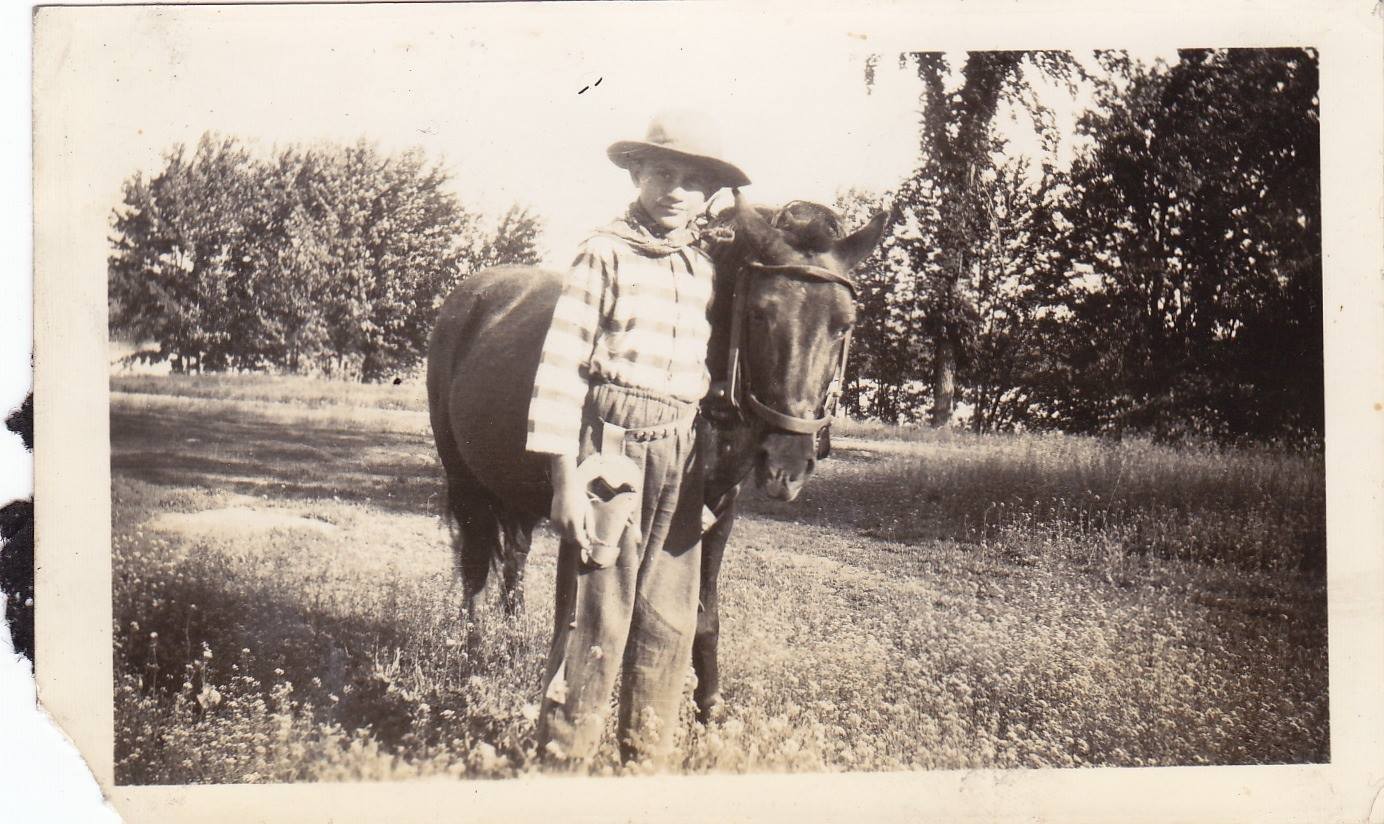
Yesterday was Father’s Day.  My sister posted a photograph of our dad, 10 or 12 years old or so, on Facebook.   My dad was born in 1926, so the photo had to be taken some time in the late thirties.  I haven’t seen many photos of my dad as a child, and I hadn’t seen this one before.

In the photo he’s with his horse and dressed as a cowboy, complete with a hat, kerchief, and a holstered pistol on his belt.  I remember him telling stories about his horse and the time and adventures they spent together.  I recognize where he is standing, in the driveway to the old farm house he grew up in, with the Chippewa River flowing behind him.  And when I look close I can recognize him, my dad, the same slight smile, a hint of sadness coupled with an unshakable and almost defiant  confidence, and the same dark eyes through which he saw a world where wonder and humor always trumped grief and sorrow.

What I know about my father’s childhood is that it wasn’t easy.   At some point, he was seriously ill.  He was the only boy with three sisters, and his relationship with his father was complex and difficult, and he was the victim of physical and psychological abuse.  He also saw his share of tragic and unexpected death close up, death by fire, by motor vehicle accidents, and by drowning.

dad and horse

But my Dad was strong.  That’s what is remarkable and revealing about this photo. Despite the harshness of the reality he was exposed to at so young an age, he was strong and defiant enough to believe in cowboys and horses and adventure, and he was strong enough to emerge from all of this a good and happy and funny man.  He was a great father to his children and a devoted husband to my mom.  The photo shows the same strength and sensitivity that would define him as a man was always there inside him.  It was what made him such a rare and special and unique human being, and it’s what I loved so much about him.

“The Sanded Down Moon in a Tar Paper Sky”


The thing about memories is they’re flat.  They’re like movies playing in our heads, two dimensional projections of moments from our past.

When you leave a part of your life behind, in your mind, that place stays constant and unchanging.  It remains forever as you last experienced it.  In reality we all know that’s not the case and the things we leave behind go on without us and change and evolve.

I left my job as an I.T. Manager in the Renal division of Baxter Healthcare more than three years ago.   When I look back at my days there, or try to imagine what my former co-workers are up to, I always go back to my office in the lowest level of the Renal building in McGaw Park, even though I know that Baxter has completely vacated and moved out of the McGaw Park campus, and the Renal division no longer exists, at least not as a separate entity.  All of that has happened without me, and as my memory recalls a place that no longer exists, so it is that I don’t exist in the world that has taken its place.

Memories of places are memories of people, too.  There are certain people who are part of the foundation of the worlds memories preserve.  Without these people, the place wouldn’t be the place.

Kathy C. was one such person.  She was on the periphery of my work, a member of the Quality Assurance department while I was a manager in I.T.  For thirteen years, her and I worked together, she making sure me and my team had followed all of the requirements and procedures for designing and developing validated systems, me asking her for guidance and interpretation.   Our relationship was often times adversarial and contentious, as she’d catch on to those instances where I tried to take shortcuts in the process, and other times where I’d argue that there was room for interpretation in certain steps, and that overly rigid adherence to the procedures only added unnecessary time and cost to the process.  Eventually, a mutual respect grew and deepened and a friendship developed.  We never completely buried the hatchet, as arguments would still ignite from time to time, but we knew and respected where the other was coming from; we knew each other well enough that we understood what made the other tick.  She learned that I wasn’t just a loose cannon looking to cheat and circumvent, and I learned that there was reason and intelligence behind her outwardly rigid façade.   Above all, we learned that each of us had a sense of humor, and we were able to make each other laugh.

I just found out that about a week ago, she passed away.  I didn’t even know she was sick.  Apparently, she’d been diagnosed with stage four pancreatic cancer in March.  That’s all I know, and I don’t know how accurate even that is.  I just know that she is dead, and that a part of the foundation of my memories of working at Baxter has crumbled.

I wish I had known.  I wish I could have talked to her one last time, that I could have told the story about the time I told her new boss that Kathy was the quality “pro to call” (which is a hysterical joke if you understand the nuts and bolts of developing a validated system) one last time,  and shared one last laugh.  I wish I’d had the opportunity to tell her how much I respected her.

But that’s the case with every death.   We bury the dead and with them all of our unarticulated wishes, all of the things we left unsaid.  And we bury a little piece of those worlds we inhabited together.

As I write this, I’ve got music on.  Lucinda Williams is singing a Randy Crowell song, and the lyric “the sanded down moon in a tar paper sky” echoes in my head.  Maybe that’s all that memories are.  Maybe that’s why they can make us ache like they do.  Time is sanding us down.  The night sky of our memories may as well be made of tar paper, because we can’t feel it, we can’t walk out into it and feel its dew on our bare feet.

All we can do is squint and look out into those misty worlds and find the people and places that were important to us, and if we look hard enough, we’ll see them as they were, and understand why they were important.   And that’s the thing – what was important to us once will be important again.

It’s important that we remember this.


Life, Death, and Jelly-Filled Bismarks


Once again, for the record, I am old.

How old am I?

I’m old enough to remember a world without the internet, without cell phones, without personal computers, without ATMs, without cable or satellite T.V., without e-mail, without Facebook, without microwave ovens.  I’m old enough to remember full service gas stations, locally owned grocery stores, rotary phones, barber shops, and one income families.    School was filled with mimeographed worksheets, film strips, and cartons of chocolate milk.   I’m old enough to remember McDonald’s before the Big Mac, when all you could get was a hamburger or a cheeseburger.  I’m old enough to remember when we got our first color television. I’m old enough to remember watching The Beatles on the Ed Sullivan show.

I grew up in a small town in southeastern Wisconsin, my family having moved there from northwestern Wisconsin when I was three and a half years old, in 1962.  It was a time when most households had one wage earner, and the moms, like my mom, typically stayed at home.  What seems so amazing about it now, looking at the way things are today, is back then blue collar, middle class working men earned enough to provide good lives for their families. There were, on the block surrounding the middle of Yorkville Avenue, three men, including my dad, who drove trucks of one kind or another, and they lived side by side with a school superintendent, the owner of the town’s grocery store, the town dentist and the town doctor, a pharmacist, an airport mechanic, an insurance salesman, and a bookkeeper.  They all lived in modest but comfortable 1960s era ranch homes.

My dad was an over the road driver, a Teamster, driving eighteen wheelers to various places in Ohio and Indiana, driving by night, home and sleeping in his own bed behind shaded windows that blocked out the daylight every other day, days that we’d only see him at the supper table.  On weekends he’d get an extra day, the one day of the week he was able to spend the entire day with us.

How old am I?

I’m old enough that when I was eleven years old, jelly filled bismarks at the local bakery sold for eight cents apiece.  Eight cents.  I can’t think of anything you can get for eight cents these days.   I remember too that a bottle of Coke out of the soda machine outside the gas station downtown cost fifteen cents.  So for a quarter, you could get a delicious jelly filled bismark and a bottle of Coke, which at the time sounded like just about the most perfect meal I could dream of.  Or, if you were returning from the barber shop with fifty cents in change, like I was one early summer Saturday morning when I was eleven, you could stop and buy six jelly filled bismarks, one for every member of my family.

Did I mention that I loved jelly filled bismarks?

We didn’t realize it at the time, but we were living in a Norman Rockwell painting.  We played basketball games in our driveway, football and baseball games in our back yards.   We shot BB guns and played hide and seek and war in the small woods behind the houses on the other side of the street from us.  In the winter we built snow forts and played duck, duck, goose.  On warm summer nights kids from the entire neighborhood would be outside until well after dark, playing kick-the-can, our laughter echoing on the warm night breeze.  We mowed lawns and shoveled snow, we walked to and home from school.  We hunted for sasquatches and ghosts and evidence of UFO landings.  We watched black and white television, mostly westerns and war shows.  We were, within the confines of our small town, isolated and shielded from the outside world, the world we saw on television news reports, the world of assassinations and riots and cities burning and body bags. None of that seemed real, none of that could reach into our little village.

Then death came to town.

I was eight years old and it was summer when a new family moved into the house at the southern end of the other side of the street.  They had two boys, Joey, who was my age, and his younger brother Jerry, two years younger.  We’d just met when they came over to play with me in the sandbox my dad had made. We played for hours under a beautiful blue summer sky, lost in the discovery of new friends and new neighbors.  Then it was time for them to go home and something strange happened, something that to this day has never left me.  We got to the edge of my front yard, and Joey and Jerry, ages eight and six, stopped, held hands, and very slowly and formally looked both ways before crossing Yorkville Avenue to get to their side of the street.  This struck me as very peculiar, as Yorkville Avenue was about as quiet a street as you’ll find, especially during the mid summer week days when all the men were off to work.

I don’t recall who told me, but a few days later I learned that not long before moving to Yorkville Avenue, on the street where they used to live, their older sister had been killed, hit by a car as she ran across the street.  Now it made sense – the two brothers holding hands, looking up and down a quiet empty street, small under the vast and enormous midday sky.  Death was real to Joey and Jerry, and it was suddenly real to me, personified by the empty presence, by the absence, of the sister I had never seen or met.

This was about the time I became so terrified of the concept of death that I tried to avoid saying or even thinking the words “dead” or “death”.   I was old enough to know that everyone dies, that death is inevitable, but now, besides the nightmarish horror stories my brother told me about dead women with rotting flesh existing and occasionally coming back to life in our shared closet, as real and frightening as those stories were they were never as real as the empty space that stood beside the two small brothers holding hands in front of Yorkville Avenue.  That empty space didn’t give me nightmares the way the stories my brother told me did, but it haunted my waking hours, resulting not so much in fear as in the overwhelming weight of sadness the image of the boys represented for me even at that young age, the same sadness I feel when my memory conjures up the image now, over forty years later.

Now, at age fifty five, I’m old enough to know that the real world is never far away. I’ve lived through the death of three family members, including my mom and dad.  Not a day goes by without me thinking about them.  I still don’t understand death, and I never will.  It still terrifies me.

One of the earliest dreams I had that I still remember came to me when I was about six years old.  In my dream, for some reason, I was going to Heaven.   Heaven, it turns out, was a small, fluffy white cloud, with an American flag sticking out of it.  That was it.  I remember waking up and being disappointed that that was all there was.

I was too young to realize that it was just a dream, and that in reality, in my small home town with my family all around me, with nothing to do all day but to run and play and imagine, and with eight cent jelly-filled bismarks and fifteen cent cokes, I was already in Heaven.

Thieves


I watched him through the window, my second son, a little bit more than a year old, on a sunny and mild afternoon in late winter.  He was wearing his blue overcoat and red rubber boots. I was watching as he discovered his shadow for the first time.  He moved from side to side, then lifted his leg up high and brought it back down, his eyes wide with wonder at the darkened shape on the ground that followed his precise movement as he stomped around.  I was careful not to interrupt this moment of discovery, not to let him know I was watching.  It was magic, a stolen moment, and I was the thief, hanging on to it all these years.

I watched out that same window, only a moment later, his six foot five and twenty four year old frame towering over his car in the driveway, as he finished loading the last of his things.  Then the car was backing out and on the road, and he was on his way to the rest of his life.

We Could Be Heroes


(This is a piece I wrote several  years ago, after attending my oldest son’s college graduation – I re-post it in honor of Jon’s birthday)

The first thing I remember writing was a poem to a girl named Anita when I was in second grade.  Anita was morbidly obese.   Immature as I was even for a second grader, however, I never joined in the cruel jokes and insults that too many of the other kids constantly abused her with.   I never made any remarks about her weight, and I was impressed by her ability to ignore and shrug off the meanness.  So it remains a mystery what inspired me to write the following ode and present it to her on a folded up sheet of paper:

                     Anita, Anita
                    I smell your feet-a

Being understandably proud as I was of this little masterpiece, you can imagine my surprise when she burst into tears and showed my note to our teacher, Miss Berg, reinforcing her well established opinion of me as a disruptive good for nothing.  I remember being shocked at Anita’s reaction, thinking she would find my little rhyme humorous.  After all, I made no reference to her weight, and had seen her silently suffer much worse insults from many of the other kids.  Maybe it was the fact that I had found something else to pick on her about, maybe it was the fact that one of the few kids who didn’t make fun of her had now joined the many that did.  Whatever might have been the reason, it was beyond the grasp of my six year old brain.

Despite the critical failure that was my first literary work, it didn’t take long for me to realize that writing was one of the few things I could do reasonably well.  I found out early on that with little effort, I could not only get good grades on writing assignments, but also that more often than not, my papers were chosen to be read aloud.  This was a rare and significant exception to the normal relationships with my teachers, most of whom shared Miss Berg’s opinion of me.  It was an extraordinary boost to my ego to have teachers recognizing me for something other than being immature and disruptive.

The best part was that this praise was earned with such a minimal amount of effort.  I could put off semester long assignments until the night before or the morning of the due date, quickly scribble something down, and get a rare A, with complimentary notes from the teacher penned in the margins.   I knew for certain, just as my Sister was born with a gift for art that I had been granted the gift to write.  In my private dreams, I invested heavily in this gift, seeing it as a vehicle to the fame and fortune I secretly knew I would achieve someday.

This God-given talent plus the fact I hated school and was a bad student convinced me, upon my High School graduation, that college would be a waste of time.   After all, I was gifted – what could college teach me that didn’t already come naturally to me?    No, the obvious direction for me was to leave home, get a job, and write in my spare time.  So it was that I left the suburbs of southeastern Wisconsin and returned to the ancestral home lands of Northwestern Wisconsin where I had been born.  I took a job at Norco Windows in the town of Hawkins, rented an efficiency apartment on the third floor of the historic Gerard Hotel in Ladysmith, and purchased a cheap used typewriter (this was 1977, nearly a decade before the birth of the Personal Computer).  The plan was that during the day I’d work my job and by night write a series of great American novels.

It didn’t take me long to realize two things about my “God-given talent”:  one, my classroom experiences had left me overrating it and two, no matter how much talent one is or isn’t blessed with, writing, when not specifically assigned by a teacher, is damn hard work.  So hard that any satisfaction I expected to experience was quickly stifled by a blank sheet of paper and a ticking clock.

Two and a half years after moving north to become a famous writer, I instead returned to my parents’ home in Union Grove, broke and unemployed.   After finding a job loading delivery trucks, I decided it was time to further my education, and enrolled in night classes.  Knowing now how difficult the work of writing actually was, I put aside any God-given talent inspired dreams and instead focused on something more practical for my major.  Thus it was that I entered the data processing program at Gateway Technical Institute in January of 1980.  The rest, as they say, is history.

The most significant historical event to occur was, early in that first semester, meeting another student, a lovely and sincere girl with long brown hair and green eyes so deep that you could see all the way to her soul.  I was quickly smitten, and, much to my surprise, she found something in my eyes, too, and soon a romance began that is still, over thirty years later, alive and deepening and redefining the world it has created.

That world has included marriage, the purchase and remodeling and adding-onto of a small house in Pleasant Prairie, the birth and raising of three children, and jobs that combined to form a career.   Nearly but not completely forgotten in the busy days and nights of this world was the God-given talent to write and the fading dream of fame and fortune as a published writer.  From time to time this dream would rise from the depths of my subconscious, and I’d entertain it for a while with abortive night time attempts to write one of the great American novels I always knew I had in me, but invariably all attempts would fade under the burden of hard work that writing still presented and the mediocrity of my output.  Part of the problem was the “you write what you know” concept, and my happy but seemingly uneventful and unexceptional suburban existence was all I knew, and struck me as so common and dull that I found nothing to draw from it that anyone would find any interest in.

Then in 2005, I was diagnosed with Parkinson’s.   At some point, it occurred to me that something interesting had finally happened to me, something that maybe I could communicate with my “gift”.  This plus the fact that early on, shortly after my diagnosis, I found myself playing little movies of  many long forgotten events from my past over and over in my head, with no idea why.   I was fascinated and found meaning in them that I hadn’t seen before.  At some point, I started putting these down on paper, and found the process extremely satisfying.

The question was what to do with these writings.  My first thought was to get them down for my family, my children, as a record of my life and my experiences with the disease.  This made sense because eventually, as the disease progresses, my ability to communicate will be impacted, as my verbal and motor skills will continue to deteriorate.

The more I wrote, however, the more the old dreams of fame and fortune returned, and I started to think of publishing my work in a book aimed to help other Parkinson’s patients deal with the disease, especially the early stages of the disease, which I found to be deceptively complex.   So I had these noble reasons to write, to put my experiences down – as a record for my children, as a mechanism for others to better deal with the disease – and there was at least some legitimacy in these goals.  But the truth be told, my intentions were not really this pure.  I found I still wanted the fame and fortune of my life-long writer fantasies.  The dream had never left, and my ego remained hungry.

Meanwhile, I found myself asking the big questions.  Aware as we are of our own mortality, we humans spend a great amount of energy trying to find meaning.   We’ve invented God and religion, and concepts like faith and truth, to help us fill in the blanks of the mysteries of life and death.   The biggest question is why do we die?   Right up there as another biggie is, why do bad things happen to people we love?

At some point, while standing in super market lines, I started noticing familiar looking headlines in the National Enquirer.   The National Enquirer, tabloid that it is, has to be given its due as one of the longest running and most successful publications still in existence.  While newspapers everywhere are folding and struggling with the changing landscape of the Internet, the Enquirer continues to flourish, even occasionally achieving relevance as one of the few effective investigative journalism outlets, breaking stories like the John Edwards and Tiger Woods extramarital affairs long before the mainstream outlets catch wind.   The reason that the Enquirer has been so successful for so long is that it understands its audience, and it understands the stories they love to read.

The familiar looking headlines I noticed had to do with Patrick Swayze and his battle with cancer.  There was a reason these headlines looked so familiar.  One of the stories the Enquirer has been most successful with over the years has been the famous celebrity stricken with a terminal disease.  The story always follows a similar arch – how tragedy strikes when least expected, often times just as the celebrity has finally found some peace in their life, then on to the courageous and inspirational struggle, complete with some short-lived triumphs, followed by the shocking photos of how the once-beautiful icon we all remember has decayed once that struggle goes south, through to the brave final days, followed by death and memorial.  These stories are as sadly predictable as they are inevitably true –whether it’s Patrick Swayze, Christopher Reeve or all the way back to John Wayne.

The reason these stories sell so well is the meaning we derive from them.  It’s the same story that we see played out amongst those we’ve loved and lost.  Whenever someone close to us is sentenced to a prognosis of a terminal or incurable disease, we react the same way the Enquirer acts – we rail against the senselessness of it all and then take inspiration from their “brave” fight or their “positive attitude”.   It’s all a part of our attempts to find some meaning, and to make some sense out of what appears to be evidence of the chaotic randomness and fundamental meanness of existence.  It’s the same reaction to the awareness of our own mortality that drives us to the belief in an afterlife and the creation of personalized images of Heaven.

Then comes the time when this “senseless” and “tragic” fate becomes our own life sentence.  Having seen this story play itself out countless times before, it informs the expectations we have of ourselves, and also the expectations of those around us. It doesn’t take long to realize what a burden these expectations add.  And, if we stop and think about it honestly, we’re surprised to admit how much importance we place on how we are perceived by others.

Our first child, our son Jonathan, was born at about 8:30 on the warm late summer night of September 5th, 1985.  To say he was in no hurry to enter the world would be an understatement.  It took a pair of forceps and 35 hours of labor to bring him out.  But that’s Jon – stubborn and independent to this day, he’s always been his own man, and his entry to the world, like nearly everything that has followed, would be done on his terms, his way

I was, of course, thrilled beyond words when the doctor pronounced, “It’s a boy.”  Deb and I had been married just over four years, having bought our house in Pleasant Prairie the previous November, and we were ready for children, ready to begin raising a family.  We had purchased a modest house in what was still a pretty rural neighborhood, on 2 ½ acres of land that was once part of a large apple orchard.  When we bought the house, there were still 35 mature fruit bearing apple trees on the grounds.  Across the street from us was a large meadow that ended where 37 acres of old growth Oak woods stood.  At night, in the winter, deer would make their way out of the woods and through the meadow to eat the remaining apples that had fallen on the ground in our yard.  One evening, Deb and I counted seven deer feeding in our front yard.  We were convinced this was the right environment for our children to be raised in.

The first night Jon was home with us, we put him in his crib in the bedroom next to ours and watched him fall asleep.  Moments later a severe thunderstorm hit that shook the rafters of the house for hours.  With each crack of lighting and boom of thunder, we were awake and in his room, the two of us, amazed every time to find him still peacefully asleep.

It seemed for the next two years that that would be the only night he slept through.  We had these cheap baby monitor walkie-talkie gizmos, one listening in his room and the other broadcasting in our room.  My ear was trained such that when the slightest sound of static would carry over these airwaves, I’d wake and shoot like a rocket out of bed into Jon’s room, and if he was in fact awake, I’d get a bottle out of the fridge, sit him on my lap in the wooden rocking chair we had put in front of the big window in his room, and rock him to sleep.  This was our nightly ritual for nearly all of the first two years of his life.  I almost always got up before Deb, even the nights when I’d lie awake and wait for either his crying to stop or Deb to get up, whichever came first, until I could stand it no more and got up, at which point Deb would stop pretending and fall back asleep for real.

But I didn’t mind waking up and spending that time with my boy.   I was head over heels in love with him.  There in the soft lamplight of the night in that rocking chair in his room, I’d talk to him in hushed, soothing tones, comforting him and reading to him.  Over the course of several months I actually read to him in its entirety Jack London’s “The Call of the Wild,” knowing full well that he understood little of it but happy to have an excuse to re-read the favorite book of my own childhood.

When the night would get too long and it was time for him and I to both get back to sleep, I’d position the rocking chair so we could see the night sky thru the big window in his room, and I’d point to the bright star in the west and tell him the story of the Jon-star.  The Jon-star, I explained, was the one star out of the millions of stars in the sky that burned brightest for Jon and Jon alone, and no matter when, no matter where in the world he might find himself, if he was ever lost in the night, all he had to do was find that star and say, “Dad”, and no matter where I was, I’d hear him, and know he was lost.  And at that moment, I’d look to the sky, and the Jon-star would also burn brightest for me, and no matter where I was or how far away Jon was, I’d follow that star and I’d find him, and he wouldn’t be lost anymore.

Flash forward to early May of 2010.  Deb and I are boarding an airplane to Minneapolis to attend Jon’s graduation from St. Cloud State University.  It’s the first time I’ve flown since my Deep Brain Stimulator surgery in January.  I show the card saying I have a medically implanted device to security, and, instead of going through the metal detector I am manually pat searched by a guard, who seems to be more embarrassed by the intimacy of the experience than I am, apologizing and saying things like, “I’m now going to pat your backside with the back of my hand.”

We land in Minneapolis, where Jon picks us up.  After stopping for some coffee and checking into our hotel room, he takes us to his new apartment, not far from the airport, not far from where he’ll be working for Mesaba Airlines as a Material Parts Coordinator.  We then go to a nearby furniture store and, as a graduation present, buy him a table and chairs and a couch to help furnish his apartment.  He is excited, as only Deb and I can tell, since he’s never been the most demonstrative kid in the world, to be out of school and starting his life.  As a parent, it is of course a bittersweet moment, as I’m glad he is getting to feel the excitement of starting his career and entering the workforce, and careful not to dampen that excitement with the knowledge that this is it, boy, the start of your working life, and the inevitability of jerk bosses, dead-end jobs and stress and disappointment that await you.  There will be plenty of time for him to learn about those things, though – this moment, this weekend, belongs to him.

Then we are off on the hour long ride north to St. Cloud and the ceremony.  Jon is driving and I’m riding shotgun.   Deb is sitting in the backseat. Halfway there, too late to turn back, I realize I forgot my Parkinson’s medication, taken every four hours, at the Hotel.  It’s already been three hours since my last dose, and in addition to the stuttering, slurred speech that is a side effect of the Deep Brain Stimulator surgery, I start to feel the stiffening and rigidity that is my primary Parkinson’s symptom.  Two thoughts occur to me:  this is going to make sitting through the ceremony an uncomfortable experience, and what does Jon think seeing me move slowly and hearing my impaired speech.  This is only the second time he has seen me since the surgery, and I am sure that he measures the time in terms of how much the old man has gone downhill since the last time he’s seen me.  I sense his patience when, getting in the car, he waits silently for me as I struggle to strap on my seat belt before he heads out of the gas station.

This is his weekend, and he seems to truly enjoy playing tour guide for his Mother and me.   I enjoy his company and hospitality, and am genuinely proud of the man he has grown up to be.  At the same time, inside, my bitterness and anger at this God Damned disease rages like an out of control inferno.  Damn this disease for all it is going to take from me, and Damn it all to Hell for what it has already taken from me and my son.  Damn it for the respect it has taken from his eyes and the sorrow and pity it has replaced it with.

The ceremony takes place in the hockey stadium, and the graduating class is enormous.  Deb and I watch Jon take his diploma from our seats at the bottom of the upper deck, and as the ceremony goes on, and on, we quietly leave and wait outside where we told Jon we’d meet him afterwards, where I can suffer my discomfort in more private surroundings.  As we sit outside in the bright spring afternoon parking lot, I think of those nights rocking Jon to sleep, and I think of the Jon-star, and how Jon has undoubtedly long forgotten that corny story, and I wonder how long before he forgets there ever was a time when he believed he could rely upon his father to find him if he was lost.

The story the Enquirer sells, the story we tell ourselves, about someone’s “brave” and “courageous” battle against the devastating odds of terminal disease is, of course, almost complete bullshit.  The “battle” isn’t really a battle at all, it’s just not giving up, and that’s not heroic, it’s just not cowardice.  The “positive attitude” is also just a weak façade, a public display that could easily be seen through if we had the guts to look.  Behind it is fear and despair, emotions that are much more real than the positive attitude we all try to project.  It’s important that we recognize these for the lies they are, and not punish ourselves too much when we fail to live up to them, for the moments when our self-pity and self absorption overcome us.  After all, these moments are more real than the facade.

But then we are reminded that there are those close to us, whom we love and who love us, and the unique needs they have of us, and us of them.  They need to continue to find comfort and meaning with us, and it is for them and for us that we need to put some kind of face to our suffering.  It is hard, for example, to tell who needs the parent to be a hero more, the child or the parent.

As I sit here, it is 9:45, the night of May 31, 2010, the end of Memorial Day.  Tomorrow I go back to work after the long weekend.  I’ve been sitting here for a good part of the day writing this.  I started out with the hope of determining the real reason I’m writing, whether it’s a continuation of my adolescent dream of fame and fortune as a published writer, whether it’s to leave a record behind for my loved ones, or if it’s to provide help and insight to others similarly afflicted.   In the end, I’m still not sure which it is, or if it’s a combination of them all or none of the above.  Whatever the reason, and whatever the outcome, maybe it’s not so important why I write this all down.  Something keeps driving me to my desk, and maybe that’s all that needs to be understood.

(May 31, 2010)