Fear and Hatred and Profits


(I wrote this in reaction to something I saw posted on Facebook yesterday that said essentially “bad people do bad things, there’s nothing we can do.”   I’ve debated posting it here until I finally said fuck it)

As I walk through
This wicked world
Searching for light in the darkness of insanity.
I ask myself
Is all hope lost?

 Nick Lowe

Friday, December 14, 2012:  The world is unrecognizable.

Maybe those Mayan calendars predicting the end of the world were right after all. When insanity rains over innocence, the structure of the world starts to fall apart, and everything we know to be true and real and important is torn.   The world isn’t the world anymore.   It’s beginning to look more like Hell every day.

No place is safe.  We’ve had shootings in temples, grocery stores, movie theatres and, just in the past few days, shopping malls and elementary schools.  Think about that for a moment – temples and elementary schools.  Places of worship and learning.   Grocery stores and shopping malls.  Centers of sustenance and commerce.   These are elemental components of any civilized society.  They may have been home to violence in other countries, but in the United States?

What’s to be done?  There will be much debate in the coming days.  Do we banish all guns forever?  Or do we arm everybody?  Nobody knows the answer.

Maybe a place to begin is to start recognizing each other as neighbors, as fellow human beings, and start treating each other as such.   What we are seeing is the result of the intense fear and resentment and selfishness that is pounded into us day after day.   How many sick people are out there with serious mental illness going untreated?   How many needless guns are out on the street for people to “protect” themselves from those evil people with different colored skin who are just waiting to hurt them?

The problem is money.   The NRA doesn’t give a rat’s ass about the second amendment or protecting people’s rights.   That’s all a sham – the NRA is manufacturing fear so gun companies can manufacture more guns.   And it’s working spectacularly well.

The same is true of the people looking to cut “entitlements.”  They aren’t concerned about leaving our children with crippling debt.  That’s a sham, too.  They’re working for the health care industry, trying to eliminate Social Security and Medicare so that private companies can take them over.   The result of this will be an even larger number of the already expanding population of people with mental illness falling through the cracks, not getting the treatment they need.

This is a volatile combination that is brewing.   More mentally ill people and more guns on the street.  More fear and divisiveness being stirred up.  More anger and confusion and chaos.   More money being made.   And more rhetoric and resentment.  It’s all festering, right beneath the surface, and it’s spreading like cancer.

It’s ironic that the same people who so fervently go on and on about the rights of the unborn are the ones shrugging their shoulders today, saying “bad people do bad things, there’s nothing you can do.”  Today 20 innocent children were slaughtered.  They were between five and ten years old.   Any society that can’t protect five to ten year old children is a miserable failure.  And I don’t care what anybody says, the right of five to ten year old children to live a fear free life and not be gunned down in cold blood is infinitely more important than the right to hunt deer or to cower to manufactured fear behind the barrel of a handgun.  I’m not saying get rid of guns, I’m saying lets’ bring a little honesty and perspective to the debate.   And these children, who are loved by parents and siblings and grandparents, who’ve just started developing friendships and passions and experiencing joy and wonder, who have so much potential, are more important than those unborn fetuses we hear so much about.  If you want to be pro-life, that’s fine, but be consistent – be pro-life for those who are already living as well as those yet to be born.

We are told to hate welfare recipients because they are cheating us.  We are told to hate immigrants because they will take our jobs.  We are told to hate people with different colored skin because they want to hurt us and take our things.  We are told to hate people with different religious beliefs because they want to blow us up and make us worship their gods.  We are even told to hate people who work for us, teachers and cops and prison guards, because they are getting better benefits than we are.  Then we scratch our heads and wonder, why all the senseless violence?

Are we really that fucking stupid?
Prodigal Son


Someday I’ll come back and they’ll be there again, the rolling fields and the small patches of woods, the corn and hayfields, whispering in the midday breeze under a fat sun in a cloudless sky.  They’ll return, and so will my youth, and I’ll run through the tall grass just because I can.  My lungs will fill with the warm afternoon air I push through, and I’ll run until I collapse in the cool shade of one of those big oaks just south of the railroad tracks. I’ll close my eyes and when I open them I’ll be dizzy from the fresh air in my lungs.   The green of the treetops will swirl with the deep blue of the sky into a kaleidoscope that twirls and spins to the rhythm of my throbbing heart.  After a while I’ll climb up on the tracks and follow them into town, past the empty backyards, the smell of freshly mown grass in my nostrils as I walk past and on to the grain elevator and feed mill.   Then I’ll be downtown, standing on the tracks in the middle of Main Street, looking south at the storefronts.  Everything will be the way it used to be; even the bank will be in that big old granite and marble building.    The Ben Franklin store, the pharmacy, the bakery, the café, the grocery store, they’ll all be how they used to be.

I’ll follow the tracks to the old train depot, and it’ll be open again, like it was when I was small, and I’ll step in and sit in the waiting area, brightly lit through big windows by the afternoon sun, dust dancing in the streams of light.  After a while, in the distance, I’ll hear the rhythmic hum of my train coming, getting closer and louder, then I’ll hear the clanging of the crossing bells on Main Street as it pulls up to  the station.   An unattended door will open and I’ll climb up and board the empty and ancient passenger car.  I’ll take a seat on one of the wooden benches next to a window.   As I sit there, the train will start to move, and I’ll wonder where it’s going to take me.  All I’ll know is that it’s not going to heaven, because heaven will be out my window, fading and vanishing.

Worn in the USA


This is getting bad.

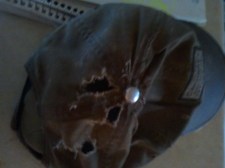
I don’t know when or where I purchased the brown baseball cap, with the words “Carharrtt  manufacturer Detroit-Mich” printed in brown lettering inside a small fading yellowish box bordered by dark brown.    I have no idea what I paid for it.  It’s just a cap, plain and unassuming.  I call it Cappy.

I like plain and unassuming.  I don’t like calling attention to myself.  I typically don’t like wearing clothes that have printing on them, that advertise something, some product or person or philosophy.   I’m not sure why, I have no problem with anyone else wearing anything like that.  I don’t sit and make judgments on anyone’s fashion taste, although I’m sure there are fashion conscious people out there who make judgments on my fashion sense.  Again, I don’t really give a rip, let them judge me all they want.  Odds are they are right.

I dress to be comfortable.  I typically wear blue jeans and a plain colored Champion t-shirt.  The only thing inscribed on the shirts is the Champion logo, which is pretty small.   I like them because they seem to be fairly durable, they are big enough that they are comfortable – they stretch out enough that they don’t hug my middle aged paunch.  I hate the other shirts I have in my drawer that I’ve outgrown that hug my pot belly – I am shallow enough that I’d rather hide that.

I have several plain denim shirts, either blue or brown, that I wear over my Champion t-shirts.  Add in white tube socks and dirty sneakers, and you have a picture of what I wear probably 85% of the days of the year.

I started wearing caps a long time ago, after I started going bald, although being follicly challenged never really bothered me.  The thing about new caps is that they are stiff, and they haven’t had a chance to adapt and conform to the shape of your head.  Then there is the bill, which at first is straight and stiff, and you need to bend it and put a crease in the middle, so it shades your eyes, and makes you look like a mysterious and tough dude.   There is nothing that makes you feel more like a dweeb than wearing a brand new cap, stiff and clean and sitting too high on your head.   There is a required period of breaking in a new cap that you have to put up with in order to eventually get the maximum effect.  Once a cap is broken in, it becomes an extension of your head, and not only is it so comfortable that you forget you are wearing it, others recognize it as a part of you.

Cappy has been my steady companion for the past several years, and we’ve become very close.   There are acquaintances I’ve made who’ve never seen me without Cappy.   He is by far the best cap I’ve ever owned.  And believe me, I’m not one to get overly sentimental about clothing.

A couple of weeks ago, my wife made the comment that Cappy has to go.  I was shocked and stunned.  We’ve been married for over 31 years, but my first impulse was to reply, maybe you have to go.   I added that being jealous of a cap is evidence of insecurity and other serious character flaws.   That may be so, she said, but it doesn’t change the fact that it’s falling apart, it’s rotting.

Cappy

After she left the room, I took Cappy off and took a long look at him.  What I saw shocked me.  There were two small holes worn through the cloth top, and the edges of the bill are frayed.  In the two weeks since, the holes have gotten bigger, and I’ve also become aware of a slightly unpleasant odor.   In short, Cappy is decomposing before my very eyes.

I still wear Cappy but I know his days are numbered.  I don’t like to think about it, we’ve been together so long.   But even caps fade away and die.   At some time I’m going to have to break down and stop wearing him.   I’m thinking of purchasing a glass case where I can stow Cappy and look at him forever more, but that seems a bit weird.  Besides, he never was much to look at – he was meant to be worn.

I suppose someday I’ll buy a new cap, but I don’t like to talk about that while I’m wearing my trusty Cappy.   Cappy, please know, that even after you are gone, there can never be another to replace you, and you’ll always live on, if not on my head, then in my heart.

Veteran’s Day


Veteran’s Day.  We drop a line on Facebook for all our ”friends” to see.   We pay tribute to them as our heroes.  We even write a couple of paragraphs on our web pages, so everyone can see how caring and appreciative we are.  We wave the flag and “support our troops” and congratulate ourselves for our sensitivity and patriotism.  Then we go about the rest of our day, and the next day, and the next, and they are removed from our thoughts, those who fought in Europe and Asia in World War Two, in Korea, in Vietnam, in Iraq, and even those who are still fighting and dying in Afghanistan.

For us civilians, for those of us who never served, Veteran’s Day is just a day, and it makes little difference if we remember it or not.

We watch the news through whatever political lens we view the world, and we listen to the talking heads briefly discuss surges and deadlines and drones and IEDs and which party or politician stands to gain or lose, before they move on to the more “important” issues, like the economy and taxes and contraception and abortion.  To those of us who’ve never experienced it, war is a distant and incomprehensible concept.   I don’t know but I’m guessing that the main thing that we who haven’t fought in a war can’t understand is what it feels like to have people trying to kill you, and what it feels like to be asked to kill other people.   Veterans are the ones for who war is a reality, who survived, the ones who are expected to come home and return to normal, as if nothing ever happened.   It’s easy to identify heroism on the battlefield, the Medal of Honor winners, the courageous acts in extraordinary circumstances.  It’s a little more difficult to recognize heroism in the every day.

This Veteran’s Day I’m thinking of a guy I used to work with who fought in Vietnam.  We worked together for eleven years, and we had a ball.  He is one of the funniest people I’ve ever met, with a wonderful ability to laugh at himself.  He is kind and caring and gentle and unassuming.  He is a good father and husband.  To me, he’s always been a good friend, one of the best.  We worked close enough for a long enough time  that he  shared some of the nightmare he experienced over there, and some of the problems he had adjusting to coming home.   I can’t even begin to imagine.

I’ll never know what it felt like to be over there, and I’ll never know how difficult the burden of those experiences has been to carry all these years.   I just know that he is a kind and decent man and a good friend, and that he’ll always be a hero to me.

Outrage


I’ve made a point not to get political on this site.   This is not a political post.    Those who know me know which way I lean, but that is neither here nor there.   I have no intention of swaying anybody.

I respect our constitutional right to free speech as perhaps the most sacred of our rights.   But sometimes, when that right is exercised in a careless and hurtful manner, I feel compelled to exercise my right to express the outrage I feel.

Near the local post office today, a couple set up a table with some literature and some signs facing traffic. The signs were of the anti-Obama variety.  There is nothing wrong with this.  These people are actively engaged in the political process.   They have every right to denounce the president, whether on his handling of the economy, foreign policy, or social issues.   They even have the right, despite all evidence to the contrary, to believe he wasn’t born in the United States, or that he is a Muslim.

It was one of the signs that sparked my outrage.  The sign said that if elected, Obama would start World War Three.   Again, I have no problem with anyone believing that.  What I do have a problem with is that the sign included a photo of Obama, with a Hitler moustache painted on.  This is what set me off.

A reminder of who Hitler was.   He exterminated more than six million jews, and he started a war that killed over 60 million people, or 2.5% of the world population.  More than 416,000 American troops were killed in World War II.

You may disagree with Obama’s policies and his beliefs, but it is careless and lazy to compare him to one of the biggest monsters the world has ever known, and one of our country’s most despised enemies.  Above all, it is disrespectful, not only to Obama and the office of the presidency, but also to all those who died at Hitler’s command, to the generation that sacrificed so much, sacrifices that have allowed subsequent generations to survive and prosper.   Such a comparison trivializes the horrors of the holocaust and the heroism of those who fought so hard and gave up so much to defeat evil at its most powerful.

I understand that in a tightly contested race, emotions run high on both side.  Rhetoric is used carelessly by all sides.   Exaggeration and hyperbole are symptoms of passion.   In the past, I have let emotions get the best of me, and made outrageous statements.  So I don’t intend to come across as holier than thou.

I know it is only a moustache painted on a sign, and the intent may have been satirical or ironic, but I’m, sorry, it doesn’t come across that way.  Not to me.  For me, this crosses a line, a line that is painted in the blood of innocent victims and heroes who deserve more than to be trivialized to make a cheap political point.

Home Team


My house stands on a dead end street on land that was once part of a large farm.  In the late 1940s, a chunk of the farm was divided into two and a half acre parcels and sold off.  One of the parcels, just south of the original farm house, part of an enormous apple orchard, was purchased by a young married couple.   He was an electrician, and in 1948 they built a small home, no bigger than a one bedroom cottage, less than 700 square feet, and started a family.

They quickly outgrew the original structure and added on three bedrooms, converting the cottage to a 1,200 square foot ranch.   They also added an attached single car garage, and later, an additional unattached two car garage.  They had three children.   The handprints of each family member along with their names and the date are still visible in the hardened cement of the unattached garage’s floor.

They lived in the house for 36 years, raised their children and finished their careers.   Ready for retirement, they sold the house in 1984 and moved to Arizona.  On Saturday, November 3rd, 1984, my wife and I moved in to the house.

We’d been married for three years.  Having lived through the inflation of the late 70s and the recession of the early 80s, buying a home of our own was a dream we never expected to come true.  But it did, and the house was perfect for us, it fit us like a glove.   I remember that first night, I slept so sound.  It immediately felt like home.

Soon we started a family, our first son born in 1985, our second in 1989, and our daughter in 1994.  When our first son started kindergarten, he was the only child waiting at the bus stop where the dead end street began.   The rest of the street was occupied by older people who had already raised their children.   We were the young couple.  Soon, they began moving out, and gradually more and more young families moved in, and more and more kids would show up at the bus stop.

In 1996, we decided we’d outgrown the house, too, and built an addition of our own, a second floor, essentially doubling our living space.  The street had changed, as more and more of the 2 ½ acre parcels were split up and additional homes were added.

Then, as our kids grew and started college, the number of kids at the bus stop started to dwindle.  Soon a subsequent generation of kids started to show up at the corner.   We were no longer the young couple on the street.  Now, 28 years after moving in, we are one of the oldest couples.

It was 64 years ago that the original structure was built.  Only two families have lived here in all that time.  I look at the date the hand prints in the cement of the second garage were made.  Without revealing the year, it was October 8th, exactly two days before my wife was born in a naval hospital in Norfolk, Virginia.  So my garage is essentially the same age as my wife.  What that means I’m not sure, and I’ll resist the temptation to remark how well built both are.

But I know this much:  I’m an excellent builder.   Right now, those who know me well, who have witnessed my ridiculously limited carpentry skills, are laughing hysterically.   But it takes more than a hammer and nails to build things like a marriage, a family, a home, and a lifetime.  It takes work and love and commitment, and, more than anything, to do it right, it takes a partner, a soul mate, someone who is willing to stand beside you in the rain and snow and the heat and cold.  The world my wife and I built has been strong enough to weather the storms of time, and our love remains unchanged by the corrosive forces of fate and circumstance.

Empty Nest


They call the process of a woman giving birth “labor.”  If that’s the case, my wife, at 36 hours spent in the old St. Catherine’s hospital, put in almost a full week’s worth in giving birth to our first child, Jon, born on September 5, 1985.  I think it was threat of overtime that finally motivated the doctor to grab a set of forceps and pull the boy out.

That was 27 years ago.  Until this past Monday, when we returned home from dropping our youngest child, our daughter Hannah, off at college, that marked the last time my wife and I were the only two residents of our house in Pleasant Prairie, Wisconsin.  Much has changed in that time, including the house, which we added a 2nd level to in 1996, effectively doubling its living space, as well as cultural and technological advances that will include me dropping a “Happy Birthday” message to Jon on Facebook. 

This past weekend, at our cabin in northern Wisconsin, was one of the increasingly rare times when all five of us were together as a family.   We hosted a cook out, and Jon drove over from his home in Minneapolis, and Nick and Hannah drove up from Eau Claire.   We had a great time, laughing and sharing memories of our time together.  At some point, as always happens when we are together, I looked at the three of them and felt the same combination of pride and sorrow and gratitude.   I am grateful that the fates smiled upon us to give us such healthy and vibrant and beautiful children.  I am proud of the people they have turned out to be:  strong, independent, smart and caring. 

It’s the sorrow I have trouble with.  I am left with such wonderful memories of each of them; of Jon sitting on my lap as I mowed our grass with our lawn tractor, of the winter’s day that I watched Nick, maybe two years old, through the window as he discovered his shadow, or the mornings I would bring Hannah her breakfast, pretending to be her loyal servant, announcing “Your breakfast is serrrrrrrrrrrrved.”   These memories have always brought me great joy; the pangs of sorrow that now accompany them seem somehow incongruent.

I think what brings me sorrow, what I am mourning, is that time goes by so quickly that when you are living it, it’s impossible to truly appreciate how wonderful life is.  When my children were small, they were with us every day, and every day some magic, some small miracle, unfolded right before our eyes.  But our eyes, as eyes too often are, were distracted, were filled with bills to pay and work and other trivial matters that seemed so important at the time but have since been long forgotten. 

It’s only years later, when our children become adults and the old house becomes an empty nest, that we realize what we missed in our preoccupation, and just how remarkable those times were. 

But then I look at my wife, and after 31 years of marriage she is still as beautiful to me as she ever was, and I love her more than I ever have, and I realize, even in these days of empty bedrooms and silent hallways, that is pretty remarkable, too.

Dream Sequence


We were born to dream, with galaxies in our eyes, the broad and endless universe confined within.

Long before we met, we were in love, and we dreamed we’d find each other.  That was the first dream to come true.

Then we tied our hearts and souls together until they became so intertwined and tangled up that the beginning of one was indistinguishable from the end of the other.   Stronger than two ever were, we dreamed as one, dreams fueled by our love.

We were married, young and broke, the times hard and bleak.  We dreamed that I’d finish my classes and get a good job.  

We dreamed we’d buy a house with a couple of acres in the country.

We dreamed of having children.

We dreamed of our children growing up happy and healthy.      

We dreamed of growing old together.

As each dream was realized, the knots we’d tied ourselves into have strengthened and our love has deepened.    We’re not kids anymore, and we’ve been around the block.  We know how to dream.  We know that we have plenty of dreams left.  And we know how to make them come true.  Long after our time here is done, we’ll still be together, still dreaming. 

No matter how unlikely the odds have been, and no matter how many of our dreams come true, one thing remains  – you’ve been the dream that all the other dreams have been based upon.  You’ll always be my dream, and even though you came true years ago, I still dream of you, and every morning when I wake up next to you, my deepest and most profound dream has been realized.

Cathedrals


This morning, a Sunday, I went and gave blood at a small church and school in Beach Park, Illinois.  I wasn’t familiar with the location.  As I pulled in, the parking lot was full of activity.  I saw the blood center van parked next to the one of the wings of the building.  There was a group of people walking in a doorway just past the van; I followed them only to find I had entered the church.  I asked an older man wearing black with a white collar where the blood drive was, he very patiently pointed me to a door on the far side of the chapel.  It was only after absorbing his directions that I realized he was the pastor, standing in the doorway to greet his congregation.  Suffice to say, I’m not a regular church-goer, and it’s been a long time since I’ve been in a house of worship.  I’m wondering, in hind sight, if I should have removed the baseball cap I was wearing.

Following the pastor’s directions, I found my way to the doorway he’d described, which was in the attached school, and upon opening it, I entered another sacred and holy room that I hadn’t been in for years.  I found myself in a school gymnasium, not the huge high school gymnasiums that double as auditoriums, but rather, the small and humble and traditional elementary school gymnasium.  I’ve always loved these places and have fond memories of them, from my own childhood to the times coaching my son’s basketball teams.

It was all recognizable, the folded up three rows of wooden bleachers, the boundary lines and free throw lines and the lanes of the basketball courts marked out on the floor, the rims and nets and backboards, and the darkened scoreboard high on the wall.  I remembered the stale but somehow not unpleasant smell of sweat that hangs in the inadequately ventilated air during a game or a scrimmage.  I could hear the holy sounds that haunt every gymnasium, the echo of a bouncing basketball, the swish when a shot hits nothing but net, and that most sacred sound of all, the sound of stopping and starting tennis shoes squeaking on the floor.

To some, it probably says a lot that a gymnasium has more meaning to me than a chapel.  I would agree, but I think I might draw a different conclusion.  For me, basketball courts and gymnasiums, along with baseball diamonds and backyard football fields, were great places to learn important rules and truths.  I learned about teamwork and sportsmanship (good and bad) and pushing yourself beyond your limitations. I learned about love, the love of the games, and the importance of community, for without other players, there was no way to express that love.  I learned about faith, faith that if thrown to, I could catch that pass, or the faith that an open teammate could make the winning shot.

Most important, they gave me a reason and a place to run and jump and release my pent up energies.  Now, with my physical capabilities in rapid decline, I understand their real value, and that these places provided more nourishment to my soul than sitting in a pew listening to incomprehensible sermons ever could.

Father and Son


People often comment how much my 23 year old son is like me.  He (unfortunately for him) not only shares many of my physical traits, but also my sense of humor, just as I shared my Dad’s sense of humor.

Today, on the way home from a short family vacation, while discussing our political views of the world, it became obvious that we have another trait in common:  the ability to take facts and figures and logic and generalize and overstate and argue a conclusion that is 100% wrong.  Without getting into specifics, he turned my own rants and raves against me and took the finger I was pointing at various institutions and pointed it right back at me.  The criticism hurt, because:

1)       I recognized it was coming from my own overstating the impending disaster I see headed towards my children’s generation (most of which is caused by the colossal failures of my generation)

2)      There was an element of truth in the hypocrisy he was accusing me of.

3)      I recognized the same unshakeable self assurance in his flawed reasoning that I have been too guilty of over the years.

It’s the last one that hurt the most.  I immediately thought of counter arguments that would shoot down the holes in his logic, but, recognizing my own voice in his, I knew he would have none of it, and he’d only dig in and argue his views more vehemently, and there’d be no convincing him, even when there was no other conclusion, he would never admit that he was wrong.   I know this because I heard my voice in his, and I knew this is what I would do.

I’ve been told too many times by too many people that they’ve given up arguing with me, because I never lose.   I have a nasty habit of twisting facts and figures and opposing viewpoints around until they support whatever B.S.  I am selling.     

My wife and I always tried to teach our children to think for themselves, and I’m proud that each of my three children have minds of their own.  What frightened me today wasn’t that my that my son held an opinion different than my own, it’s that he was just as cock sure of his flawed logic and reasoning as I have been too many times over the years.

I could have pointed out the flaws in his logic.  I could have argued with him until we were both blue in our faces.  Instead, I just got quiet.  I did bring it up much later, and got in some gentle jabs, and I kind of regret doing that.   It really didn’t accomplish anything.

I want him to feel passionately about things.  I want him to be able to defend what he feels and believes.  It’s just that I don’t know how to teach him to hold on to these passions and when to stick to his guns and when to give it up, to let go, to admit defeat. 

I have to admit, I really don’t know.  I am 53 years old, and he is only 23.

That means he has another 30 years to admit he doesn’t know something.