Time After Time


OK, I know it’s not very manly of me to admit this, and some may say it points to a certain lack of sophistication, but I am a Cyndi Lauper fan, especially the song “Time After Time.”   I think that it is simply one of the best songs written in the last 30 years, and even though it has been covered by a variety of other artists, I still like Lauper’s version the best.

The thing that has me thinking about “Time After Time” tonight is that today, my wife and I attended my daughter Hannah’s graduation from high school.  Hannah is the youngest of our three children, following her brothers, Jon and Nick, who graduated in 2004 and 2007.   So as emotionally charged such an event is anyways, when it’s your youngest, when it’s the last time, it’s even more bittersweet.

“Sometimes you’ll picture me …”

Hannah posted a photo of herself in her pre-school graduation gown on Facebook this morning.  It was perfect because it is such a good photo and sums up what a wonderful little girl she was (and is).   The thing is, that picture was taken in 1999, which the calendar says is thirteen years ago.  I know that in my mind, it was taken only yesterday, and it frightens me how fast time really moves.

I have so many images running around in my head tonight, like when I tucked her in on September 11, 2001, after the World Trade Centers fell, when she said to me, “Leave a light on tonight.  That way if something happens, they’ll know there was a little girl in here.”

Or, after learning about fire safety in kindergarten, her obsessive fear of things suddenly combusting into flames, resulting in my realization some five uneventful minutes after putting slices of bread in it that the toaster had been once again unplugged.  “Do you have any idea how many house fires start from toasters?” she’d lecture if I dared to complain.

There was the vacation to Kentucky when she was almost four years old, when we were on our way to see the house where Abraham Lincoln was born.  “How much longer,” she asked, “until we get to thinkin’ Lincoln?”

When she was little, she had more energy than anything my wife and I had ever seen.  “Hurricane Hannah” we called her.  From the moment she woke up in the morning, there’d be only one speed, overdrive, and she’d speed and collide and crash her way through the day.  And then, suddenly, like a switch had been turned off, she’d be asleep.  It always amazed Deb and I.  There were times when she’d be talking and she’d stop in mid sentence and not finish.  We’d turn around and look and, whether it was in her car seat in the back of the car or the sofa in the living room or a chair at the dinner table, she’d be out, sound asleep, and I’d carry her up to her bed and she wouldn’t wake up until the next morning when the hurricane would strike again.

There were the driving tests I took her for, and there was the first time she drove by herself, to the corner store, my eyes nervously fixed on the driveway until her return.

There were the nights she was out with friends, and the phone calls she always made to her mom and I, telling us where she was, asking if she could stay out an extra half hour and, surprisingly, not complaining if we said no.   If we told her she had to be home by ten o’clock, she was home by ten o’clock.

She was always headstrong and stubborn.  She was never afraid to argue with her parents, particularly her mother.  She could be manipulative and a master at melodramatically changing the point and shifting the blame if she was ever caught doing something wrong.  But even when she’d get right in our faces and tell us how wrong we were about whatever, she somehow always remained respectful.   She knew which buttons to push, but she also knew which lines not to cross.

Suitcase of memories”

There are so many moments of inspired nuttiness that we have shared over the years.  Like the time we were Christmas shopping in the Casio store at the old, original outlet Mall.  She couldn’t have been more than four years old.  Standing beside me, Hannah had discovered the electronic drum machine when she said, “Daddy, tell a joke.”

“I just flew in from California,” I said, “and boy, are my arms tired.”

No sooner had I delivered the punch line, Hannah produced a perfectly timed rim shot.

Then there was the time a couple of weeks ago.   I was home, working late in my office, when she wordlessly appeared in my doorway, her face white from a new moisturizing crème, and proceeded to do mime routines including being stuck in a glass cage and walking against the wind.    When she mimed casting a fishing line in my direction, I knew enough to mime getting hooked, and let her reel me in.

There are the bad puns she forwards to me all the time, the random text messages she sends, including vivid photos of whatever grisly animal they were dissecting in biology class.  Whatever, nothing ever consistently brightens my day as much as these isolated moments of silliness.   That we share the same sense of humor is a small part of it, that she was thinking of me if for only a moment in her busy day is the bigger part.

If you’re lost you can look and you will find me / time after time / if you fall I will catch you I’ll be waiting / time after time

When a father’s little girl grows up, and when he looks at his reflection in the mirror, or at that photograph of himself bald headed and potbellied standing beside her in her graduation gown, he can’t help but wonder if she needs him anymore.  Especially when she has turned into such a strong and smart and good person as my Hannah has.  But if she ever does, if she’s ever lost or if she ever falls, I will be there for her, and she’ll find me.  Time after time.

Rejected But Not Dejected


Rejection – you never really get used to it, no matter how often you have to deal with it.  I’ve been lucky enough to be married to the same woman now for over 30 years.  And although I was very young at the time, my single years were not pretty.  In the process of trying to get young women to notice me, I struck out more frequently than Sammy Sosa with runners in scoring position.  Fortunately, I developed a pretty thick skin.

Lately I’ve been submitting some pieces of fiction to various literary journals, all with the same result.  Rejection.   I’m beginning to understand why alcoholism is so prevalent among writers.  It’s the same reason that a single male drinks – the conventional wisdom is that it is to get his courage up to approach that girl he’d never approach sober – the real reason is that only when he’s drunk can he deal with the rejection that he knows is inevitable.

I’ve submitted enough stuff now to appropriately lower my expectations.   I’m certainly not surprised when I receive the e-mail thanking me for but rejecting my submission.  But I’d be lying if I said it didn’t hurt, at least a little bit.  The thing about writing is, it is intensely personal, and to have somebody, not just anybody, but somebody who makes their living judging these things, tell you that your work isn’t good enough, it can’t help but sting.

The people who are doing the rejection, the editors of the publication, understand this, and they try their best to ease the sting, to soften the blow.  They are also tremendously overworked, reviewing ridiculous numbers of submissions for every one they accept, so they have no choice but to be formulaic in their responses.  It’s gotten so that when I see a note in my in-box from someone I’ve submitted to, I know essentially what it says before I open it.   I often think back to my bachelor days and imagine, what if the women who spurned me had used the same language in their rejection of me?  It might sound something like this:

“While I appreciate the offer to go back to your place, after careful consideration, I feel that your piece isn’t right for me.”

“I considered your request for my phone number very carefully, and have decided to pass.  I really did like your style, though, and hope you’ll ask me again in the future.”

“Thank you for the invitation to dinner.  I appreciate the offer but after careful consideration will have to decline.  This one was really close, David, but you didn’t quite grab me the way I hoped, but your style and voice are clearly top notch.  I hope you consider asking me again in the future.”

These are variations on actual rejection letters I’ve received from various literary journals over the past couple of months.  Compared to the “get lost, creep” I normally received from the fairer sex, I’m not sure which is worse.

So then the defense mechanisms, the rationalizations, begin.  “Oh, they don’t know what they’re talking about,” “[insert famous author here] submitted [insert famous work here][insert large number here] times before he was accepted ,” or  “I’m not that big of a fan of that publication anyway.”  This works for a little while until you accept the truth:  you are not [insert famous author here] and your work is not [insert famous work here].  Eventually, you come to the realization that maybe, just maybe, the editor reviewing your work was right!  The work wasn’t good enough.  I don’t know why this should come as such an epiphany – after all, they are professionals who do this for a living, who are trying to put out the best publication they can – and you are the amateur.  It’s shocking to think that they might be right and you might be wrong.

You come to accept these facts, and that fame and fortune and that NPR interview aren’t going to happen, at least not yet, and you get down for a little bit.  But then something hits you, an idea, an experience, whatever, and you just have to write about it, and you do, and you read it, and you think, hey, this isn’t bad, and then you think, this is actually kind of good.  And you start the whole process over again, only this time, what you’ve written is better than what you wrote before, because you’ve kept at it, you’ve learned, you’ve honed your craft just a little bit, and the cycle repeats until one day, if you’ve gotten good enough and you’re lucky enough and all the stars are aligned perfectly at the exact perfect time, it’s not a rejection that shows up in your e-mail, it’s something else.

I can only imagine what that might be, of course, because I haven’t seen it yet.

But imagination is a key attribute of a writer.   And hey, at least I’ve got that going for me.

Roy and Eric and I


It was 1983, and I was working nights as a computer operator for a Credit Union in Racine.  It was the end of the month, and I had to run the jobs that created the monthly statements and babysit the printer.  It was essentially several hours of sitting around alone making sure nothing failed or broke and that we had enough paper in the printer.

I’d been married for two years, and was going to school in the days.   The big economic recovery of the 1980s was still a year away and the country was still in the throes of a great recession, with both interest and unemployment rates in the double digits.   My wife and I were both working part time jobs, the only jobs we could find, scratching out a living.   The outlook seemed grim.

The night was moving at a snail’s pace.   I’d brought a book with me but didn’t feel like reading.  At 1:00 A.M. , I was sitting alone in my boss’s office with his old clock radio tuned in to an oldies station, tired and bored, feeling depressed and defeated, when, from out of the radio, came a strange little voice singing:

                                Dum dum dum dumdy- do ah
                                Whoa, yeah, yeah, yeah-yaa
                                Oh, whoa, whoa, whoa-oow, ah-ah
                                Only the lonely.  Only the lonely.
 

I’d just started thinking, what is this crap, when the music stopped, and another voice, pure and clean and strong, cut through the cheap radio speaker and sang:

                                Only the lonely
                                Know the way I feel tonight
                                Only the lonely
                                Know this feeling ain’t right
 

It was, of course, the great Roy Orbison.  At the time, I didn’t know that, I didn’t know anything about Roy Orbison.  Whoever it was, I was amazed at how good that voice sounded through the tinny speaker of the clock radio.  More than that, I was stunned at how perfectly and eloquently that voice and those simple lyrics expressed exactly what I was feeling at that precise moment, and as I looked around, the building didn’t seem quite as empty and the night didn’t seem as dark.  I was still alone, but no longer by myself.  Someone else knew the way I was feeling, and that that feeling ain’t right. 

A few minutes later, the radio played the old Eric Burdon and the Animals Song “It’s My Life”, with the opening lyrics:

                                It’s a hard world to get a break in
                                All the good things have been taken


I was familiar with this one, and I’d always admired the lyrics, but they really resonated, they really spoke to me that night.  It was as if Roy Orbison and Eric Burdon had been in my head, and were playing back what they’d heard me thinking.   I suspect that for a brief time, the clock radio was tuned to a frequency that only I could hear, and that Roy and Eric were speaking directly to me.

That was nearly thirty years ago, but those songs and that clock radio remain stamped in my memory.   This is, I think, what art is all about.  It’s about reflection and recognition.   When art, in whatever form, connects with us, it’s an intensely personal experience.  It holds a mirror up to our soul, and enables us to see our shared humanity, our common experience, our joy and pain, our love and despair, and beauty and truth.   Most importantly, it lets us know that we are not alone.

When we connect with art, we connect with the artist, and a relationship is made. That night Roy and Eric picked me up when I was down, and though we’ve never met, we’ve  remained good friends ever since.


Still Drivel After All of One Year


If we mark the birth of this site as the date and time of the first posting, then at 22:37:55 on May 5th, “Drivel by Dave” will officially be one year old.

How best to commemorate this momentous event?  My first thought was to go Hollywood and hold a glamorous award show.  I bought some red carpet and a stunning, low cut gown (not unlike the one Angelina Jolie wore at the Oscars this year) designed by Armani (or by an Armenian, the label was faded).  I spread the carpet down my driveway, put the evening gown on, and no sooner had I started my stroll through the paparazzi that the Police showed up.  They had received two calls, one from one of my unenlightened neighbors who called to complain that there was a bald headed man in the street wearing an evening gown, and one from an Armenian who called to complain that there was a bald headed man in the street wearing an evening gown that he had designed.

Here are some of the vital statistics from my first year:

77 posts

4,223 page views

47 different countries

389 views on my busiest day (February 26, 2012)

The 5 Most Viewed Posts:

1.  “Bring on Your Wrecking Ball”  (Springsteen fans are scary – I thought I was a fanatic!)

2.   “Clint Eastwood and the Mythology of the American West”  (This one keeps being googled by what appears to be students writing term papers – if they are citing my essay, I would sure hate to see what kind of grades they get!)

3.  “The Mathematics of Loss”  (A tribute to how well liked my Dad was, and how many lives he touched)

4.  “Parkinson’s and Grief vs Self Pity”  (I hope this was helpful in some way to some people)

5.  “It Was Thirty Years Ago Today”  (Probably people who know my wife and are still wondering, all these years later,  just what in the Hell does she see in him?)

I’ve posted 77 pieces in 52 weeks, or an average of about 1.5 per week.  If you’re into quantity, you might think that is a pretty impressive pace.  If you are into quality, then that pace may explain a lot.  The subject matter has varied, the amount of effort put into the posts has been inconsistent.  My goals remain the same:  for the reader, not to waste too much of the your time and maybe even entertain you a little bit, for me, to keep me writing and to help me continue learning and polishing craft.   I think I did pretty good in following my rules of 1) avoiding politics and 2) being as honest as I can.

All told, after a year of doing this, I think I have a little bit better idea of who I am (and who I am not)

I’d be interested in whatever comments anybody might have, likes or dislikes, things I might want to do differently, plastic surgery I may want to consider, whatever comes to mind.

Now, drum roll please, the moment you’ve all been waiting for:  The first annual Drivvies, where I pick my favorite posting in each category.  I’d be interested in what you, all three of my dedicated readers, have to say:

Favorite Fiction – “That Would Be Nice”

This is probably the weakest category, and paradoxically, the one I am currently spending almost all of my time in (after several starts and stops, I’m hard at work on a novel these days).  I still have a tremendous amount to learn about fiction writing, and feel that I am just now really learning how to tell a story.  The fiction I’ve posted so far is weak on story development (among other things) – a perfect example being “That Would Be Nice”, which is really a character sketch and not so much a “story.”  As such, it’s probably a little bit better and more efficiently written than the other postings in this category.

Favorite General Essays – “Vulture”

This is another weak category, and I lumped a whole lot of crap into it.  I am going to pick “Vulture” because I think it is pretty tight and honest.

Favorite Humor – “My New Year’s Resolutions for 2012”

If only because number 3 (“Learn the proper way to fold a map of the cities Portland and Eugene and their surrounding areas (also known as the art of “Oregoni”)”) and numbers 17 (“Remember to always go the extra mile”)  and 18 (“(Related to #17) Always carry a GPS with me, so I can find my way back after going the extra mile”) for some reason still make me laugh

Favorite Memoir – “The Mathematics of Loss”

Some of my best writing has been about my Dad, because he was such a wonderful man, and I always loved him so.  I still can’t believe that the day he died, I went home and wrote this one.   There isn’t a day that goes by that I don’t think of him.

Favorite Parkinson’s Disease essay – “Parkinson’s and Grief vs. Self Pity”

It was between this one and “Heaven and Hell.”  I chose this one because I think it pretty accurately sums up my experiences in the early phases of the disease, when the emotional and psychological aspects of knowing there is something wrong with you are more prevalent than any physical challenge.

Favorite Review – “My Favorite Movie”

Much of what I put in this category aren’t really reviews, but just lists of things that have had an effect on me.   “My Favorite Movie” is probably as close to a real review as I’ve posted, so it gets my vote.

The DBD Lifetime Achievement Award for Most Dedicated Devotee to Drivel: 

Who else but my Aunt, Phyllis Mae Stevenson, the retired school teacher who I can always depend upon for a comment, and who has been unwavering in her support.   All the more impressive when take into consideration the fact that I have always been her least favorite nephew.


Kids These Days


Last night, my wife and I attended Choral Fest, the annual concert given by all the student choirs in the Kenosha Unified School District.  Each choir performed separately, and there were several numbers where the combined choirs, under the direction of a guest conductor, joined and sang as one combined choir.  It was, as it has been every year I’ve attended, an impressive and stirring concert.  There’s something incredibly beautiful about the sound of human voices singing live.

My wife and I were there to watch our daughter, a senior in high school, perform as a part of her school choir.   My daughter is the youngest of our three children, and it occurred to me, as the concert went on, that we are nearly done, my wife and I, that we are rapidly approaching the end of a long line of events we’ve been attending for the past twenty four years or so.  From preschool Christmas programs to youth sports leagues to award ceremonies to graduations, we’ve sat in auditoriums or sidelines more times than I can count.   Soon that will be over, and we won’t have to suffer through crowded amphitheatres and uncomfortable bleacher seating and the inconvenience of the inevitability of the event falling on the same evening something else was planned.

One constant that I’ve heard adults complain about over the years, starting with my parents, is “kids these days.”   I’ve been guilty of using this phrase myself.   Amongst the crimes “kids these days” have been accused of over the years are:

–  Having no respect

–   Not understanding the value of a dollar

–   Being lazy

These have always been, of course, legitimate complaints.   Kids have always disrespected their elders, they’ve never understood the true value of a dollar, and, if not pushed, have always been lazy.  These are and have always been among the fringe benefits of being a kid and things like respect and a work ethic are things that have to be learned.  The part that the complaints get wrong is the “these days” part, as if these are sudden attributes that have only become evident with the latest generation.

As I watched the concert last night, it occurred to me that kids these days are really no different than kids ever were.  Sure, they may be better at video games and understand technology better, and they might not have to work as hard as kids say, 100 years ago, but these are environmental and cultural shifts.  At their core, where it matters, they are the same as they ever were.   They are still kids.  Scanning the assembled choirs last night, I noticed that they still come in all sizes and shapes, they still, when it’s not their turn to sing, have trouble sitting still, and they still have best friends that they whisper things to that make them laugh.  I recognized, in some of the boys, the same longing glances at pretty girls that they have secret crushes on that I used to hope nobody noticed, and I remembered the mysterious combination of fears and dreams the world was when I was in 9th grade.  It was easy to spot kids who were popular and kids who were not, kids mature beyond their years and kids who were struggling to contain their immaturity.  These are the things that have always made being a kid both wonderful and painful, both simple and complex.   These are the things that kids need parents for.

As my wife and I drove home from the concert, I thought about all of this, and I thought, our time is over.  There will continue to be school concerts, softball and basketball games, graduation ceremonies, but we won’t be part of them.  Kids will still be kids, and parents will still be parents, but whatever role my wife and I played in this cycle is just about complete, and at some point our children will become parents, and it will be their time.

This morning, I ran to the grocery store to pick up a few items, when I ran into the mother of one of the children I used to coach in recreation league softball.   It was the first time I had seen her in years.   Her husband, who used to occasionally help me out with coaching duties, died unexpectedly a few years ago.    Their son Jimmy was one of my all time favorite kids, sweet and funny, a good player, always respectful and courteous and well mannered, always with a beaming smile on his face.  When I talked to her in the super market aisle this morning, I expressed my condolences about the loss of her husband, and asked her how long it had been.   She said it was in 2006, nearly six years already, and I couldn’t believe it had been that long.  I asked how Jimmy was doing, and she said great, although she wished he could find a job.   She then asked me about my son, and I replied he’s doing well in college, that he is in his second senior year, to which she replied, he always was such a smart boy, and I said, just like a Father, if he was so damned smart he’d be out of school by now.

We said goodbye, and I continued on to the check-out and then drove home, thinking about her and her son and her late husband.   He was such a good guy, and his wife and son are such good people.    I can’t comprehend the depths of their loss, and I can’t comprehend what it would mean to be taken so soon.

Then I thought about the conclusion I had come to after the concert last night that our time is over, and I realized how wrong I was.   My wife and I will always be parents to our children; it’s just that the role changes, that’s all.   Children will always be children, and parents will always be parents, and if nothing else, as we go on, my job will be to make sure that this is understood.

Valentine Dream


I am lost and alone in the grey dark, the wind blowing cold and hard.  The woods are deep and endless and unrecognizable.  Naked trees twist and turn.   Dead leaves cover the worn path.    The whole world is icy and frozen, and I can’t find my way home.

My doubts and fears walk beside me.  I can hear their voices.  I am weak, they say, I am a weak and pathetic fake.  I am not who I say I am.  I am a failure and a fraud.

But then in the impenetrable blackness I feel you against me, breathing in my arms.  I cannot see you, it is too dark, but my arms remember, they remember the soft smooth warmth of your skin, my fingers remember tracing your lips, my chest remembers the way your back fits against it like interlocking pieces in a jigsaw puzzle that rise and fall together to the rhythm of your sleeping breaths.  And the icy dream world dissolves and the voices go silent, because they know, whatever else I might or might not be, I am yours, and nothing else makes any sense or matters.

Him and Her


(My thanks to Robin Rhodes, who hosted a wonderful workshop in tonight’s Kenosha Writer’s Guild meeting that gave me the prompt for the following little tidbit)

Even when we’re not lost, she wants to get the frigging map out.   Have I ever gotten us lost?  We’ve been married for over thirty years; you’d think she’d understand by now that my internal compass is pretty damned good.

He never stops to ask for directions, and he gets pissed off when I get the map out.  He always tells me that in over thirty years, he’s never gotten us lost, and that’s true.  But how can I tell him that he’s slipping, he’s not as sharp as he used to be?  Just the other day, he couldn’t remember Zach’s name, and all those years he was over here with Nick, all those years he coached their softball and basketball teams, it’s not like him to forget anything, let alone a name like that.

I try to be patient with her.   I know she’s been through a lot.  But come on – a map?  When we’re still on the interstate?   What is she afraid of?  What’s the worst that can happen?  We take a wrong turn?   We end up in a bad neighborhood?   We’re a couple of minutes late?   That didn’t seem to bother her when she had to have her coffee this morning.  I always try to tell her, leave room for contingency, it’s better to get there a few minutes early than late.  But nothing can break up her morning routine.   The world might be on fire, but it’ll have to wait until she’s had her morning coffee.

He’s so damn fragile.   I get tired of having to tiptoe around his feelings all the time.  I know that he’s in a rough spot.  He doesn’t want to admit he’s deteriorating.    He tries to hide it.  But I see it all the time.  Usually I don’t say anything, but it’s there.  It’s in the way he walks, the way he’s always crashing into walls and the look on his face when he hopes nobody notices.   It’s in his voice, and in the times I have to ask him to repeat himself.   It’s in the stuttering, the stammering, it’s in the soft and unintelligible syllables.

She knows how I hate being late.

We’ve been together for over thirty years now.   He still makes me laugh.   It hurts me to see what is happening to him.   But he is still a good man.  I still believe in him.  

Sometimes I suspect she is writing me off.  Like when I say something and it comes out garbled, and she’ll nod her head as if she heard me, as if she could understand me, because she gets tired of asking me to repeat myself.  And most of the time, when I get the nod, I’ll silently accept it, even though as a response a nod has no connection with what I was trying to say, and I’ll just let it go, because I know how frustrated she gets having to ask me to repeat myself.

We’ve built a world together, and it’s comfortable, it’s home. 

I guess it’s inevitable that she would look for signs of my decline.  Hell, I look for them, too.  But I think she’s looking a little bit too close.    If I trip over the shoes our daughter left in the middle of the living room, in her mind, I’ve lost my balance, and she accepts it as further evidence of my slide.

He can’t ask directions, he gets pissed off when I get the map out, because he doesn’t want to admit that he’s lost.  And he doesn’t want to admit he’s lost because he’s never been lost before, and he’s afraid of what that means, of what else he might have to admit.  But we’re all going downhill – after all, he is 53 years old. 

I look at her, and I see the same eyes, the same face that I’ve known, that I’ve loved, for more than 30 years now.   I look in the mirror and I see a bald guy with a big gut staring back.  But that bald guy in the mirror is still me, and I still have the same internal compass that all those years ago led me to her.

I don’t want to dwell on things.  He knows that no matter how bad things get, I’ll always be by his side.  I shouldn’t have to tell him this – the past thirty years speak for themselves.  

I guess when you get right down to it, the truth is, the real reason we haven’t gotten lost in all these years is that we’ve navigated the road together.   When we started out, neither one of us had any idea where this journey would take us.   But here we are, after all the twists and turns, the bumps and detours, still riding together, and as we coast down the darkening highways to our uncharted destination, if she thinks a map will help, who am I to question?

Snow Day


It had started snowing late the night before, and it continued through the Saturday morning, ending just about noon.   All told we got about three inches of the stuff.   I was 23 years old, and we were living in the upstairs apartment on 18th Avenue at the time, and we had nothing to do and nowhere to go for the rest of the weekend.

Shortly after noon, after it stopped snowing, I put on the old army fatigue jacket that Jack Anderson had given me about three years earlier, a stocking cap, a pair of gloves and my rubber boots.  On the back landing, just outside of the entrance to our apartment, I grabbed the little metal snow shovel and began clearing off the steps of the stairway.   It was cold but not too cold, probably in the low twenties.  It felt warmer when the clouds moved out and were replaced by the bright January sun.  The snow was light and powdery, and I felt good as I moved to the bottom of the steps.

Next, I cleared the little gravel driveway we shared with the woman who rented the downstairs apartment.  Once I had finished that, I started on the sidewalk in front of the house.  Compared to the rutted gravel of the driveway, the sidewalk was a breeze, and I was able to quickly get to the end of the property line.  The house the apartment was in bordered a vacant lot that was the corner of 18th Avenue and 45th street.   I had been outside only a few minutes and had cleared the back steps, the driveway and the sidewalk in front of our house.  I felt good and had nothing else to do, so I figured, what the Hell, I may as well keep going.

I cleared the sidewalk to 45th street, then, heading east, I cleared the 45th  street side of the corner lot.  When that was done, I found myself in front of another old, two story house, with sidewalks and a driveway hadn’t been cleared yet.  I felt good, and I didn’t want to stop, so I kept going, and started on the sidewalk in front of the house.  About halfway thru, the front door opened.  An old, frail man I had never seen before  stood in the doorway.

“Thank you”, he said.

“Don’t mention it”, I replied.

“Would you mind doing my driveway, too?”

“Sure, no problem”, I said, quickly surveying the short, cement two care driveway.  With the snow this powdery and light, I figured I could knock it off in a few minutes.

“Thank you so much”, he said, and went back inside.

I quickly finished the sidewalk in front of his house, and it didn’t take me long to do his driveway.  Every now and then I’d glance to the window, and each time he was standing there, stooped over, watching me

I finished the driveway and turned my attention to the short cement walkway that ran from the sidewalk to his front porch.  I made quick work of it and just as I was finishing up, the front door opened again. My guess was that he was going to offer me a few bucks for my work.

“Thank you again,” he said.  “When you finish up, why don’t you come inside for a few minutes”

I nodded my head and he closed the door.  It was only a couple of more minutes when I finished.  Standing on the steps to the front door, I was just about to knock when it opened.

“Come on in, come on in.”  I stepped in, and he took my coat and I took off my boots.  He motioned for me to sit in a chair in his living room. Then he went to the kitchen.  He came back with two glasses filled with a golden brown liquid. 

“Cold out there, huh?”, he said, handing me a glass.

“Not too bad”, I said.

“Well, drink some of this, this’ll warm you up.”  He sat in a chair across from me.  It was warm and very good.  I was able to recognize it as brandy. 

We sat there in the warmth of his living room, surrounded by framed photos of what I assumed to be children and grand children and great grand children.  The room looked like it belonged to a bygone era.  We talked about the cold, we talked about his health – there was something wrong with his lungs that made breathing cold air difficult – but mostly he talked about brandy and how whatever kind it was that we were drinking was top of the line stuff.  When the first glass was finished, he bought me a second glass, this one of a different, more famous make of brandy, and he explained to me why the second one was inferior to the first.  I didn’t know anything about any of that; I just knew they were both warm and good. 

We sat and drank brandy and talked for about a half an hour.  After I had finished the second glass, he offered me a third, which I politely declined, saying if I drank any more I might not be able to find my way around the corner to home.  I got up and put my boots and coat on, and as he thanked me again, I took one last look at his living room.  It was so warm and comfortable.  There has always been something sacred, something even holy, about people’s living rooms, especially the ones belonging to strangers who invite you in.

It was about 3:00 when I left and started back for home, feeling a little bit of a buzz from the brandy and a contented ache in my bones from the work and the cold air.  The sun was still out but lowering in the west.  I grabbed my shovel and walked back home.  I was 23 years old, and the future lay out before me like an undisturbed coat of fresh snow on an endless city sidewalk, waiting to be uncovered.

Parkinson’s and Grief vs. Self Pity


“Grief is a process where nothing remains the same, even the big stuff, and none of it, sadly, fits back inside that old, comfortable box.”   – Peg Rousar-Thompson

 A few years ago, fearing that I may be suffering from the depression that is common with Parkinson’s disease, I went to a therapist for a brief time.   This was about the same time I had started to write, as a way to fill the hours I suddenly found myself awake for in the middle of the night.  After a few sessions, the therapist and I agreed that I wasn’t depressed.  If anything, I may have been suffering a slight case of anxiety, and by writing I was probably already engaged in the most effective therapy.

Our time together was extremely helpful anyway, if only for a very revealing exchange early in the first session.  I was trying to explain what I was going thru, when I said “I don’t want to sound like I’m feeling sorry for myself, but …”

She stopped me in mid-sentence.  “Why don’t you want to feel sorry for yourself?”

I stuttered and stammered, when she said, “Why wouldn’t you feel sorry for yourself?  You’ve got Parkinson’s disease.”

I was stunned.   It’s not that I hadn’t felt sorry for myself before; I had, plenty of times.   After all, I was only in my mid 40s when I received my sentence, my diagnosis.  It’s just that it hadn’t occurred to me it was okay to feel sorry for myself.   I think this was when I started to understand the difference between grief and self-pity.

They say then that one of the first things people go through after being diagnosed with Parkinson’s is a period of grieving, or mourning.  I think this is common for the diagnosis of any chronic disease.  Suddenly you are flawed, and the image you held of your future self is dead.  With a sentence of Parkinson’s comes the awareness that things are going to be different now, and that the days still left will be days of diminishment and loss.  It’s only natural to grieve for these losses.

There are also the expectations of how one is supposed to behave under these circumstances.  To understand these, one only needs to stand in the line at the supermarket and read the headlines of the National Enquirer.

One of the stories the Enquirer has been most successful with over the years has been the famous celebrity stricken with a terminal disease.  The story always follows a similar arch – how tragedy strikes when least expected, often times just as the celebrity has finally found some peace in their life, then on to the courageous and inspirational struggle, complete with some short-lived triumphs, followed by the shocking photos of how the once-beautiful icon we all remember has decayed once that struggle goes south, through to the brave final days, followed by death and memorial.  These stories are as sadly predictable as they are inevitably true –whether it’s Patrick Swayze, Christopher Reeve or all the way back to John Wayne.

The reason these stories sell so well is the meaning we derive from them.  It’s the same story that we see played out amongst those we’ve loved and lost.  Whenever someone close to us is sentenced to a prognosis of a terminal or incurable disease, we react the same way the Enquirer acts – we rail against the senselessness of it all and then take inspiration from their “brave” fight or their “positive attitude”.   It’s all a part of our attempts to find some meaning, to make some sense out of what appears to be evidence of the chaotic randomness and fundamental meanness of existence.  It’s the same reaction to the awareness of our own mortality that drives us to the belief in an afterlife and the creation of personalized images of Heaven.

Then comes the time when this “senseless” and “tragic” fate becomes our own life sentence.  Having seen this story play itself out countless times before, it informs the expectations we have of ourselves, and also the expectations of those around us. It doesn’t take long to realize what a burden these expectations add.  And, if we stop and think about it honestly, we’re surprised to admit how much importance we place on how we are perceived by others.

In the first days after being diagnosed, I promised myself I’d approach my newly defined fate with courage and dignity, resist the urge to ask myself “why me”, maintain a good attitude, and make the best of my remaining good time.  This sounds great, but in reality, I was a wreck, completely overwhelmed by and obsessed with my condition.  I anguished and brooded over the appearance of every slight symptom, such as the subtle and constant presence of a small amount of saliva inside my right cheek, attaching levels of importance to them that now seem laughable.   But the zenith of my self-absorption was reached when I realized how impatient I had become to having to listen to the seemingly insignificant problems of friends and co-workers.  As I half listened to them, I found myself thinking so you’re going through a divorce – it could be worse, you could have Parkinson’s – so you have advanced Rheumatoid Arthritis – at least you don’t have Parkinson’s like me.  I finally listened objectively to myself and realized what a pathetic self pitying ass I had become.  First, it was so early in my diagnosis that the disease was little more than a minor annoyance, and second, I realized that just because of my so-called personal “tragedy” that the rest of the world didn’t stop, and there were still real people out there with real problems, living real lives.  This may sound painfully obvious, but it came to me as a major epiphany, and jolted me at least partially out of my dark clouds of self-absorption.  Unfortunately, I landed in the even darker and more dangerous clouds of denial. 

This denial was manifested in my approach to work.  I found myself in charge of a large project that wasn’t going well, and, in fact, needed to be halted and re-evaluated.  But I was going to be damned if I let that happen, and, despite having an hour long commute at the time, I was the first of my team in the office in the morning and the last to leave at night.  I invested so much of my time and energy that when things didn’t go well, which they most frequently didn’t, I’d find myself awake at 2:00 AM on my laptop working until 4:00 A.M.   This was at the same time I was early in my diagnosis and my neurologist was attempting to determine the right mix of medications. The primary drug in the early stages is any one of a variety of dopamine agonists, drugs that are intended to trick the brain’s dopamine receptors into thinking they are still receiving signals even though Parkinson’s has destroyed the transmission.  These drugs can have significant side effects, and only through trial and error can the right dosage of the right medication be determined.  Chief among the many potential side effects of dopamine agonists are sudden and frequent attacks of daytime drowsiness, and feelings of dizziness and nausea.  I remember on several occasions, shortly after taking my morning dosage of Mirapex, the first dopamine agonist subscribed for me, shutting the door to my office and putting my head down on my desk and closing my eyes, waiting for the room to stop spinning.   This plus the daytime drowsiness that was already evident by short nights of sleep and an hour long commute made for a bad time to be in denial.  

Then came the inevitable moment that the project, despite my best efforts, reached what in hindsight was the only logical conclusion it could have reached:  it was cancelled.  My reaction was devastation and depression, and, after a couple of weeks when I was finally able to put some distance between the project and myself, I realized was about more than just the project’s cancellation.  I realized that all the work, all the stress, all the obsessive attention I paid to it were ways of not thinking about Parkinson’s, and I realized that not only was I in danger of working myself to an exhaustion that had no possible good ending, I was also spending months of valuable time obsessing over something I had no control of – as a means of not obsessing over something else I had no control over, that being Parkinson’s.

So if self pity was turning me into an unfeeling and insensitive ass, and denial was threatening to kill me, some kind of balance needed to be reached.  This is where the therapist helped me, and when I think I started to understand the difference between self pity and grief.

Grief, I think, is a natural and healthy response to loss.  It is the questioning of how and why, and even when the answers that come may not be satisfying, maybe aren’t what we want to hear, it is a necessary component of finding the truths buried within our losses.

Pain is a byproduct of loss, and self pity is a natural response to temporarily dull the anguish it causes.   But wallowing too long in self pity is to treat the symptom but not the disease.

When I started writing, I understood none of this.  I was just trying to find my way through the darkness of those sleep deprived nights.  I still don’t understand much about pain and loss and grief and self pity except, I think, that each are naturally occurring phenomenon and need to be dealt with.  I now understand that writing was and is, for better or worse, my way of dealing with these things, and, it turns out, of dealing with just about everything else.  I now find myself compelled to write, usually without understanding why or what the Hell I am trying to accomplish.

Writing has at least provided me with a mechanism for framing some of the questions – whether I eventually stumble upon any answers remains to be seen.  I make no claims about the quality of my writing and have no illusions about uncovering any profound truths – heck, half the time I am challenged to put even one coherent sentence together – all I know is that, for now, at least, this is what I do.

List O Mania: Movies of the 1950s


The 1950s were a conflicted and confused time in our history.  Having vanquished evil at its most powerful in World War II, the United States emerged as the world’s greatest military and economic super power.    While most of the world was rebuilding, we were flourishing, producing goods for the world and fueling the long awaited post depression prosperity that for the better part of 20 years had been longed for.  Great value was placed on the “modern” material conveniences that we couldn’t afford in the depression and war years.

We may have been experiencing peace and prosperity, but underneath it all was the uneasiness of the cold war and living in the atomic age.   Mass culture at the time emphasized conformity and blandness, and was supported by the paranoia evidenced by the McCarthy hearings and the term, “un-American.” (which , if you really think about it, is in itself just about the most “un-American” term).  The threats of communism and the cold war resonated with the public, who had grown up in times of sacrifice and belt tightening, and naturally felt uneasy with the new found prosperity.  The result was a mass culture that comforted and reassured people, with music by the likes of Perry Como and Mitch Miller being popular.

The emphasis on blandness and conformity, of course, lead to rebellion in nearly all of the arts.  It’s no accident that rock and roll, which has always had at its core themes of rebellion and sex, became immensely popular.  In literature, Jack Kerouac and Allan Ginsberg and William Burroughs were leading the “beat generation” to places American literature hadn’t gone before, while novelists like Norman Mailer and James Jones were churning out gritty and authentic accounts of their experiences in World War Two and its aftermath.  In theatre, playwrights like Tennessee Williams and Arthur Miller were producing their greatest works, and the Lee Strasberg Actor’s Studio revolutionized the art of stage and film acting.

Hollywood, still under strict control of the production code, was especially impacted by McCarthyism, with Joe McCarthy’s famous list of supposed communist sympathizers leading to the House Un American Activities Commission subpoenas and black-listings.   As a result, the output from Hollywood was more cautious and conservative than ever before, and more bland and boring.   Hollywood instead focused on technological advances such as Cinema Scope and VistaVIsion and advances in Technicolor as reasons to put people in the seats.  Big budget Bible pictures (The Ten Commandments, Ben Hur, The Robe) with their casts of thousands and wide panoramas were presented as showcases for these new technologies, and they were politically safe.  The western remained the most popular genre.

New fears  about the atomic bomb and threats from the cold war lead to an abundance of bad, low-budget science fiction films – these films were cheaply and quickly made and prayed upon the public’s fears of radiation, with mutant monsters like The Blob and The Thing and The Creature of the Black Lagoon becoming immensely popular.   A few of them, like Invasion of the Body Snatchers, tapped into the underlying paranoia of the times.

Rock and roll fueled teenage rebellion, which fueled fears of gangs of teenagers run amok, which fueled a new teenage rebellion sub-genre, with films like The Wild One (with a great Marlon Brando performance)and The Blackboard Jungle scaring the snot out of parents everywhere.  There were also attempts to sympathetically portray the teenage rebel as a misunderstood victim of the stagnating culture, such as Nicholas Ray’s expressionistic Rebel Without  a Cause, with the great James Dean, in which the adults were portrayed as so physically and morally weak that they were worthy only of contempt.

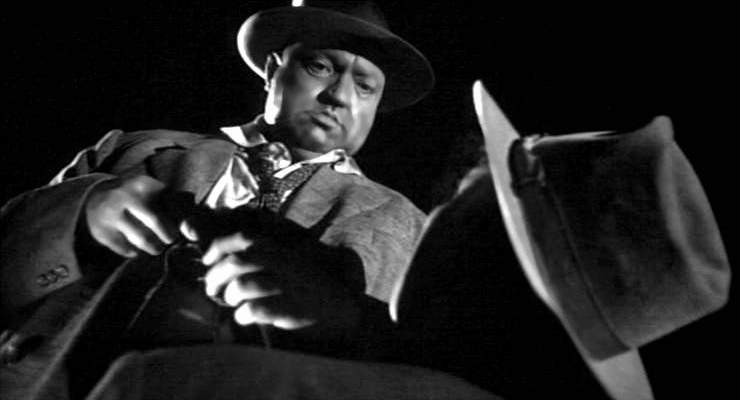
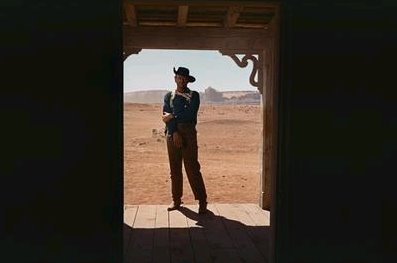
As the 50s went on, it seemed that popular culture was about to pass Hollywood by.   Things were moving fast in music and literature, and Hollywood, bogged down by the production code, its investments in technology, the studio system and its inherent conservatism, seemed unable to keep up with the times and often times came across as anachronistic.  Where rock and roll, for example, was dealing directly and bluntly with sexuality, Hollywood was forced to use the same euphemistic language it had been using for the past thirty years.  Even the greatest of Hollywood’s directors had to play these games – for example, Orson Welles could only get the brilliant Touch of Evil made by agreeing to cast Charlton Heston (!) in the lead role of a Hispanic detective.  John Ford’s western masterpiece The Searchers attempts to deal with serious issues of racism and frontier justice, yet he is only able to imply and insinuate many of the specifics.  Alfred Hitchcock made some of his most personal films dealing with his own confused sexuality (Rear Window and Vertigo), but had to rely upon heavy handed symbols to represent his own obsessions.

It’s no accident then that some of the best movies of the decade were made overseas.  While Hollywood was struggling to keep up, European cinema was experiencing a renaissance, with Bergman and Fellini at the peak of their powers, and the French new wave auteur movement introducing such giants as Godard and Truffaut.

Here then is my list of favorite films of the 1950s:

14.  Invasion of the Body Snatchers (1956), directed by Don Siegel

13.   Bad Day at Black Rock (1955),  J. Sturges

12.  Shane (1953), Stevens

11.  Night of the Hunter (1955), Laughton

10.  Sunset Boulevard (1950), Wilder

9.  Touch of Evil (1958), Welles

8.  Vertigo (1958), Hitchcock

7.   An Outcast of the Islands (1952), Reed

6.  The Quiet Man (1951), Ford

5.  The 400 Blows (1959), Truffaut

4.  The Searchers (1956), Ford

3.  A Streetcar Named Desire (1951), Kazan

2.  The Seventh Seal  (1957), Bergman

1.  La Strada (1954), Fellini