See the Lights


If they’d listen to me, I’d tell them all to lighten up.  Up close, things are never as clear as they are far away.  The things we tangle ourselves into knots about are almost always not important, at least not as important as we convince ourselves they are.

What is important is the people we are thrown together with via genetics or random chance.  We are shadows and light, “stardust” as Joni Mitchell put it, and our time together is limited.  This is so painfully obvious, yet it isn’t real to us until we are separated.

A few months after I left work, I went out to lunch with a former co-worker.  Afterwards I decided to drop by the office and see what everybody was up to. Big mistake. Most of the desks I stopped by were empty, their occupants off to meetings, and the few who were at their desks were tied up in phone calls.  Of course they were, I’d already forgotten how crazy hectic work was.  I walked past a windowed meeting room and there in a meeting were a number of my former co-workers.  They motioned me in, I stopped and exchanged a couple minutes of small talk, but that was all, as they had important work to do, work that no longer included me.  I left the meeting room and then the building, and as I got in my car and pulled out of the parking lot, I realized for the first time that my departure was permanent.  It hurt.  I actually felt it in the pit of my stomach.  The work I had, for better or worse, thrown myself into for the previous thirteen years, had no place for me anymore.  I also began to understand that the relationships I’d formed and treasured with my co-workers were almost all framed by the shared experience of work, and that my departure had severed those connections.

There were several reasons why I left when I did, all having to do with my instance of Parkinson’s disease, and all valid.  There were the tremors that intensified with stress, the micrographia (illegibly small handwriting), the incoherent speech, the stiffness and rigidity of my wearing off periods when I could barely move, and the episodes of falling asleep, in my office usually in the late morning, and almost every evening while driving home.  Waking up behind the wheel and across the center line, in the glare of oncoming headlights, was a terrifying but all too frequent occurrence.  I remain convinced that it was the right time to leave.

Needing something to do, I decided to take a whack at a long put off dream, and started writing.  I threw myself into it, and now, two and a half years later, I’ve finished a first novel (still trying to get it published) and am about halfway through a second.  Although I’ve made a number of new friends in the writer’s group I joined, it’s still largely a solitary existence, especially compared to the high energy, high stress corporate world I was part of before.   I love writing and I think I’m getting better at it.  I approach it with all the passion and energy I can muster.  I thank the heavens that I have something I love so much, because if I didn’t, there’d be nothing to deflect the pain and loss of losing my job, my career, and the emptiness would be all consuming.

Work gives us a sense of purpose, a sense that we and what we do matter.  These things are often illusory, or at least exaggerated.  What is the most real are the relationships we form with our co-workers, dear friends or bitter enemies, accomplices or obstacles, the people we spend more of our waking time with than anyone. It’s only when these relationships are lost that we realize how precious and fragile they were.  I never imagined I’d lose them this quickly, or how much their loss hurts.

A long time ago, at a different job, I had a boss explain to me that working is like sticking your arm into a bucket of water.   Whey you leave, you pull your arm out.  The water ripples for a few seconds, but soon is smooth and calm, all evidence of you having ever been there vanished.  And that’s the way it has to be, he said, because there is too much at stake, too much is dependent upon the simple fact that time and life go on.

But memories endure.  I pull them out from time to time and watch them shine.
Indian Summer


(This is a short piece of fiction I wrote today – it’s pretty rough and not very good, but what the Hell …)

For two weeks, all anybody would talk about was the weather. It was mid October and unseasonably sunny and warm, into the seventies almost every day. The courtyard of Silver Creek Care Center was shaded by the ancient and immense sugar maple that rose from its center. In the early afternoon sunlight, its leaves were a brilliant gold and falling, a thin layer already covering the red brick walkway that lead to the front door.

Dad was holding a little album Dean had put together with photos from last year’s trip. In them we were sitting at the picnic table, cluttered with bottles of Makers Mark and Crown Royal and Rolling Rock and plastic red cups. We were all wearing jackets and sweatshirts. It was gray and damp and cold. If October this year felt more like September, last year it felt like November. Dad was wearing his hokey blue fishing cap, beaming in every snapshot, proud and happy to be with his sons. I was surprised by how much younger he looked only a year ago. You wouldn’t think there’d be that much difference between seventy seven and seventy eight, but it was striking. His face still had good color and he looked strong and substantial under his black windbreaker. It was quite a contrast to the ashen gray his complexion had turned since, and now there were lines around his eyes and the corners of his mouth that weren’t evident in the photos.

Looking out the window I could see Dennis pull in to the parking lot and park his red Ford F150. I watched as he and Dean got out and approached the entrance. I motioned to Dad, and he watched them, too, my older brothers, in their fifties now but still looking fit and strong. They were talking in the early afternoon sunlight, and Dennis laughed at something Dean said, and Dean was grinning, the same laughs and grins that had always come so easy and natural to us.

We’d been doing the October trip to the cabin by the lake for the past twenty five years, just dad and his three sons, just like Fred MacMurray on that old television show. In those twenty five years, we’d evolved from a middle aged man and his young adult boys to an elderly fellow and his three middle aged sons. We hadn’t felt the changes, at least, not before this year. Dad always seemed as vital as ever, and as the three of us navigated the fifty years old meridian, we all felt the same as we ever had. None of us had ever missed a single year. Aside from dad slowing down a little bit, our regime remained the same. For three days we’d drink and fish and play poker, and then we’d help dad close the cabin for the winter. We’d leave Thursday night after we got off work and kissed our wives goodbye, and get to the cabin around 11:00. We’d start a fire in the wood stove and play cards and drink until five in the morning, when we’d finally hit our bunks for a couple of hours of shut eye. Late Friday morning we’d take dad’s boat out on the lake and fish for the last time of the season, stopping around 2:00 in the afternoon at Leon’s Lakeshore Lodge for drinks and a hamburger, then we’d hit it again and come in right before dark. We’d fry the fish we caught over an open fire and eat. Then we’d walk down to Leon’s again and drink ourselves stupid. The last few years dad stayed in, and the three of us would get shitfaced and come back drunk at one in the morning and wake dad up and we’d play cards again until about three, regaling him with stories from the bar. One year, our brains poisoned by alcohol and Leon’s juke box, the three of us came in singing the song “Elvira” by the Oak Ridge Boys at the top of our lungs. I’ve been told, though I don’t remember, that we were continuing a performance we’d began an hour earlier at the bar. I’ve also been told that that our voices didn’t meld together nearly as well as we thought they did.

Saturday was always spent all day at the cabin, recovering from Friday night, playing cards, drinking, and cooking out. Saturday night we’d stay in and play more cards and drink. Dennis would find the radio station from the Indian reservation that played folk and old, old, country music, from dad’s time, Hank Williams and Jim Reeves and Marty Robbins. We’d have a fire going in the stove and we’d sit there, the four of us, playing cards and shooting the shit, making up for the rest of the year, when we were too preoccupied with our wives and children and our careers to spend much time with each other.

Sunday morning we’d wake up, clean up the cabin, wash dishes, take out the garbage, shut the water off and drain and winterize the pipes. Then we’d be in dad’s car, always dad’s car, a big Buick most of the years. The past couple of years, after mom died, dad was driving a little Ford Explorer. We’d split up the five to six hour drive home, dropping Dennis off first in West Allis, then Dean in Racine, and finally me in Kenosha. Dad lived in Kenosha, too, in the house he raised us in, only about ten minutes from me.

We’d decided a long time ago that if one of us couldn’t make the trip, none of us would go. For one thing, three handed poker isn’t any fun. But mainly, it was all for one and one for all. We were the three musketeers, reminding anybody who’d say “but there are four of you” that the book was about four, D’Artagnan joining forces with the three. Of course, we’d all argue endlessly about which one of us was D’Artagnan.

Dennis and Dean entered the room, and pulled up chairs next to dad. I’d seen them all last weekend, one at a time. This was the first time we were all together again. It was Thursday afternoon, the Thursday that we’d usually depart for our fishing trip up north. We’d known for about two months that there wouldn’t be any more trips. We decided we’d get together anyways, at the Silver Creek Care center.

We sat there and visited, reminiscing about past fishing trips, about wives and children, for about half an hour. Dennis and Dean were getting wound up, like they always do, but dad was withdrawing, getting quiet. We all noticed it, but pretended we didn’t, hoping that one of the stories would bring him out of his funk, but nothing worked.

Finally, he broke down, and started sobbing. Dean reached out and put his arms around him.

“I’m sorry, guys,” dad said. “It’s just that I never imagined things would turn out this way.”

“It’s okay,” Dean said. “It’s okay.” Dean looked at me. Dennis did, too. I tried to smile, to indicate that everything was okay, that at least we were all together. That’s what I wanted to say, that we were all together, and that I loved them all. But with that damn feeding tube shoved down my throat, I couldn’t say anything. All I could do was lie there and listen to the beeps and clicks of the machines that were keeping me alive.

Dad stopped crying and tried to change the subject. “Supposed to turn colder this weekend,” he said.

“Yeah,” Dennis said. “Maybe even snow some.”

“That’s Indian summer for you, “dad said. “It’s nice while it lasts, but it’s a son of a bitch when it’s over.”

Feet on the Ground, Heart in the Clouds


I’m a Midwesterner, born and raised in the working class of the great state of Wisconsin.  My dad was an over the road semi driver, and my Mom was what is now considered an ancient artifact, a stay at home housewife.   Like a lot of middle class Midwesterners, our feet remained firmly on the ground.   Other than a couple of car excursions to California when I was very young, vacation was always “up north,” near where my dad was raised, a six hours plus drive on State Highway 12 through an endless parade of small towns until they finished I-94, after which we were able to make it in about five hours.  Jet airplanes were observed from below, their fluffy white trails carving up blue skies.

In 1997, after working more than eleven years for an electrical utility, I took a job as an I.T. manager at a small advertising company.   One of the job requirements was “some travel.”  The corporate I.T. office where I worked was in Milwaukee, but their headquarters were in New York, in Manhattan, right next to the Ed Sullivan theatre where “The Late Show with David Letterman” was and still is staged.  Their billing department, which would be one of my major clients, was located in Hoboken, New Jersey, and they had satellite offices throughout the country.

My prior business travel experience, with the electrical utility in northeastern Illinois, consisted of two or three car trips to the training center outside of Joliet, where the company put us up in a dirty and dank hotel that someone in the corporate office undoubtedly scored big points in the budget process.  I’ve never been able to figure out exactly what a “frill” is, but I can guarantee I didn’t see any in the Shorewood Inn.  Cinder block walls and stained carpeting is all I remember about the place now, almost thirty years later.

So it was, shortly after taking my new job, my new company sent me on my first business trip to New York.   I’d been on a plane only once in my life, in 1979, eighteen years earlier, with my Mom and Dad for a rare trip to visit my aunt and uncle in California.  As I checked in and found my gate, I tried my best to act worldly and sophisticated, watching other business travelers closely and trying to act natural and confident as I imitated their behavior and followed their leads.

I somehow made it on the plane without incident.  I had a window seat, and I nervously waited for take-off, not knowing how I’d respond, nervous because when I was a kid I had an acute fear of heights.  Soon we were speeding down the runway, then the nose of the plane was pointing up, and we were off the ground.  My stomach was in my chest as I watched out the window, and then we were above the clouds and cruising, and I calmed down, and I loved it.   I spent every second of the flight gawking out the window, looking down at the tops of cloud formations and the earth below, the cities and the farm fields and the woods.  It occurred to me that I was experiencing something that all of the great men and women who’d ever lived before say 1900, before the Wright Brothers and Kitty Hawk, never experienced.  I was seeing a view that Socrates or Abraham Lincoln or Gengis Kahn had only been able to imagine.   I looked around the crowded plane at the other, veteran air travelers, and they were all either asleep or reading something.   I felt like screaming, “How can you sleep?  Look out your windows!  That’s our world down there!  It’s amazing!”

It was dark when we landed in the Newark airport.   My hotel reservation was in the town of Weehawken, New Jersey, in the Ramada Inn, from where I’d be visiting the New York office the next day and the Hoboken office the day after.  I was told to find a cab and have it take me to wherever Weehawken was.  I took my one bag and found the taxi station, where fortunately there was a guy whose job it was to call cabs for the lines of arrivals.   After a couple of minutes I was in a cab, giving the driver the address, and we sped off into the New Jersey night.

Although I grew up and had spent virtually all my days in the heart of the Midwest, two of my cultural heroes happened to be Bruce Springsteen and Woody Allen.  Their over the top romanticism with their home turf framed my understanding and expectations of New Jersey and New York.  As we drove through the Jersey night, I saw nothing exceptional, nothing romantic, just a lot of pavement and traffic.

I finally made it to the Ramada Inn, and by this time I was tired, my first foray into the business travel world having left me exhausted and drained.  I checked in and was given a card to a room on the 12th floor.  Bleary eyed, I opened the door, my expectations framed by the flea bag hotel in Joliet that had been my previous business travel experience.  Instead of the four cement block walls, I opened the door to an expansive suite, with a full and spectacular and living color view of the Manhattan skyline, all lit up, the lights reflecting and mirrored in the water of the Hudson River.  The view was amazing, and I walked into the room in the dark, not turning the lights on, because I didn’t want to spoil the moment.   I immediately recognized the skyline as a full color version of the opening montage in Allen’s “Manhattan.”  As beautiful as that sequence in the film was, it didn’t compare to what I was seeing.  I remember two thoughts entering my mind, the first, “Wow,” the second that there must be some kind of mistake, I must have gotten the wrong room, I’m only a low level manager, I’m not important enough for a room and a view like this.  This is a typical Midwest reaction – it’s not false modesty or humility – it’s just that we know with a lifetime of certainty that we aren’t very important.

The next day, I made it to Manhattan, and to Hoboken the next, and then back home to Wisconsin.  In the months that followed, there’d be a lot of return trips to New York, as well as trips to San Jose, Boston, Montreal and Miami.  Soon I’d be fast asleep before take-off, just like all of those other experienced, travel-weary passengers.

That’s the way the world operates.  We become jaded, pre-occupied, indifferent.  “Experienced.”  It occurs to me that it would be exhausting if we experienced everything in life with the same intensity we experience it the first time.  But it also occurs to me that everything I felt on that first trip to New York remains real and honest and heartfelt, and I long to feel that wonder and awe again.   I wonder how many of those moments I’ve missed, how many I’ve slept through.  I guess I’ll never know.

All I can do is to try and be awake for the next one.

The Lost Notebooks


(Excerpts from the notebooks and journals of famous authors are frequently published and studied by noted scholars.  Although I am not famous, I have been studied by various health care professionals in white coats who frequently appear to me late at night, especially after I’ve eaten fried food.  So it is that I have compiled the following excerpts from my personal journals – some have been shared on Facebook, others have not.   My hope is that these selections help lead to a wider understanding and appreciation of who I am, and maybe eventually help me understand why I am afraid of cardboard.)

October 4:  Today my would-be financial advisor asked me what’s my net worth.  I told him, maybe six dollars and 99 cents.  It’s only for a ping pong table, after all.

October 1:  For dinner tomorrow night, I will be capturing and incarcerating poultry.  I want to try this “cagin’ chicken” I’ve been hearing so much about.

September 23:  Tonight I wrestled with my conscience and won two of three falls.  In the third round, as I scored on a brutal take-down, my conscience suffered a bilateral TMV (torn moral value).  Although responsible, I feel no remorse.

September 1:  Somebody up there likes me – either that, or squirrels have nested in my attic again

July 19:  Today I decided to stop and count my blessings.  It turns out I have six and a half.

June 4:  Being self-absorbed is a good thing if you spill your guts.

May 3:  Tried out my brand new belt sander today with mixed results.  Next time I think I’ll remove my belt before I start.

April 17:  If it rains all day tomorrow, then it will be a sadder day.  If the clouds go away, the next day should be a sun day.

Jan 9:  I’m thinking I’ll insert an escalator clause into my elevator speech.

Dec 14:  Lucille Ball used to measure how angry her husband was by how loudly he’d yell at her.   The unit of measurement was “Desi-bels”

Nov 8:  ”Torte reform?”  As long as it has multiple layers and a crème filling of some sort, I’m okay with tortes as they are.  If they’re serious about improving desserts, they should start with pudding reform.

Jan 1:  If I eat a hamburger on an airplane, am I actually eating air-beef?

Nov 19:  Idea for a new product:  Colgate with sodium pentothal added to it – I’d call it “Truthpaste”

June 23, 1887:  An existential sweet potato might say, “I think, therefore I yam.”

July 4, 1776:  Next Tuesday I have a semicolonoscopy scheduled, a procedure where the doctor inserts a scope in my novel and searches for two complete sentences where the conjunction has been left out. The worst part is the prep, as I have to go twelve hours without using any punctuation.

37 B.C.:  Somebody stop me – I have an overwhelming urge to go to the refrigerator and put all of my eggs into one basket

9 billion years ago:  Little known fact: Dracula loves to eat baby chicks. So, don’t hatch your chickens before the Count.

7 zillion eons before the Big Bang:  Today’s forecast: Showers will occur this morning, most likely right before shaving. Relative humidity will be in the Uncle Leon and Aunt Martha levels. Barometric pressure will rise when grizzlies learn about centimeters. A cold front will occur after standing with your back to the shower for too long. Temperatures will be normal, 98.6 degrees. A tropical depression will take hold amongst sad people who live near the equator. Tonight, expect extended periods of darkness.

Last Tuesday:  Phobiphobia: The irrational fear of developing irrational fears of things

Untitled


(I wrote this on a cold and rainy day in 1994 on a train from Chicago to Kenosha – for some reason it’s stayed with me all these years)
 
Great white wilderness
I want to walk into your misty morning
never to return
I want to lie on the banks of your forbidden river
and taste your cool, clear waters
I want to breathe in deep and fill myself
with your warm breezes, your gentle winds
I want to walk and continue walking
deeper and deeper inside you
until I come to the place under the shadow of your clouds
where we both were born
my destination, my destiny
your glowing heart
and there forever I will sleep
my arms wrapped around your soul
 

Yes, but Can a Diamond Ring Do This?


At tonight’s meeting of the Kenosha Writers Guild, Darleen Coleman (who is a terrifically talented writer) shared a wonderful short story about a young woman coming  to terms with the fact that the real world bears little semblance to the world she imagined for herself.  In the story, the woman’s young boyfriend is excited about the gift he has purchased for her birthday, which makes her apprehensive:

She worries how disappointed she may be when she opens the real gift tonight. She recalls the look on Hoff’s face as he swung the bag. Men were always getting excited about the wrong stuff;

This instantly reminded me of the Christmas, twenty some years ago, when I was convinced that I had found the perfect gift for my wife.  We always spent liberally on our children, and skimped on spending for each other.  So Christmas shopping for my wife every year became a quest for the holy grail:  a simple but meaningful gift.   My wife, maybe because of who she married, has historically low expectations for gifts.   She is genuinely happy with whatever I give her, usually books or cooking ware or some other unimaginative offering.  She is more concerned that I stay within budget.  Meanwhile, she always manages to find something nice and unexpected for me.

That year, either in the late 80s or early 90s, I decided was going to be different.  I wasn’t going to wait until December 24th to find a gift for her.  I started looking two weeks earlier, determined to maximize the fifty dollar investment our gift budget allotted for each other.  I hit mall after mall, inevitably ending up in the book or the record store, absent mindedly browsing titles that interested me until closing time approached.

So it was that on December 23rd, with no progress in the search for the perfect gift having been made, I entered the old Original Outlet Mall out on I-94 near Highway 50.   Desperation was already setting in when I stopped in some hobby store.  Nothing piqued my interest until I found, stowed away high on the shelf above the check-out counter, with the other  items that there was no room for amongst the various Christmas displays, the perfect gift.  I pointed at it and asked the cashier if she could get it down.

“This one?” she asked, pointing.  She was young, late twenties, kind of cute.

I could barely contain myself.  “Yes, that’s it.”

“Really?”

“Yup, that looks to be about perfect.”

She looked at me and smiled, my enthusiasm for the item apparently infectious, and got out the little step ladder they kept on the floor under the cash register and, reaching high up over her head, brought it down for my inspection.

It was perfect.  I was beaming.  I asked her how much it cost.  She turned it over and read the price tag on the bottom.  “Thirty nine ninety five,” she said.

“I’ll take it,” I blurted out.  I couldn’t believe it.  It was under budget.  I asked her to gift wrap it, and she did, and I walked out of the store, the perfect gift under my arm.   I remember waving to the girl as I walked out, grinning, and again, my enthusiasm had to be infectious, because she was grinning as she waved back to me.

I took it home and put it under the tree, pointing the package out to my wife, and bragging, “You won’t believe what I got for you.”

She looked up from the book she was reading and said, “I won’t?”

“No way,” I replied.

She  put her nose back in her book and continued reading.

“ Nope, there’s no way you’re going to be prepared for this gift,” I continued.

“Is that so?” she said, without looking up from her book.

“Because it just so happens to be the most perfect gift ever,” I boasted.

“I can hardly wait,” she mumbled.  She continued reading her book.

Two days later, Christmas morning, the kids ripped through their packages, and one by one, my wife and I opened the gifts the kids had gotten for us.  I played it cool, waiting until the absolute perfect time to present her with the perfect present.    I handed the package to her.

“So this is the one you couldn’t wait to give me?”

I vigorously nodded yes, grinning the same grin that I grinned in the outlet mall when I found it, unable to speak.  I was giddy with anticipation and secure in the knowledge that finally, after all these years, I had found the perfect gift.

She slowly opened it, and somehow restrained the gasp that I’d expected to hear.   She was silent for a moment, then she asked:  “What is it?”

What is it?   Are you kidding me?

“It’s a cookie jar!”  I could barely contain myself.  She started laughing.   Laughing!  Then the kids joined in, they started laughing too.  I was crestfallen.  My face must have revealed my disappointment, because my wife started apologizing.  “I’m sorry,” she said, “it’s very …” and before she could finish the sentence, she started laughing again.

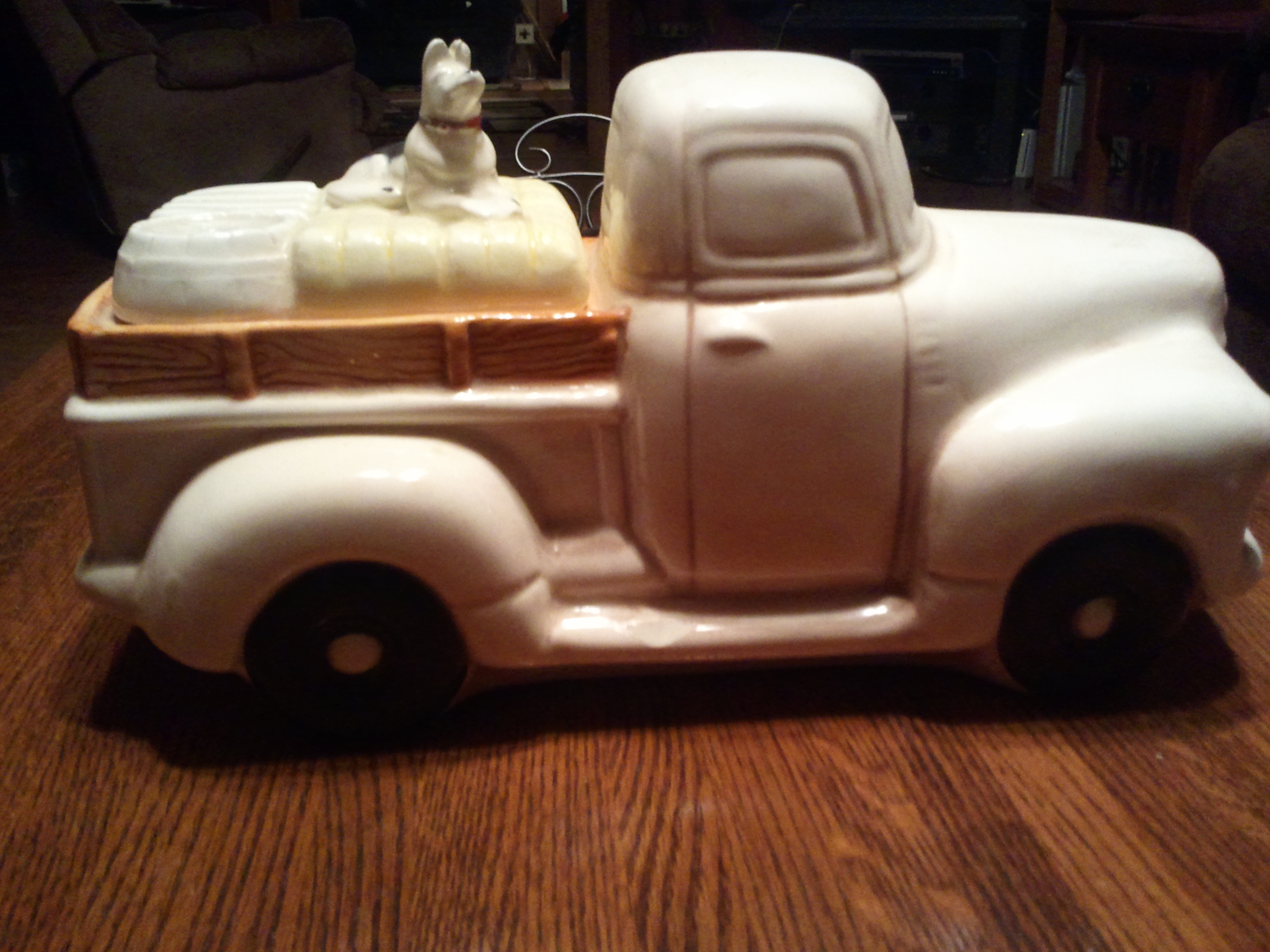
So let me describe the gift and why I thought it was perfect and see if you agree.   It was a ceramic cookie jar, in the shape of an old pickup truck, with ceramic bales of hay in the back, and a ceramic black and white dog lying on top of the hay.  To open it, you lifted the dog’s head, and the dog and the bales of hay came off, the cover to where the cookies would be stored.   The reasons I thought it’d be perfect included:

SAMSUNG

The perfect gift!

1)       Nostalgia – my wife grew up on a farm.   Nothing says “farm” like an old pickup truck.

2)      At the time, we had horses that we stalled in our barn out in back.  We always had a supply of bales of hay to feed the horses with, so the hay in the back of the truck struck home.

3)      We had a dog.  The cookie jar had a dog.  Who doesn’t love a dog?

4)    My wife frequently bakes cookies.  I love cookies.

For some reason, the gift didn’t go over as well as I’d hoped.  It never made it to the kitchen, my wife instead preferring the old plain white cylinder for a cookie jar to my finely detailed ceramic work of art.

Today, the piece sits proudly on display in my office, where from time to time I stop and admire the fine craftsmanship and detail that went into its creation.

SAMSUNG

Lift the dog to get to the cookies within

One thing I did get right, though.  I always thought it’d be an unforgettable gift, and that it has been, as almost every Christmas my wife and kids tell the story of the “perfect gift.”    And here’s the good news:  it has become the standard that all subsequent gifts have been measured against.  More than once, through the years, I’ve heard:  “At least it isn’t that ugly cookie jar.”

I adjust well.

Labor Day


I first posted this two years ago today, in honor of my oldest son’s birthday – I remain immensley proud of him – he’s taught me so much over the years, and I treasure the time we get to spend together. Happy birthday, Jon, with all my love and respect.

djgourdoux's avatarDrivel by Dave

On September 5th, 1985, at about 8:30 P.M., I became a father.   Our first child, our son Jon, was born.

Talk about “Labor Day” – my wife was in labor in the hospital for more than 36 hours before Jon was finally born.  Even then, the doctor had to use forceps, a device that resembled a giant salad tong, to get him out.  But the moment when he finally said “It’s a boy” made it all worth the wait.

I thought I was well prepared and ready to be a father.  I had everything figured out – what rules I’d enforce, what beliefs and principles I’d instill, how fair and balanced I’d be.  Little did I know that you can never be adequately prepared, because, once born,  it turns out that this thing you’ve been obsessing over and reading and theorizing about is alive, and as unpredictable as any…

View original post 478 more words

First Deer


It was the biggest thing he’d ever done.  Standing over the carcass in the snow and staring into the blankness of the eye that looked back up at him he saw the enormity of the cosmos.  It’d all been summoned by his right index finger.   He looked down at it, the glove removed from his hand, and he slowly moved it back and forth, up and down, and he got down on his knees, still staring at his right index finger, the all powerful and omnipotent, master of even time and space.  It had made time stop and stand still, and he watched his finger and waited for it to give some indication that time could start again.  Then he felt the icy November wind blow in his face, and it reminded him that your finger might be master of time and space, but I am the wind, and I am blind and cold and unfeeling, and your finger is just a finger, nothing more, and life is only life, and death is only death, but I am perpetual and unending.

Good Parents


Why did the fire engine wear red suspenders?

To keep its pants from falling down.

Okay, I admit, it doesn’t make any sense.   It never did.  But when I was four years old, I’d walk around repeating it, and I’d always get a big laugh, especially from my mom and dad.

Last Friday marked the second anniversary of my dad’s death.  My mom’s been gone for almost twenty years now.

When you’re growing up, your parents are always there, looking out for you.   You long to be grown up and on your own, independent, out of their reach, but then the excrement hits the fan, and the world reveals something you hadn’t expected, and you reach out to your parents, and they guide you through.

Then the day comes when you realize, this is it, I’m grown up now, I’m independent.   You start making your way through the world.  You’re armed with the tools your parents gave you, and they’re still there, to help you out if you find yourself in a bind, to guide and advise you, to show you how to use those tools.   More than anything, you hope for their approval.  You want to make them proud, and at the same time, you know that in those moments you come up short, the times you fail, they’ll forgive you, because they love you.

The years go by and you become comfortable enough in the world to have children of your own.  Your parents age, and they change, your relationship with them changes, but they’re still there, they’re still your mom and dad, and you love them as much as you ever have.

I miss them both.  I miss making them laugh, and laughing with them.  I was always a show-off, a ham, and they were my first and favorite audience.   When they laughed, their faces lit up, and everything was okay.  There’s never been anything as satisfying as making my mom and dad laugh.

I’ve been thinking about how lucky I was.  My mom and dad may or may not have been the world’s greatest parents, but they were the greatest parents I could have ever had.   I’ve been thinking about what makes a good parent, and a few things become apparent when judging a parent:

Good parents are not perfect.  Good parents are not cool.  Good parents sacrifice for their children.   Good parents let their children develop their own interests.   Good parents raise their children to be independent.  Good parents have a sense of humor.  Good parents learn from their mistakes, and let their children make their own.  Good parents want better for their children than they had.  Good parents respect each other, and respect their children, too.  Children of good parents never forget that no matter what happens, their mom and dad love them.

I learned these things from my mom and dad.  Whether, as a parent myself, I practiced them or not is up to my children to decide.  I’m certain I fall short of the standard my mom and dad set.  But I’ve tried, and I like to think that, seeing the beautiful full grown adults my children have grown into, they’d be as proud of them as I am.

Oh, and I almost forgot:  good parents laugh at the stupid jokes you tell, and let their children show off for them every now and then.

Gravel Driveways and Kitchens in Chicago


Last night I drove down to Chicago to attend a book signing by Michael Perry at the Book Cellar, a really cool and atmospheric independent book store in Lincoln Square.  It was a great opportunity to see one of my favorite writers in person.  Perry is a great speaker, with a stand up comic’s timing and rhythm, and with a voice and a stage presence that heightens his beautiful and moving writing.  As a humorist and the leader of a band, he is comfortable in large venues; seeing him in such a small and intimate setting (there were about fifteen people) made it feel like we were all standing in a gravel driveway listening to him shooting the breeze.

He read some excerpts from Visiting Tom, did a very funny hour or so long monologue, and closed by reading my favorite passage from any of his books, from Visiting Tom, where he describes Tom and Arlene’s kitchen, and the depth of meaning he takes from its familiarity.  It’s a great passage because it goes beyond nostalgia and atmosphere and memory and gets to what the familiarity really means to him, and recognizing the same meaning in the woman who will later become his wife instantly deepens his bond with her.  It’s a wonderful example of Perry’s gift, the ability to find the profound in the every day, and hearing him read it out loud added another layer to its meaning.  I’d reprint the passage here, but you’re better off buying the book.

Afterwards, I had him sign my just purchased paperback copy of Visiting Tom, (I previously only had an e-copy of the book – it’s difficult to get one of those signed) and introduced myself as the guy who’d interviewed him for the 2nd First Look website (here is a link to the article and interview  http://www.2ndfirstlook.com/2013/05/michael-perry.html ).  He was gracious, and I was pleased that he remembered me, but I don’t know if I got across to him how grateful I was for him agreeing to do the interview.

Not that that matters much.  Interviews, it occurs to me, are a dime a dozen.  What I wish I had told him was how grateful I was that he let me into Tom and Arlene’s kitchen.