Breathing Lessons


I grew up in an isolated, virtually all white small town in southeastern Wisconsin.  It was the 1960s, and my world was the small town streets and the shaded neighborhood backyards.  We were buffered from the bigger cities of Milwaukee and Racine by miles of farmland, and grew up in an idyllic world of fields and woods and backyards, isolated from the turmoil that invaded our homes via the television airwaves. While city after city was burning with race riots or bleeding with anti Vietnam War demonstrations, we were playing kick the can on warm summer nights or pickup basketball games in driveways.  The economy was booming, and most families were able to live comfortably with a single wage earner.  My mom, like a lot of moms, didn’t work, while my dad made a good living as an over the road semi truck driver.  From our vantage point, it was about as close to paradise as you could get, and adults and children alike couldn’t understand what the rioters and protesters were so angry about.

About the time I turned nine years old, in 1967, I became a huge professional sports fan, starting with football and the Green Bay Packers.  Soon I became a big fan of professional baseball and basketball.  I had many favorite players, with the great Packers quarterback Bart Starr becoming my hero.  Other heroes included Willie Mays and Bob Gibson in baseball, and Bill Russell, Oscar Robertson and Elgin Baylor in basketball, and Gayle Sayers in football.  Later, I’d grow to admire Muhammad Ali and later still Joe Frazier.

With the exception of Bart Starr, all of these great athletes had one thing in common:  they were all African Americans.  I really didn’t notice that.  They were all great at what they did, and they had skills that set them apart from the rest. They all imposed their personalities on the games they played, and they were all artists in the truest sense.  Meanwhile, in my isolated small town, I grew up and graduated high school never knowing a single black person.

My mom was a big reader, and would go to the library a couple of times a week.  I’d often go with her, and check out the books in the children’s section.  I remember graduating from the animal books I’d check out in the first and second grades to the slightly older section, and in fourth grade discovering the sports section, and the book The Willie Mays Story.  I checked it out and took it home and stayed up all night reading it.  The book told how Mays was born into poverty in the south (I think it was Alabama) and how he started his professional baseball career in the Negro Leagues.  It was the first I’d ever heard of the Negro Leagues, and I remember being shocked when the book told about Jackie Robinson and Monte Irvin and how there was a time when black players weren’t allowed in the major leagues.

I loved the book, mainly for the stories about how young Mays, while playing for the New York Giants, would still play stickball in the neighborhood streets with the kids, and the patience his manager, Leo Durocher, had with him when he started his career in a massive slump.  Over the course of two or three years, I probably checked the book out and read it about ten times.

There were other books, too, like Bill Russell’s Go Up For Glory and Bob Gibson’s From Ghetto to Glory.  These books inspired in me a love of reading, and they also opened my eyes to what was going on outside my town’s limits.  I began to understand that not everyone in our country had the same advantages I had, and that there was real suffering igniting the race riots I saw on television.

About the same time I was listening to a lot of AM top forty radio and falling in love with the sweet and simple and innocent songs of Smokey Robinson and the Miracles and The Temptations.  I’d see them on television and damned if they weren’t black, too.

It’s difficult to exaggerate the role that sports and music played in developing my sensibilities towards race. The fact that so many of the athletes and musicians I admired had to overcome so much was a revelation to me, and by the time Tommy Smith and John Carlos raised their fists at the medal ceremony in the 1968 Olympics, I understood at least on some small level their courage and the symbolic power of the act.

Go forward about twenty years, and two of the most powerful black cultural icons are basketball players Michael Jordan and Charles Barkley.  Jordan avoids getting involved in politics and becomes a corporate conglomerate, saying famously that “even Republicans buy shoes.”  Barkley stars in a television ad where he famously pronounces, “I am not a role model,” eloquently making the argument that parents should take responsibility for their kids and not look to sports figures to provide guidance.

Now with the events in Ferguson and the Eric Garner death, questions are being debated about whether it’s right for athletes to use their forum for political protest. I’d argue that of course it is, and I applaud LeBron James, this generation’s Michael Jordan, for wearing an “I can’t breathe” t-shirt.  Barkley may have been right that parents shouldn’t look to athletes to instill values in their children, but the truth is that athletes and musicians and actors all have a platform that reaches beyond cultural and physical and geographic barriers and touches people that wouldn’t otherwise be touched.  They can use this platform to sell shoes or to increase awareness and effect change.  Cultural battles may be waged in loud and acrimonious front lines, but they are usually won quietly and over time, when people far removed from the front lines see something they recognize in those who choose to get involved on the periphery.

There is responsibility that comes with this platform, and it isn’t limited to African American athletes.  White athletes have an even bigger platform. Imagine the impact if, for example, Aaron Rodgers wore an “I can’t breathe” t-shirt to his weekly press conference.

Just like in the 60s, the front lines of these battles are the inner city streets where violence and poverty run rampant, but real change will occur only when those who are isolated and far removed from the realities of this landscape understand what is at stake, and that there are lives in the balance, lives that they can recognize through the eyes of the football or basketball player they cheer for.  Athletes have a unique opportunity to not only increase awareness but also empathy.  With empathy comes compassion and understanding, the foundation of change.

Running Away With Me


gerard hotel

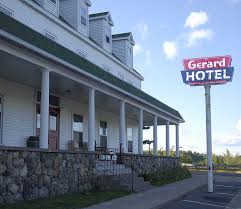
The setting for much of my second novel, and for the recent short story I posted here called “The Silence,” is the fictional Mayflower Hotel in the fictional northern Wisconsin town of Neil.  While the events I’ve written about are completely made up, the Mayflower Hotel is based upon the very real Gerard Hotel in the town of Ladysmith, Wisconsin.  I lived in an efficiency apartment on the third floor of the Gerard from August 1977 until December of 1978.  I was eighteen years old when I moved in, and had just turned twenty when I moved out.

It’s a grand old building, rising high from the tall banks of the Flambeau River, and can be an imposing and eerie sight on mornings when mist rises from the river.

I’m not sure why I’ve been drawn to write about it so much lately, why I’ve set so much of my fiction there.  I have vivid memories of what the place looked like, and how the midday shadows hung in my apartment, and how I’d look out the dormer windows from my bed and see, every night before going to sleep, the red blinking of a radio relay tower on the other side of the river, and how when I opened my eyes in the morning, the same blinking red light would be the first thing I saw.

Last week, on Wednesday morning, while I was up at my cabin, I had to run to Ladysmith for some errands.  I had a little time to kill, so I thought I’d stop by the Gerard Hotel and check it out.  Maybe I could talk to the current manager and have a look around.  I parked in front of the hotel, the same place that thirty seven years ago I’d park my first car, a green 1974 AMC Hornet, and I walked up the steps past the little stonewall and the white columns and once again I stood on the immense front porch, and I put my hand on the doorknob and tried to open the front door.  It was locked, and there was a note taped on the door that tenants were to leave it locked.  I couldn’t remember if we left it locked when I lived there or not, but it made sense, at least in 2014, that they wouldn’t want people wandering in off the streets to bother the residents.  I peeked through the glass of the door, and I was surprised at how small it looked inside.  The lobby was hardly a lobby, the stairs that I always had to climb to get to my apartment were right behind the front door, and the front desk, where the manager sat and where I’d pick up my mail, was only a few feet to the right of the stairway, and was small and cluttered.  I looked to see if anyone was behind the desk, someone who I could ask to let me in, but there was nobody.   I looked inside for a while longer, and I wondered, did the hotel show its age as much when I lived there, or was it the additional thirty five years since then that had taken its toll?  I stepped back and off of the porch, and I could see on the side a hole had rotted out of the porch’s stone foundation.  The exterior looked like it could use a fresh coat of paint.

old gerard

I found this about the Gerard hotel in an article on the web about the history of Ladysmith:

Travelers arriving in Ladysmith by train in the early 1900s were met at the depot by representatives of the various hotels. Patrons looking for the finest hotel in town most certainly would have stayed at The Gerard.
 
When it opened in November of 1901, the Gerard was regarded as “the most modern and complete hotel between Minneapolis and Rhinelander,” according to the “Gates County Journal.” The hotel featured new furnishings and steam heat. Electric lights were added after the Ladysmith Light and Power Co. plant was completed in November of 1902.  
 
The hotel was piped for running water when it was constructed, and it had its own water system before the village had a water works. Aside from these “modern” conveniences and good food, the Gerard offered something no other hotel in town could equal – a beautiful location. Situated on the high bank of the river, the Gerard commanded a breathtaking view of the Flambeau. … 
 
The hotel, itself, is both charming and stately. The white clapboard exterior and third story dormers are characteristic of buildings from the colonial era. The hotel seems more imposing than it actually is because one normally approaches it from the south and sees the long view of the building and its expansive porch. The effect would not be the same if the building could be approached from the front. The Gerard’s most distinguished guest was Thomas Marshall, Vice President of the United States, who stayed there while in Ladysmith to give an Armistice Day speech in 1920. Governors and other notables, including James L. Gates (afterwhom Gates County was named) feasted there.

So the hotel was seventy six years old when I moved in, and now is one hundred and thirteen. I was eighteen in 1977, and now I’m fifty six.  I’m still a pup compared to the Gerard, but like the Gerard, I’ve weathered and rusted, and like the floorboards of her porch, I creak and ache.

I remember the Gerard of the late seventies for its cheap rent and the collection of oddballs and misfits (including me) who lived there.  Among the tenants I remember was a middle aged alcoholic disabled veteran, a recently divorced man in his early thirties, a humanities professor from the small, private liberal arts college that used to call Ladysmith home, and a pretty young girl who’d been thrown out of her family home and disowned by her parents.  I never got to know any of these people very well, just well enough to know their situations, and well enough to germinate seeds in my imagination that I’d use to breathe life into in my fiction writing. Aside from the unique characters the place attracted, it was also old and atmospheric and spooky, and just Gothic enough for me to use it as the setting for stories like “The Silence.”

gerard from the river

So while the place has become fertile ground for my imagination, the truth is that my time there was lonely and unexceptional.  Maybe that’s why I romanticize it so much; nothing much of real interest happened to me there. Maybe I’m trying to recreate that time and make it more substantive than it was.  Maybe I’m creating my own personal mythology.

Maybe it’s because I was young and healthy then, and I’m older and broken now.  Maybe it’s because I look back at those days and long for all of the youth and freedom that I so carelessly burned up.  Maybe it’s because I know that Hotels and people wither and fade.

I’m old enough now that I look back on the days when I was eighteen to twenty with a heavy dose of romanticism.  My past is looking more and more like a bad Bob Seger song.   The truth is, while I was physically stronger and leaner, I didn’t know anything about anything.  There’s a Seger song that contains the line “wish I didn’t know now what I didn’t know then.”  What a load of crap.  I recognize that I was a complete and total idiot at age 18, and if nothing else can be said about the almost forty years since, I am happy to report that I am at least somewhat less ignorant today.

I can fictionalize my memories of the Gerard as much as my imagination will let me. It remains a beautiful, unique and spooky setting for whatever stories I might decide to tell. But I have to remember that, in the words of that great Motown group The Temptations, it’s just my imagination, and not let it run away with me. If I really think about it, and take off the romantic lenses I view the past through, I’m happy where I am, loose floorboards and peeling paint and all.

Trick or Treat


We just finished the mid-term congressional elections, and soon the political focus will center on the 2016 Presidential elections.  The current front runner for the Democrats is Hillary Clinton.  For the Republicans, former Florida governor Jeb Bush is a potential candidate who is generating some enthusiasm.

Let’s assume for a moment it ends up being Hillary versus Jeb in 2016.

Here’s one thing recent history has taught us: once elected to a first term, a president is likely to get re-elected to a second term.  Going back to 1968, five of the seven presidents elected to a first term won re-election to a second term.

So let’s assume that whoever wins in 2016, Hillary or Jeb, he/she also wins re-election in 2020 and serves out a complete second term. If this happens, it would mean that for 28 of the 36 years between 1989 and 2024, the United States would be lead by a Bush or a Clinton.

The 2010 census put the U.S. population at 316 million.  316,000,000 people in the country, but seven of nine presidential elections would be won by members of two families. When I grew up, I was taught in school that in the United States, anyone could grow up to be president.  Nothing was said about having to change your name to Bush or Clinton,

Now, about those mid-term congressional elections we just had.  In polls before the election, the public approval rating for congress was as low as 9%.  That’s one out of ten.  So how many of the bums were thrown out?”  Well, not too many.  96% of incumbents won re-election.

So we disapproved of 91 out of every 100 congressmen, yet we reelected 96 out of 100.

Huh?

What do these numbers tell us?  Well, I’m not going to discuss swings to the right or left, what’s shifting or who does or doesn’t have a mandate.   Those are all opinions.   The numbers I stated up above are fact (except for the speculation about the 2016 and 2020 presidential races). So what in my opinion do the facts tell us?

Well, I think they say that the system is seriously broken.  When only two families are in the most powerful position in the world for 28 of 36 years, it’s obviously unrealistic to say that anybody can become president. Democrat or Republican, it’s hard to believe that in a country of 316 million people, the best choice has been a Bush or a Clinton so often.

In the mid-term elections, it’s estimated that campaign donations totaled $3.7 billion.  That’s not much when you consider that $7.5 billion was spent on Halloween!  Trick or treat!   (Source:  http://www.washingtonpost.com/blogs/the-fix/wp/2014/11/06/the-2014-election-cost-3-7-billion-we-spend-twice-that-much-on-halloween/)

But here’s the thing:  that $3.7 billion in campaign funding was donated by an estimated 670,000 people, or about .2 percent (.two, or two tenths of a percent, or .002. not to be confused with two percent, or .02) of the population.  And since money is the biggest factor in winning elections, it means that two tenths of a percent of us is determining who our leaders are.

How do we change this?

We can try and get campaign finance reform passed, try to get the Citizen’s United supreme court  ruling overturned.  Great idea, but not likely to happen when the incumbents are the ones benefitting from the current system.

The only answer is more spending from more of us.  Lets look at the numbers:

$3, 700,000,000 raised in the 2014 mid-term elections

670,000 (.002 of the population) donors in 2014 election

$5,522 average donation per donor

If ten percent of the population donated, that would result in 31,600,000 donors (compared to 670,000 in 2014)

If the average contribution for that 10% was $125, they would raise $3.95 billion, thus outspending the $3.7 billion raised by the .02 percent of the population.

Asking ten percent t of the population to participate in the political process doesn’t seem to be too much .

You say, that’s fine and well, but you’re ignoring the most important number of all:  voter turnout.  Voter turnout in 2014 was only 36%, the lowest rate since 1942.  But I’d argue that voting is just the punctuation on the sentence that money writes.  Many voters are turned off by the spending, by the negative ads.  If more of them were to be involved in what is the real political process, the funding of elections, more of them would vote, and most importantly, the votes would support the money invested.  More candidates, more challengers, would have more funds, and be able to get their message across to whatever the voter turnout would turn out to be.  I have no doubt, for example, that many candidates for many offices had great ideas and  would have made better representatives than many of the incumbents, but they were never heard, drowned out by the money donated by the point two percent.

$125 is a significant cost for many of the 10% that would be asked to contribute.  But maybe it’d be better to skip a Halloween and try a different form of trick or treating.  We might be surprised at what we get.

The Silence


(I shared this short story at the Kenosha Writers’ Guild meeting last night.  Still very much a work in progress, I want to thank everybody who provided their input)

Ever since the tornado hit and leveled most of Main Street in June of 1963, the Mayflower Hotel, about a block away and untouched by the storm’s path of destruction, has been the tallest building in the small town of Neil, Wisconsin. Standing high on the banks of the Ojibway River at the corner of Mayflower Avenue and Columbus Street, it’s been an imposing sight since its construction in 1884. The windows in the fourth floor dormers protrude from the hotel like gun turrets in a fortress, guarding the residents from phantom marauding enemy boats approaching up river from the east.  In the morning, the warmth of the sun lifts fog off of the cold river that rises and floats on the morning air until it spills over the banks and encircles the bottom of the hotel, making the top three floors appear to float like a ghost on a bed of mist.

Most mornings, the sun over the river is bright, and if you look up from the street to the fourth floor windows, all you can see is its reflection in the glass.  About thirty years ago, though, by the late afternoon, after the sun vacated the east, particularly on gray and dimly lit days, if you looked up you’d see the outline of her, frail and small, sitting in the third window from the left, watching the cars crossing the bridge or the fishing boats on the river, her hair as white as the shawl she wore around her shoulders.

In October of 1987, it’d already been eleven years since Mr. and Mrs. Boswell moved into Apartment 2E, the small three-room on the east side of the fourth floor.  Precious little was known about them.  They came from somewhere down state, presumably Milwaukee, and they were already in their mid seventies when they arrived. They were both deaf mutes.   They rarely left their apartment, having their groceries delivered in via a service offered by the local IGA.  The only mail that the hotel manager, Mr. Williams, received for them and placed in their box behind the front counter was their monthly social security checks and the occasional anonymous sales flyer.  They didn’t have children, and no one knew of any family they might have had. The deliveries from the current IGA delivery boy were their only contact with anyone from the outside world.  About one morning every other week or so, Mr. Williams would find a filled out form, with a “12” written neatly in the column besides “eggs” or “1/2 gal.” written next to “milk.” The form was always left on the front desk sometime over night for Mr. Williams to find first thing in the morning.

Nobody remembered the last time a human voice was heard from the Boswells’ apartment. They didn’t own a television or a radio, and they never joined the other tenants who’d sit out on the rocking chairs on the porch on warm summer evenings, or gather to watch television together in the lounge off of the lobby once the days grew shorter and the nights cooler.  They were forgotten by many of the tenants, and completely unknown of by others, who’d never seen them or even knew about their existence until the day they’d innocuously glance up to the fourth floor window on the way in and see the unmoving sight of Mrs. Boswell staring out her window.  Mr. Williams had to explain to more than one tenant that it wasn’t a ghost that they’d seen, it was in fact Mrs. Boswell, while other tenants weren’t so sure, while still others shrugged their shoulders and said, what’s the difference, they may as well be ghosts, given that they spent all their time in the shadowy silence of their little three room apartment.

They pre-dated even Mr. Williams, having arrived and taken up residence in Apartment 2E when the hotel was still under the management of his predecessor, Mr. Johnson.  All Mr. Johnson, in that usual cryptic style of his, ever told Mr. Williams about the Boswells was that they weren’t any trouble.  In his early days as manager, Mr. Williams always tried to engage Mr. Boswell in conversation whenever he stopped by the front desk to pay their rent or pick up his mail, but Mr. Boswell would just smile pleasantly and shake his head that he couldn’t understand Mr. Williams, and he’d politely wave and venture back up the stairs. Mr. Boswell was thin and short, stooped, always well dressed with clean and unwrinkled clothes.  He was always clean shaven and his white hair was always neatly trimmed.  He seemed nice enough, Mr. Williams thought. Dignified.

The passing of time, after experiencing the usual problems dealing with the younger tenants that comprised the bulk of the Mayflower’s clientele, made Mr. Williams appreciate Mr. Johnson’s simple and succinct summary of the Boswells.  Compared to the endless complaints about loud music and problems with drug and alcohol abuse and Mr. Williams’ personal crusade to rid the Mayflower of the presence of the aging whores and their johns that Mr. Johnson had profited from, he grew to appreciate the Boswell’s silent existence for what Mr. Johnson said it was: No trouble.

One Tuesday night, not too long after he and his wife, Evelyn, had taken up residence in the manager’s apartment on the first floor, Mr. Williams woke from another occurrence of what had become a recurring nightmare at two in the morning.  In his dream he was young, in the war again, and it was spring.  He was standing by himself in an abandoned railroad yard and he could hear the muffled sound of something moving, something alive, from behind the locked door of a lone railroad boxcar. He woke to a faint thumping sound coming from the basement.  He put his robe on and stealthily crept down the stairs.  The sounds were coming from the coin operated washers and dryers the hotel had installed for the tenants.  He paused at the open doorway of the laundry room and looked in and there, still and silent, sat Mr. Boswell, reading an issue of Time Magazine as the washer and dryer hummed and thumped away.  There was nothing wrong with doing laundry at 2:00 A.M. if one so chose, there were no hours posted.  Mr. Williams just found it odd that Mr. Boswell, with all the time in the world available to do his laundry, would choose Tuesday at two in the morning.  He stood at the doorway for a moment and quickly studied Mr. Boswell, who was as always neatly dressed and the picture of dignity as he sat there, reading his magazine. By this time, Mr. Williams already knew that any attempt to communicate with him would be pointless, so he turned and went back to his apartment, leaving Mr. Boswell alone with the sounds of the washer and dryer that he couldn’t hear.

It’d been six years, 1981, since the last time Mr. Williams was in the Boswells’ apartment. The worn and fading orange carpet that covered the entire fourth floor was being replaced.  Mr. Williams sent the fourth floor residents a note detailing the schedule for the change out, and that each tenant would have to be out of their apartment for about a three hour period while the old carpeting would be pulled up and the new carpeting installed.  For the Boswells, Mr. Williams was sensitive to their handicap and how difficult being displaced for even three hours would be to them, so he wrote them a personalized note inviting them to lunch with him and his wife the day of the change out.

Mr. Williams knocked on their door at 11:30, the time he specified in the note. The door opened and Mr. Boswell was standing there, his jacket already on.  It was unzipped enough for Mr. Williams to see that underneath he was wearing a white dress shirt and a necktie.  He had on neatly pressed slacks.  Mrs. Boswell was seated at the kitchen table.  She was wearing a blue dress dotted with a pattern of small white flowers under a black sweater. Her white hair was tied up in a bun.  Mr. Boswell motioned for Mr. Williams to come in.  Mr. Williams stepped in and without thinking said, “Good  morning.”  When neither one answered he remembered that they were both deaf, and felt foolish for having spoken.  He stood in the tiny apartment’s doorway and quickly took inventory.  It was immaculate, not a trace of dirt or even dust.  To his left the bedroom door was open.  The bed was neatly made, on top of the dresser sat framed and fading black and white photographs of them on their wedding day, individual head shots, Mr. Boswell unwrinkled in his tuxedo with slick, dark hair parted down the middle and a confident smile, and Mrs. Boswell in her wedding gown, young and pretty with her dark hair curled under a white lace veil. There was a larger photograph of the two of them together holding the wedding bouquet, she leaning her head on his shoulder, both smiling. Mr. Williams looked for clues in the photos that would tell him when they were taken. They both looked so young, in their mid twenties, which he guessed would have been about fifty five years earlier. Doing he math, subtracting fifty five from 1981, he guessed their wedding to have occurred sometime around 1925. He wondered, were they both already deaf and mute at that time? Or did something happen to cause one or both of them to lose their ability to speak and hear?  He couldn’t imagine what type of calamity could have impacted them both in the same way, and he figured that the odds were they’d always been deaf mutes, and had lived all those years together in silence.

Mr. Boswell helped his wife to her feet and she grabbed her purse from the kitchen table.  They were ready, they both smiled at Mr. Williams, and Mr. Boswell held the apartment door open as his wife and Mr. Williams exited. He shut the door behind them and joined them at the top of the stairs

They picked up Mrs.. Williams at the bottom of the stairs and exited the hotel, getting in Mr. Williams’ enormous maroon Buck, the Boswells in the back and the Williams up front. He drove the five blocks across town to Gustafson’s, an old-style northern Wisconsin supper club that on Friday nights was the most popular place in the area for all you can eat fish fry.  They served good lunches, too, from a variety of burgers, melts and club sandwiches to fresh salads and homemade casserole dishes.  They sat in a big three sided booth in the back, Mr. and Mrs. Boswell in the center, Mr. and Mrs. Williams on the outside, one on either side of the Boswells.

Mrs. Williams had taken a basic sign language course at the local community college and tried signing some of the simplest and most basic conversation starters, but to no use.  Mrs. Boswell just sat there with a confused frown, while Mr. Boswell smiled politely, waved his hands and shrugged his shoulders, indicating that they didn’t understand. Mrs. Williams, with a hand over her mouth, muttered softly to Mr. Williams, “They don’t know any sign language at all.”

The four studied their menus in silence, and when the waitress came to take their order, when it was Mr. Boswell’s turn, he pointed to the turkey club sandwich and pointed to Mrs. Boswell, then pointed to a tuna melt for himself. It took a while, the waitress working with Mr. and Mrs. Williams, to figure out if the Boswells wanted fries or chips and what beverages they wanted, but eventually they got through it, and the waitress left.  Then the silence fell, heavy and dark. Finally, Mr. Williams reached in his back pocket and pulled out a small notebook.  He pulled a pen out of the breast pocket of his olive green work shirt, and started writing.  He scribbled, looks like rain this afternoon, doesn’t it?  He slid the notebook and pen to Mr. Boswell, who read it and nodded enthusiastically in response. Mr. Boswell wrote yes, those clouds are quite dark, aren’t they, and pushed the notebook back to Mr. Williams, who nodded yes in response.  Then Mrs. Williams took the pad and pen and wrote, “Mrs. Boswell, I just love your dress,” and slid the notebook to Mrs. Boswell.  She read it and blushed visibly, writing “Thank you,” and returning the notepad to Mrs. Williams.

They ate their lunch, finishing just as the restaurant started filling up with the noon lunch crowd.  As more people came in, Mr. Williams could sense traces of anxiety appear on both of the Boswells’ faces, especially Mrs. Boswell, and he noticed that Mrs. Boswell slid closer to Mr. Boswell.  He noted how they communicated, how they’d learned to read what the other was saying with their eyes, hers dark and deep, his blue and watery.

He also observed that Mrs. Boswell seemed even more uncomfortable than Mr. Boswell, and that she relied upon him to shelter her from the imposing outside world they found themselves in. Mr. Boswell was protective of his wife, helping her off and later on with her coat, making sure she understood the scribbled lines on the notebook Mr. and Mrs. Williams used to communicate with them, and wrapping his arm around her shoulder as they left, navigating the tables and the chairs and the people sitting in them, and helping her into the back seat of the Buick for the ride back to the hotel.

It was only one o’clock when they returned to the Mayflower. The carpet installers still had another hour and a half until they were finished with the Boswells’ apartment, so Mr. Williams invited them into his apartment behind the front desk for coffee,.  The Boswells nervously accepted, and the four of them sat in the living room, sipping from cups of coffee, Mr. Boswell looking surreptitiously at his watch. They made more small “talk,” making further use of the notebook, but it was slow and painful, and never got past the most innocent and superficial of topics. Mr. Williams noticed again the way they’d look at each other and he became convinced they were communicating, somehow, imperceptible to anyone else, but it was there, in their eyes, on their faces.  If Mr. Williams had hoped the event would remove the aura of mystery that always surrounded the Boswells, he had to be deeply disappointed. When it was over, when the new carpet .was installed and the Boswells were returned to their apartment, the only thing that Mr. Williams knew about them that he didn’t before was that they loved each other with a depth that he previously hadn’t appreciated.

The final time that Mr. Williams was in the Boswells’ apartment was on a Saturday morning in early October of 1987. A front moved in from the north, dropping the temperature nearly twenty degrees to the mid thirties within a fifteen minute span, causing the Hotel’s furnace to kick on for the first time in months, pushing warm air thru the vents.  Mr. Williams was at the front desk when Jim Hayward, the resident in the fourth floor Apartment 1E, next to the Boswells, came down the stairs.

“There’s a bad smell coming from the Boswell’a apartment,” he said.  Mr. Williams grabbed his passkey and ran upstairs with Jim. “It started when the furnace kicked on,” he added.  As they approached the top of the stairs, Mr. Williams instantly recognized the strong and pungent odor. It’d been more than forty years since he and the rest of the 45th Infantry Division of the Seventh Army approached the abandoned railroad cars on the outskirts of the town of Dachau, but the acrid odor that permeated the fourth floor air brought it all back as if it’d been yesterday, and he was filled with an overwhelming dread of what he knew waited behind the Boswell’s door.

He buried his nose in his shirt. Jim Hayward did the same. He inserted the passkey and opened the door.  The stench was unbearable as he stood in the dim light of the Boswell’s apartment.  Looking across the kitchen, he could see Mrs. Boswell, seated on her chair at the dormer window, with her back to him, looking out at the river, her white shawl wrapped around her shoulders and her white hair neatly brushed and flowing down to her upper back. As Mr. Williams approached her, the smell grew stronger, and he knew what he’d find, but that didn’t prepare him for the rotting flesh, the bulging eyes, and the death mask grin.

Turning back to the door, he saw Jim Hayward, still standing in the doorway, the color drained from his face, as he started retching.  He ran out of the apartment to vomit somewhere safe.  Mr. Williams turned and stood at the closed door to the bedroom, and he knew that Mr. Boswell was in there.  He opened the door and scanned the room before entering. He didn’t see anything amiss.  The bed was neatly made.  He entered, and looked again at the wedding pictures on top of the dresser at the foot of the bed, taking the photo of Mrs. Boswell in his hand.  He heard the faint sound of something moving, and his eyes caught a slight flash of motion, a shadow, on the floor on the other side of the bed, and he looked, and there laying on the floor was Mr. Boswell, crumpled and naked, his ribs and hips sticking sharply out of gray flesh, his eyes vacant but alive in boney eye sockets.  He was still alive, barely, waiting for death, in the relentless silence of Apartment 2E on the fourth floor of the Mayflower Hotel.



What I Am


One of the symptoms of my instance of Parkinson’s disease is micrographia, a disorder of the basal ganglia that results in small and cramped handwriting. Granted, in the scope of things, this is not the worst disorder to suffer from, so I’m not looking for any pity from anyone on this one.  Those who have known me for any length of time know that my handwriting was always bad.  But at least in the past, even if it was incomprehensible to everyone else, at least I could read it. Now, I can’t make heads or tails out of most of my own scribbling.

This can be an unfortunate handicap for one who’s trying to pass himself off as a writer.  It means that unless I have a computer handy, I can’t write – not in notebooks, or journals, or random pieces of paper.  Even taking down a phone number can be a lost cause. So it is that I lug my laptop with me to meetings of the Kenosha Writers’ Guild, and anywhere else that I might have the opportunity to write.

The result of all this is that I don’t have a real, true journal that I write in, where I put down my daily thoughts and ideas and experiments  For the past three and a half years, the closest thing I’ve had to a journal has been this site, “Drivel by Dave.”

What “Drivel by Dave” has actually been is beyond me.  Sometimes it’s a blog, sometimes it’s a website, sometimes it’s a dumping place. It hasn’t been very successful at one of the goals I had for it, which was to build a platform for me as a writer.  While it appears that I have a very small and loyal group of readers, the numbers haven’t grown significantly in the past three and a half years.  This is mostly because I am painfully bad at promoting myself, and I don’t have any unifying strategy or goals for gaining a large following.

But I really don’t give a crap about that. All I want to do is write, and in that regard, “Drivel by Dave” has been moderately successful.  Since I started whatever the Hell this I, I’ve posted exactly 200 tidbits to it.  DBD has kept me writing and given me a place to post whatever’s going on in that defective brain of mine.  Many of the 200 have been instantly forgettable and awful, there’s a few haven’t been too bad, and a small percentage that have actually been pretty good, that show some growth, that I’m actually proud of.  Overall, I think I’ve been pretty good at articulating what was on my mind at the time – the fact that so many of them are incoherent muck is because so much of my brain is incoherent muck.

And that’s the thing – what you see is what you get.  Regardless of the quality of the output, I think I’ve been pretty honest and open in my writing.  As a journal, taken collectively, I think the aggregate of the posts represents an approximation of the sum of the man.   To put it simply, what I am is contained in these ramblings.

When I started writing several years ago, in the first sleepless nights in the early days of my diagnosis of Parkinson’s, my goal was first to express what was going on inside me, and second to record my thoughts and memories so that my children might have a record of who their father is and was.  These goals have expanded to writing short and long fiction and maybe, someday, one or two people out there might consider me a serious writer.  But however lofty my goals and aspirations become, writing will always be first and foremost an exploration and articulation of who I am.  The act of writing, even when it produces some of the worst drivel, is always  intensely personal to me, and there hasn’t been a time that I haven’t sweated some trepidation when I’ve hit the publish button.

Earlier this year, I self published my first novel, Ojibway Valley, and I finished the first draft of my second, I Don’t Know Why.  The final copy of IDKW is a ways off, though, as it is still very, very rough and needs a lot of work.  I still think it could be pretty good when I get around to finishing it, and when I do, I’d like to take another whack at getting published via an agent or small press.  When I pursue that, I suppose I’ll have to get more serious about promoting myself, which would include figuring out what has to change with “Drivel by Dave.”  I’m thinking, before I retire the site (as we know it today), that I might self publish a collection of the best posts plus some other short pieces I have laying around.

I’d appreciate any ideas or suggestions from any readers out there …

Outside Looking In


Somewhere the night grew colder
and called you by name, again and again.
It reached round your shoulders
and locked you within.
Lost in its shadows, trapped in the rain,
alone in its darkness, wrapped in your pain,
it left you out there, cold and hidden,
on the outside, looking in.

But in that same cold tonight,
in the sorrowful dark,
shines the eternal light
of your glowing heart,
because you’ve been released.
You’re free now, you’re at peace,
in that place where you’ve always been,
on the outside, looking in.

Collision


(This is the very first piece I shared at the very first meeting of  the Kenosha Writers’  Guild, more than five years ago.)

In August of 1981, Deb and I began our married life together in the upstairs apartment of an unassuming old house on the corner of 18th Avenue and 45th street.   It was in an older neighborhood that thirty five years earlier had been reborn and refreshed with post war optimism.  The tasteful, simple, and practical houses that were built,  the small fenced in green lawns that were carved out and the tiny saplings that were planted  were all symbols of the long awaited peace and prosperity that had been fought for and promised for almost 20 years.  In 1981, when we moved in, many of these houses looked small, worn and outdated, but the love and promise with which they were built somehow endured in the warmth they projected.  The tiny trees that were hand planted in those early post war years had grown to mature and impressive heights, and even as the houses and backyard brick barbecue pits became anachronistic and out of fashion and the middle class money and influence slowly migrated out to the suburbs and subdivisions, those trees now sheltered the neighborhood from complete decay and within their shade locked in the hope and faith from which they were born,  resulting in a charm and dignity that to this day has yet to leave those narrow streets.

It was a great apartment, very small, not a note of pretentiousness to be found.   There was a door off the driveway to the side of the house that hid a stairway that lead to a little screened-in landing room at the top, from which you’d enter through a screen door into the kitchen, with old painted white cabinetry, a gas burning stove, and a small table with three chairs.  In the center of the apartment past the kitchen was a nice living room that had big windows on the south side that let in plenty of daylight, then a room off to the right that was too small for anything but storage, and to the west of the living room, facing the street, a bedroom just big enough for our bed and headboard to fit in, underneath the windows that looked down on 18th Avenue.   The bedroom was lit by a single light bulb in the ceiling with a long string attached to it that came down to the exact midpoint of our bed.   Our bed was a double bed that my wife had brought with her from her basement bedroom in her parents’ house, it was already old and rickety; suffice to say, after those first few months of marriage, it was in an accelerated state of collapse, as a very discernable valley in the middle of the bed emerged.  To this day my wife and I sleep closely together, the whole night our arms wrapped around the other, and while this is indicative of how deeply in love we remain, it is also indicative of learned behavior from those early months.  The fact was that we had worn this valley into the middle of our early marriage bed to the point that if we even tried to sleep on one of the edges, gravity would eventually exert its pull and cause our sleeping bodies to roll to this middle, and we’d wind up pressed against each other anyway.

The house our apartment was in was separated from the corner of 18th Avenue and 45th Street by a small vacant lot butting against 45th street.  On the other side of 45th street and a couple of buildings to the east was a biker bar, the LP Lounge.  On Saturday evenings the sides of the streets would fill up with parked cars and motorcycles, and we’d witness the migration of bikers and their drinking buddies, their wives or their girlfriends, on their way to the mayhem Saturday night at the LP promised.   I remember many Saturday nights Deb and I lying awake in our newly married bed, often times with candles lit on the headboard, laying and listening to the sounds of muffled juke boxes, broken glass,  and, at the completion of closing time, the occasional metallic crash of automobiles colliding with parked cars on the narrow street.  One night such a collision occurred in the front yard of our house, right below our bedroom window.   It all contributed to the wonderful feeling that outside of our little apartment, our home, away from the two of us, the world was an incomprehensible blur of sound and fury; and even when it came loudly crashing in our front yard, just feet away from the thin wall of our fortress, inside that apartment we were safe and secure. As chaotic, random and cold as the outside world was,  inside, wrapped up in each other’s arms,  everything made sense, everything was warm, everything was calm.

Nothing could shatter that calm until one cold February night, about six or seven months after moving in and shortly after we fell off to sleep, when we were awakened by a loud thump as if something heavy had been thrown in the apartment beneath us.   We sat up in bed and promptly heard the sounds of the hard-looking, middle aged woman with the fading red hair who lived below us being beaten by her boyfriend.  There was the unmistakable sound of punches connecting, groans, screams from her, angry yelling from him, undoubtedly the thin, short man with the Navy hair cut and tattoos we had recently noticed hanging around.  This went on for about five minutes, but it seemed like five hours.  Deb and I both sat up in bed, me thinking I should go down there or at least call the cops, but both of us paralyzed by shock and fear.  I am ashamed to confess that I did nothing and when the sounds stopped I felt relieved, not as much for the sake of the woman as I should have, rather, more relieved that I had an excuse for continued inaction.  We tried to go back to sleep but instead we both laid there, awake and silent, for a long time.   Our fortress had been compromised – these were no anonymous drunk bikers loudly and incoherently arguing over crushed fenders in our front yard for our amusement, these were real people, this woman was our neighbor, living and sleeping under the same roof and behind the same walls that shielded Deb and I as we explored the depths of our passion and love for one another.  Violence and pain had now penetrated these walls, and their presence would be felt like ghosts for the remainder of our time in the apartment.

Our relationship with the woman downstairs had consisted of “Hi’s” as we passed on our way in or out.  Deb stopped and talked with her a few times about her hanging plants, and it seems she may have mentioned a distant divorce, but otherwise, we knew nothing about her, and never stopped to think of the silence of the apartment below us.  That night that silence was shattered, and I remember being shocked at how easily we could hear.  It wasn’t until much later that I realized that she could probably hear us just as easily as we heard her, and looking back on it, I wonder if she hated us.  I picture her alone in bed at night in her apartment, listening to the sounds of my wife and I, and wonder if she was reminded of a long ago honeymoon period of her own, and if the sounds and the memories they conjured up only intensified what had to be the bitter despair of loneliness, a loneliness that eventually brought into her life and home the small navy man who beat her.

We’d noticed him hanging around for a few days before, and thought how nice she had someone to spend time with.  Chalk that error in judgment up to ignorance and naiveté.  I don’t recall if we saw the man again after that night.  I do remember that in the days and weeks afterwards, the passing “Hi’s” became quicker and more impersonal, as all parties involved turned their heads away as quickly as possible, resisting at all costs  the shame that eye contact would bring.  We were resisting that shame but we were also resisting the truth that there on the corner of 18th Avenue and 45th Street, two opposite worlds had intersected and collided, and the realization that both the upstairs world of happiness, innocence, promise and love, and the downstairs world of loneliness, despair and pain, were simultaneously as real and unreal as the other, and that only a thin layer of fate and circumstance lie between them.

Not a Rock


We were walking on the beach on a warm late summer afternoon.

“Man, do I feel light-headed,” Herb said for the third time.   Then you could hear a “ffffft” sound and Herb’s head unattached from his neck and floated up into the sky, like a helium balloon, until it stopped and hovered there, about twenty feet above us.

“You ain’t just whistling ‘Dixie’,” Norm said, turning to me.  He was right.  I wasn’t just whistling “Dixie.”  In fact, I wasn’t whistling at all.

“What time is it?” Mrs. Clooney asked.

“It’s parsley sage, Rosemary,” Paul Simon answered.  He then pointed to an old man with a long white beard selling bushels of parsley from a nearby vegetable stand.

Art Garfunkel was not amused.  “I’m not amused,” he said.

“He’s right,” Norm said.  “He’s not amused.  He’s Art.”

“I don’t know if I’d go so far as to call him art,” Herb’s head called down from above.   His headless torso stood motionless on the beach.  Finally, Herb’s head stopped floating, and fell back towards the earth on top of his torso, reattaching itself to his neck.  Herb smiled.  “There, much better,” he said.  “Reunited and it feels so good.”

“Yep,” Casey Kasem said, kicking the sand at his feet.  “That head and torso are reunited, thanks to beaches and Herb.”

“You’re still not whistling ‘Dixie’,” Norm said, looking at me.

Once again, Norm was right.  I wasn’t whistling “Dixie.”

In Distrust We Trust


To say things are out of whack would be an understatement.

The news is filled with stories about how we’re dropping bombs on radical factions in the Mideast, in response to the sick and inhuman beheadings of American and British journalists.  The right wingers were quick and vocal to demand that the president take action, that such brutal and barbaric slaughter of innocent Americans cannot go unpunished, and that if we stood by and did nothing, our enemies would be emboldened and more innocent lives would be lost.

They are, of course, correct.  We know this because of recent history.

On December 14, 2012, twenty six innocent Americans, twenty of them children under the age of ten years old,  were murdered by a madman in Sandy Hook Elementary school in Newtown, Connecticut.   In the two years since, despite overwhelming public outrage, nothing has changed.  All attempts to tighten gun laws have been defeated by a small but vocal minority funded by the National Rifle Association and the mostly Republican congressmen they control.  These are the same people who two years ago threw up their arms and said, “Bad people do bad things.  There’s nothing you can do.”  The same people who   when madmen across the ocean kill, demand swift retribution and immediate action. And, of course, since Sandy Hook, we’ve only seen an increase in mass shootings.

But beheading an innocent victim is so brutal, so insane, so inhuman, that anyone with a shred of humanity would have the save visceral reaction.  This is true, but how can the same people not have the same reaction when twenty innocent children, children, are brutally murdered?

I personally know many people who dismiss the Sandy Hook killings as “the price of freedom” and are quick to criticize when the president doesn’t react swiftly and aggressively to perceived foreign threats.  They are good people, people who’d be the first to help if their neighbors were in trouble.  They’re not stupid.  The problem goes a little deeper than mere intellect.   I think the real problem is actually something that we all have in common, left and right, rich and poor, powerful and weak, the haves and have-nots, the blacks and the whites .

It’s all a matter of trust.  Or rather, distrust.

Nobody trusts anybody any more.  Conservatives don’t trust liberals, whites don’t trust blacks, religious people don’t trust scientists, libertarians don’t trust government, you can go on and on.  There are so many groups, so many labels we define ourselves by, and they are all so different except they are the same in one fundamental and powerful way:  they all have, at their core, a fundamental distrust of some other group or cause.

In many cases this distrust is warranted, in many it’s not.  I’m not so egotistical as to claim any super knowledge or all encompassing wisdom to pass judgment (although I have opinions!  Boy, do I have opinions!).  But there seems to be something in the air, something in the times we live in, that is fueling general feelings of discontent and distrust.

And where did all of these labels come from?  I’ve been called a liberal, a tree hugger, a skeptic, an agnostic, white, a 99 percenter.  I have friends who are tea-partiers, ditto heads, Christians, Muslims, atheists, black, Hispanic, Asian,  libertarians, republicans, democrats, independents, environmentalists, corporate officers, and on and on.   But  before I congratulate myself on the diversity and openness of my relationships, I have to be honest and admit that with each group or label I might use to define  my friends, there’s always at least one topic that isn’t safe for honest and unemotional discussion.

I understand why we can’t always agree with one another.  There’s nothing wrong with disagreement.  It can be healthy.  But distrust is personal, and  corrosive.

In the end, there is only one label we all share, the only one that matters – human being. Only when someone invents a way for us to recognize this will our distrust begin to dissolve.

Of course, the opportunistic bastard will probably be in it just for the money, and then where will we be?

Peaks and Valleys


I recently had an appointment with my Movement Disorders Specialist in Chicago to treat my instance of Parkinson’s disease.  She tweaked my Deep Brain Stimulator and gave me a wider range of settings to try.  The most interesting thing we’re trying involves a program she set up on one of the four pair of leads to decrease the frequency of the pulses but increase the voltage.  In other words, less frequent but stronger signals being sent to my brain.

The results so far have been interesting.  Many of my side effects, including voice and balance issues, have been much better.  At the same time, the meds I take are wearing off every three hours  compared to every four to four and a half hours before, and these “off” periods are hitting harder. Up to now, my “off” periods would slowly and gradually take hold, announcing their presence first in my toes and fingers and slowly moving over my entire body.  Now, it’s like a light switch being turned off, as literally one minute I’ll be fine and the next any movement at all is difficult and I am slowed to a nearly inanimate state.

So I’m learning how to deal with these new settings.  The good part is that during my “on” cycles, my peaks, while shorter in duration than before, are higher than they were, while the bad part is that I crash down harder and faster in the valleys of my “off” cycles.

Peak:  There are trade-offs, and today I was able to use my improved voice to appear on my writing group’s radio show, which I’ve been avoiding in recent months.  Today not only was I able to read a short piece I’d written, I was also able to conduct an interview with one of my favorite writers, Michael Perry.  For a half hour, we spoke about writing, and it was great, we talked and we listened to one another, and it was incredibly gratifying to have a conversation without having to worry about my ability to articulate and be clearly understood. I immensely enjoyed every moment.

Valley:  Tonight my wife and I were playing Scrabble and having our normal great time, when I crashed into a bad off period.  Suddenly, I couldn’t make my fingers work to reach into the little bag and get my letters.  She had to help me, which she did with her usual grace and good nature, and it wasn’t a big deal, because she is so good at preventing things from becoming a big deal.  But I’d be lying if I said that at least on some dark and deeper level it didn’t bother me.  The game was nearly over, we finished and spent the rest of the valley watching the Brewers lose again.

Peak: A couple of hours later I’m straightening up my office, with music playing, Frankie Valli singing “You’re just too good to be true,” and Tucker, our ten month old English shepherd puppy is lying on the floor, and I’m feeling so good I start dancing and lip synching “at long last love has arrived, I thank God I’m alive.”  Tucker looks at me and tilts his head in confusion.

Valley:  My wife is showing me some decorating she’s doing in our bedroom, and she is so animated and content that I am overwhelmed by how much I love her, and the lyrics “you’re just too good to be true” come back to me, and I realize that she is the truest thing I know. The past thirty four years we’ve been together flash in front of my eyes, and I see us as we were then and I see me as I am now and it takes all my strength not to burst into tears.

I used to get angry when I’d think of what this damned disease is doing to me and what it’s taking from us.   Lately, I just feel sad, and that worries me.  I want my anger back, I want to be able to tell my PD to go fuck itself.  There is strength in anger, and weakness in sorrow. I want to be strong again.

I need to work at that.