Fun With Telemarketers


I’m one of the few people who enjoy receiving calls from telemarketers.  It drives my wife crazy, but I just love taking up as much of their time as I can.  The key to prolonging a telemarketing call is acting stupid.  I’ve become so successful at it that my wife says it’s not really an act.  She may be right, but I enjoy myself anyway.   I know I’ve succeeded when I get the service rep to put the manager on the line.

The first time I ever got the manager was probably twenty five years ago, and remains one of my favorite calls ever.    It’s not verbatim, but the call went something like this:

My phone rang, and the voice on the other end said, “Congratulations, Mr. Gourdoux, your name was selected, and you’ve just won a free charcoal grill!”

“That’s great!,” I  replied.  “I was just going to buy one.”

“Well, now you won’t have to.   We’re going to have a representative in …”

“I just love to barbecue,” I interrupted.  “Don’t you?”

“Yes, sir, now we’re …”

“What’s your name?” I asked.

“Shirley,” she cheerfully replied.

“Well, Shirley.  I love hamburgers on the grill.  And brats.   And hot dogs.”

“Yes, sir, so do I.  Now as I was saying …”

“And ribs!  How can I forget about ribs! “

“Yes, sir, now, we’re going to have a representative in your area giving estimates on new windows.  We can bring the grill with us when we come out to give you your free estimate.”

“Ribs with the right sauce, wow, I can almost taste them already.”

“Yes sir, now when shall we come out to give you your free estimate on windows?”

“I’m sorry, I just purchased new windows.  Plus I’m working pretty late these days.  You can just leave my free grill on my front porch.”

“Sir, I’m sorry, we can’t do that.”

“Kielbasa!”

“What?”

“I just remembered, a smoked Kielbasa is really good cooked on a grill.   Have you ever had kielbasa?”

“No, I don’t ….”

“Oh, you don’t know what you’re missing.  It’s like a polish ring bologna.   It’s really good grilled.  In fact, now that I think about it, that’ll probably be the first thing I grill on my new grill.”

“Sir, I must …”

“When will they deliver it?”

“Well, sit we’ll have some representatives in your neighborhood next week.”

“Excellent!”

“When can we give you your free estimate on new windows?

“I’m sorry, like I was saying, I just installed all new windows.  Just tell them to drop the grill off on my front porch.”

“Sir, I’m sorry, we can’t ….”

“Wow, what a lucky day.  I don’t normally win anything.   And now I’ve won a grill, of all things.”

“Sir, you have to talk to one of our estimators.”

“Salmon.”

“I’m sorry?”

“Have you ever grilled salmon?  That’s something I’d like to learn how to do.”

“Sir, you have to talk to one of our estimators in order to get the grill.”

“Estimators?  Estimators of what?”

“Windows, sir.  I told you that you have to receive a free estimate for new windows in order to receive your grill.”

“I’m sorry, I thought I made it clear, I just installed new windows.  I wouldn’t want to waste any of your time.   Just drop the grill off next week and leave it on my front porch.  “

“Sir, we cannot just drop the grill off. “

“Well, is there a place where I can come pick it up?”

“What?”

“Pick it up.  If you can’t deliver it, maybe I could drive to your distribution center and claim it there.”

“Sir, how are we going to give you an estimate on new windows if we don’t come out to your home?”

“An estimate for new windows?”

“Yes, that’s right; you get a free grill in return for us providing you with an estimate for new windows.”

“Shish-ka-bob!”

“Shish-ka-bob?”

“Yeah, isn’t that what they call it when you cook those skewers of vegetables and meat over the grill? Shish-ka-bob?”

“I don’t know, sir. Now, in order to get your free grill, you have to let us give you an estimate on new windows.”

“So when do you think you’ll deliver my grill?  How about next Thursday?

“You’d like to speak to one of our estimators next Thursday?”

“Oh, no, I won’t be home next Thursday.  We’re going out of town for a long weekend.  You can just drop the grill off on my front porch, I’ll tell my neighbor to keep an eye out for it.  I can’t wait to tell him I’ve won a free grill!”

“Mr. Gourdoux, we cannot drop the grill off!”

“Tell me, does my new grill include a warming tray? Because a warming tray can really come in handy …”

“Mr. Gourdoux, let me put you on hold.”

I then listened to some tape recorded music.  When I was off of hold, there was another woman on the line.

“Mr. Gourdoux,” she started.  She sounded firm.

“Hello, who is this?” I asked.  “You don’t sound like Shirley.”

“This is Shirley’s  manager.”

“Oh, well, Shirley’s doing a great job.   She explained to me how I won a new grill!”

“Mr. Gourdoux …”

“I can’t wait to try it out!  I’m going to get some steaks and marinate them.  You ever …”

“MR GOURDOUX,” she asserted. “YOU HAVE NOT WON A GRILL!”

“What are you talking about?  Shirley said …”

“I don’t care what Shirley said, you HAVE NOT WON A GRILL.”

“Hot dogs, hamburgers …”

Click.  Shirley’s manager finally hung up on me.

. . .

My all-time favorite was the call trying to sell me a credit card, I think it was a Visa card.  It was sometime during the 1990s.  I listened very patiently to the woman’s long winded spiel, agreeing to everything, expressing my interest in the card.  Then it was time to close the deal.

“Now, I just need to confirm some basic information,” she said.  “Your name is David Gourdoux?”

“Yes,” I replied.

“And that’s spelled, D-A-V-I-D, G-O-U-R-D-O-U-X?”

“Well, that’s close.  It’s actually spelled I-G-O-R, S-T-R-A-V-I-N-S-K-Y”

“Your name is Igor Stravinsky?”

“It’s spelled Igor Stravinsky, but it’s pronounced David Gourdoux.”   I’d used this gag before, and it always ended up with the agent slamming down the phone in disgust.  Not this time.   The woman was going to close the deal no matter what.

“And your address is 99999 99th Avenue, Pleasant Prairie, Wisconsin?”  (the nines are placeholders for my real address.)

“Close,” I said again.

“When you’re ready, sir, give me the correct address”

“Okay, “ I said, “It’s 1600 Pennsylvania Avenue, Washington, D.C.”  The address of the white house.  I could hear her type away.  When she was done, she told me that my new card would be mailed out to me in a week or two.

I know I screwed up the zip code, but that didn’t keep me from imagining Bill Clinton opening up the mail one day to find a Visa card with Igor Stravinsky’s name on it.

Identity Crisis


I used to be a manager in I.T. for a large corporation.  I made a lot of friends in the time I worked there.  Beginning some time in 2003 or 2004, a group of us got together every month for a poker game.

In 2005, I was diagnosed with Parkinson’s disease.  About the same time, one of the guys who used to work for me, and one of the original members of our poker group, moved away to Silicon Valley in California.  Despite the loss of our good friend, the games went on.

In 2011, after several instances of falling asleep behind the wheel on my way home from work, and with other symptoms making it more and more difficult to do my job, I left the corporate life behind.   Parkinson’s brought an end to my corporate career.   I was now a full-time “Parkie.”

But I refused to accept that that was all I was.   With time on my hands, I decided to take a serious whack at something I always wanted to do, so I started writing.  At first I wrote about my experiences with Parkinson’s, but as time went on, that wasn’t enough.  I began writing fiction, eventually working my way up to novels, and in January, I self published my first novel, Ojibway Valley.  Now, while still a Parkie, I’m starting to think of myself as a writer, too.

The poker games continued but gradually became less frequent, as time went on and more of us went our separate ways, until last August, when they seemed to abruptly end.   As the games ended, my contact with my friends and former co-workers waned.  I understood that the shared experience of work had always been at the core of those friendships, and now that I wasn’t part of that world anymore, all I had to offer was the past, and that meaningful friendships need more than memories to sustain them.  I was busy forging my new identity, and while their world moved on without me, so too was my world moving on without them.

Then about a month ago, our former co-worker who’d moved to California sent an e-mail out to the poker group, saying he’d be in town in February and asking if we could get a game together.  So it was that we reconvened last night.

Leading up to the game, I admit to a bit of apprehension at how things would go, given the different directions our worlds were moving in and the space that had been put between us.  Would they still recognize me?  Would we still have anything in common?

The turnout was great, as we had ten participants, an all-time high.  Guys showed up who I hadn’t seen in three or four years.

When I walked in, I was warmly greeted by smiles and handshakes and, much to my surprise, by copies of my novel.  It turns out that they were all very interested in my new world, and here’s the part that really shocked me – they were even proud of me!   As the night went on, it felt warm and close like it always did, for the more than ten years since our first game, and I realized that I wasn’t the only one who’d changed in all that time.  We’d all changed, as we’d grown older and raised our families.  Some changed jobs, new members joined us and old members dropped out, but sitting around the table playing poker and telling bad jokes hadn’t changed one iota and felt just as great as it always had (that wasn’t all that hadn’t changed – I again lost almost all of my money, proving once again that I am a terrible poker player!)

So it turns out that the various identities I’ve worn – corporate I.T. manager, Parkie, or Writer – haven’t been as important as that of Friend.  Once established, friendship is strong enough to encompass a galaxy of different identities.  In our friends, we recognize and respond to the core identity we all share, that of living and breathing and changing human being.

I’ve been working for a while now on a second novel, and when people ask me what it’s about, I respond by saying that it’s about a guy who emerges from the clouds of self absorption to recognize that there is a whole world beyond him.  Little did I realize that I was describing exactly what our little get together did for me last night.  It made me recognize the sustenance that friendship provides.

Now if only I could recognize when I’m drawing dead against a full house, I might be getting somewhere …

My Point and I Do Have One Is …


If I were to teach a class about writing, here’s how I’d open:  When it comes to writing, it doesn’t matter what kind of writing you’re doing, there is only one rule that has to be obeyed:  make your point.  Whether it’s a novel or a poem or a short story or an essay or a technical procedure, understand the point you‘re trying to make and make it as best you can.   That’s it.

Things like grammar and punctuation and characterization and description and plot are all tools available to you.  The more you learn about how to use them the better you’ll be able to make your point.  For some jobs, some of the tools are more important than for other jobs.  For example, if you’re writing a procedure on how to successfully diffuse a bomb, where a misplaced or omitted comma may blow the readers’ arm off, grammar and punctuation are going to be more important than if you are writing a play about two drunken high school dropouts from the rural south.

There are almost as many reasons people write as there are people writing, and they are all valid.  You might be writing because you dream of being on the New York Times bestseller list or you might be writing a poem for only your spouse or lover to see.  You might be writing historical nonfiction about an event or people that interest you, you might be writing to express a political or philosophical point of view, you might be writing because you have nothing else to do.  Whatever the reason, it’s legitimate, and my one rule applies – just try and get your point across.

It strikes me that people are often moved to write for the same reasons they are moved to draw a picture, or play music.   It’s the need to express something we feel strongly about.  It’s also the absence of rules – when we draw, for example, we are free to draw whatever the hell we want to; using whatever materials and colors and shapes we feel like using or are available to us.  There are no rules  to what we draw or how we draw it, just like there should be no rules when we write – well, maybe my one rule.

But it’s driving me nuts lately – all the “rules” out there that people are saying “good” writing must follow.  They may have good intentions, and their “rules” might make sense most of the time, but they are not “rules,” they are not absolutes.   A writer friend of mine who I have a great deal of respect for was recently bemoaning the glut of self published crap that is out there, and that to minimize it, maybe a writer should have to pass a certification before being allowed to publish.   This strikes me as so wrong on so many levels that I don’t know where to begin.  Suffice to say that for me, creating art (which a lot of but not all writing aspires to) has always been about freedom, that there are no rules, that Jackson Pollack and Andrew Wyeth can both be considered “modern artists.”  Art is where we turn when we feel the need to break free of the rules that dominate the rest of our lives.  There is a certification for public accounting, let’s leave it out of art.

It seems that the “gatekeepers,” those who control who and what get published, are  imposing  more and more rules on writers and writing now days, especially when writing short or long fiction.  It’s becoming something of a cottage industry.  There are an endless supply of books, web sites, webinars, seminars, conferences and retreats where you can study all of the rules for good writing.  And don’t get me wrong, most of them are sincere, and many of them are helpful.  But I think the best approach, no matter how impassioned or emphatically the “rule” is expressed, is to take them as advice but not gospel.  I think there are few if any hard fast rules that are absolute.

Some examples of popular “rules:”

The “show, don’t tell” rule – good advice, to a point.  But if you take it as absolute, and show everything, your story will never go anywhere.  After all, they don’t call it “story showing,” it’s “story telling.”  You should show what’s important to show and tell what’s important to tell.  How do you decide what to show and what to tell?  Whatever helps you make your point best.

The “less is more” rule – again, a good idea generally, but there are times when “more is more.”

“Always write with an active voice” – avoid things like “to be” and “had not.” Sorry, Hamlet, your soliloquy from now on is going to start “Be or not?  That is the question.”

“All stories must have a clear antagonist” – Tell me, in Faulkner’s “As I Lay Dying” or “The Sound and the Fury”, or Vonnegut’s “Slaughterhouse Five,” who the clear antagonist is.    In Hemmingway’s classic short story “Big Two Hearted River,” is time the antagonist?  Is it the war that has damaged Nick? Or the swamp?   Whatever answer you come up with, it’s not obvious or clear who the antagonist is, or if there even is one.  (“Antagonist” shouldn’t be confused with “conflict,” which I think is the one thing, in addition to a point, that every piece of fiction absolutely needs.)

“Every novel has to have a beginning that pulls you in immediately” – This is good advice, but is too often misinterpreted that every story has to start with some dramatic event or action packed cliffhanger.  There are multiple ways of drawing a reader in.  You can gently and simply introduce the main character (“Call me Ishmael”), or poetically describe the setting (“Cannery Row in Monterey in California is a poem, a stink, a grating noise, a quality of light, a tone, a habit, a nostalgia, a dream,” or “Summer here comes on like a zaftig hippie chick, jazzed on chlorophyll and flinging fistfuls of butterflies to the sun.”) , or briefly summarize the plot (“This is a tale of a meeting of two lonesome, skinny, fairly old white men on a planet which was dying fast.”)  These beginnings all draw the reader in; note that there is no breathless description of pulse stopping suspense, nobody tied to the railroad tracks with an approaching freight engine rumbling loudly.

So back to my one hard rule – I don’t mean to imply obeying only one rule makes things easy.  It’s still work, getting your point across, and even when you do, you can be assured that you always could have done it better, more concisely or completely.  The tools matter and you’re better off mastering as many of them as you can.  It’s easier to build a doghouse with a full toolbox than with just a hammer.

When you’re building a doghouse you need not only tools but materials.  In writing, the materials come from inside you.  They are how you view the world and your place in it, your experiences and what you’ve learned to be true.  They are the things important to you.  No matter what kind of writing you do, it’s going to be framed by how you process things.  Even journalists trying to write the most objective report of a news event  are affected by their experience, because writing isn’t only about what you write, what you put in the story, it’s also about what you leave out.  By better understanding yourself, you are given access to stronger and better tools.   You can build a much better doghouse with some two by fours and a couple of sheets of plywood than with cardboard, and you can write a much better story if you’re clear on why it’s important enough to you to spend the time and effort putting it down.

Whatever your reason for writing, remember that it is just as valid and legitimate as any other reason.  And if you are serious about writing, keep at it – the more you write, the better you get at it, no matter which rules you choose to follow.

So that’s it.  I’m done pontificating for now. I’ve made my point.

I think.

Winter Dream


(This is what I remember from a real dream I had last night)

I’m sitting at an empty bar.   It’s early evening, and it’s a bar I’m very familiar with.   It’s empty, nobody else either in front of or behind the bar.  The front door opens, and I immediately recognize my Dad as he walks in. At the same time, the bartender emerges behind the bar, and two more people walk in behind my dad.  My dad silently acknowledges me, nodding in my direction, and I can feel myself beaming, unable to suppress my happiness at seeing him.  The bartender looks at me, a puzzled expression on his face.  My dad starts talking to the bartender, telling him about his winter in Texas, when the two who came in with him take their seats on his other side.  With my dad standing between us, I recognize the other two as my mom and my oldest brother.

I remember why I’m here, why I’m at the bar.  I was supposed to meet them here, as they returned from Texas, then drive them somewhere north.   I can’t remember where but I know it’s about a two hour trip from where we are.

The conversation between the bartender and my dad pauses, and the bartender again looks at me, the same puzzled expression on his face.  Though I’ve seen him a hundred times before, it’s been a while, and it isn’t surprising that he might forget my name.

“I’m his son, Dave,” I say.  “I’m giving them a ride.”

“I know who you are,” he says, “it’s just that I didn’t expect you here so soon.”

And then it comes back to me, then I remember, that the bartender and my dad and my mom and my oldest brother are all dead.

Remembering this, I wake up.

Life and Death and Decay and Our Town


I’m aging.  I’m damaged goods.  I’ve hit the mid fifties, and while we may not admit it very often, we’re all damaged goods by this point.  With me, the chief vandals have been time and Parkinson’s disease. I try not to think about it all that much, but every morning the difficulty I have getting out of bed serves as a daily reminder that I don’t function as well as I used to, that I’m not who I used to be.

I don’t dwell on these facts, and I try my best not to let them get me down.  They are simply things that are part of my life now.   Like the Deep Brain Stimulator, or the neuro transmitter installed in my chest that sends signals to the electrodes implanted in my brain. It helps much of my Parkinson’s experience, but there are side effects, including my speech.   My movement disorders specialist has given me a device with a range of settings that I can use to control the signals sent to my brain so I can adjust them to minimize the side effects if, for example, I am going to be speaking in public.   Today, for example, I videotaped two recordings of me reading the first paragraph of Chapter 15 of my novel “Ojibway Valley” with minor tweaks to my settings.  My intent was to upload them to this post and share them, but I quickly learned that I’d have to pay for a Word Press update, which I’m not ready to do just yet.

So it is that these things just become a part of my life now, and things I used to take for granted I can’t anymore.  But that’s not a big deal, it happens to everyone – it’s just that mine are a little more dramatic and unusual than most people’s changes.

We all change, every day, more significantly and quickly than we might care to admit.  We lose a little hair, we add an inch or two to our midsection.  Here is a quick photo tour of certain points of my evolution (or devolution?):

4th birthday

On my 4th birthday

jenny & i number one

My sister and I ready for battle

At age 18 - maybe the first sign of abnormal brain was a canoe paddle sticking out of my head.

At age 18 – maybe the first sign of an abnormal brain condition was a canoe paddle sticking out of my head.

On the radio show "Speaking of our Words", with Chris Deguire and Lisa Adamowicz Kless

On the radio show “Speaking of our Words”, with Chris Deguire and Lisa Adamowicz Kless of the Kenosha Writer’s Guild

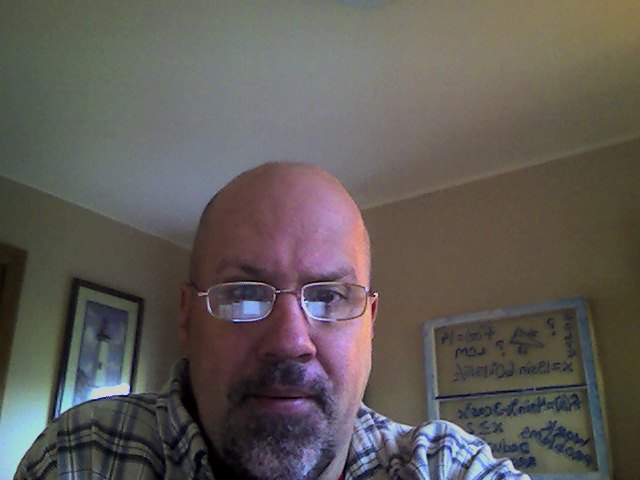
Recent selfy, practicing my stink-eye

Recent selfy, practicing my stink-eye.  The canoe paddle may have been removed but defects and malfunctions are still apparent

I’ve been thinking about these things because recently I re-read the great American play, “Our Town,” by Thornton Wilder.   “Our Town” takes a look at life and death in a small New England town called Grover’s Corners shortly after the beginning of the 20th century.  The first act is about everyday life, act two is about love and marriage, and act three is about death and dying.  The third act is incredibly powerful.  It is only when considered against death that life becomes meaningful, that we are granted the perspective to view it with.

My familiarity with the play goes back about forty years now, beginning with a production by my high school drama club in the mid seventies.  I’ve seen a few performances of it now on television, the most memorable being a made for television production from the late seventies with Hal Holbrook playing the pivotal role of the Stage Manager, our guide into the world Wilder created.    It’s a unique character in that Wilder uses him to break down the wall between the players and the audience, and he weaves in and out of the action of the play, interacting equally with the characters and the audience.   The play is written to be performed with minimal set design, the actors miming most of their actions.  These devices work extraordinarily well and, by using the audience’s imagination, highlight the timeless universality of Wilder’s words.  We all form our own image of Grover’s Corners, because we all have experience with the moments he chooses to linger on.

In Act three, the main character, Emily, has died while giving birth to her second child.  She was 26 years old and joins the dead in the cemetery on the hill overlooking Grover’s Corners.  She learns that she is free to go back and live her life again, although the others of the dead strongly advise against it, telling here it won’t be like she thinks.  She settles on reliving her 12th birthday, and the pain becomes overwhelming:

Emily:  I can’t bear it. They’re so young and beautiful. Why did they ever  have to get old? Mama, I’m here. I’m grown up. I love you all, everything. I can’t look at everything hard enough. Oh, Mama, just look at me one minute as though you really saw me. Mama, fourteen years have gone by. I’m dead.  You’re a grandmother, Mama. I married George Gibbs, Mama. Wally’s dead, too.  Mama, his appendix burst on a camping trip to North Conway. We felt just terrible about it-don’t you remember? But, just for a moment now we’re all together. Mama, just for a moment we’re happy.  Let’s look at one another.

It soon becomes too much, and she asks to be taken back to the cemetery:

EMILY:   (In a loud voice to the stage manager.)

I can’t. I can’t go on.  It goes so fast!  We don’t have time to look
look at one another!  (She breaks down sobbing.  The lights dim on the left half of the stage.)  I didn’t realize. So all that was going on and we never noticed. Take me back -up the hill -to my grave. But first: Wait! One more look.  Good-by, Good-by, world. Good-by, Grover’s Corners … Mama and Papa. Good-by to clocks ticking … and Mama’s sunflowers. And food and coffee. And new-ironed dresses and hot baths … and sleeping and waking up.  Oh, earth, you’re too wonderful for anybody to realize you.

 She looks toward the stage manager and asks abruptly, through her tears:

Do any human beings ever realize life while they live it? Every, every minute?

The stage manager answers “No,” then, after a short pause, adds “The saints and poets, maybe – they do some.”

Shortly after, we get the stage manager’s closing soliloquy:

Most everybody’s asleep in Grover’s Corners. There are a few lights on: Shorty Hawkins, down at the depot, has just watched the Albany train go by. And at the livery stable somebody’s setting up late and talking. Yes, it’s clearing up. There are the stars doing their old, old crisscross journeys in the sky. Scholars haven’t settled the matter yet, but they seem to think there are no living beings up there. Just chalk … or fire. Only this one is straining away, straining away all the time to make something of itself. The strain’s so bad that every sixteen hours everybody lies  down and gets a rest.

The strain is so bad that rest isn’t enough.  It’s art, it’s story telling, it’s shared experience, it’s beauty and language and music, and love, that occasionally relieve the burden of our straining long enough for us to get a brief glimpse of truth.  These are the things that replenish and nourish the soul as it trudges on through its long and incomprehensible journey.  They are sustenance, they are our defense against the slow and steady and unfeeling advance of time and decay.

Feet on the Ground, Heart in the Clouds


I’m a Midwesterner, born and raised in the working class of the great state of Wisconsin.  My dad was an over the road semi driver, and my Mom was what is now considered an ancient artifact, a stay at home housewife.   Like a lot of middle class Midwesterners, our feet remained firmly on the ground.   Other than a couple of car excursions to California when I was very young, vacation was always “up north,” near where my dad was raised, a six hours plus drive on State Highway 12 through an endless parade of small towns until they finished I-94, after which we were able to make it in about five hours.  Jet airplanes were observed from below, their fluffy white trails carving up blue skies.

In 1997, after working more than eleven years for an electrical utility, I took a job as an I.T. manager at a small advertising company.   One of the job requirements was “some travel.”  The corporate I.T. office where I worked was in Milwaukee, but their headquarters were in New York, in Manhattan, right next to the Ed Sullivan theatre where “The Late Show with David Letterman” was and still is staged.  Their billing department, which would be one of my major clients, was located in Hoboken, New Jersey, and they had satellite offices throughout the country.

My prior business travel experience, with the electrical utility in northeastern Illinois, consisted of two or three car trips to the training center outside of Joliet, where the company put us up in a dirty and dank hotel that someone in the corporate office undoubtedly scored big points in the budget process.  I’ve never been able to figure out exactly what a “frill” is, but I can guarantee I didn’t see any in the Shorewood Inn.  Cinder block walls and stained carpeting is all I remember about the place now, almost thirty years later.

So it was, shortly after taking my new job, my new company sent me on my first business trip to New York.   I’d been on a plane only once in my life, in 1979, eighteen years earlier, with my Mom and Dad for a rare trip to visit my aunt and uncle in California.  As I checked in and found my gate, I tried my best to act worldly and sophisticated, watching other business travelers closely and trying to act natural and confident as I imitated their behavior and followed their leads.

I somehow made it on the plane without incident.  I had a window seat, and I nervously waited for take-off, not knowing how I’d respond, nervous because when I was a kid I had an acute fear of heights.  Soon we were speeding down the runway, then the nose of the plane was pointing up, and we were off the ground.  My stomach was in my chest as I watched out the window, and then we were above the clouds and cruising, and I calmed down, and I loved it.   I spent every second of the flight gawking out the window, looking down at the tops of cloud formations and the earth below, the cities and the farm fields and the woods.  It occurred to me that I was experiencing something that all of the great men and women who’d ever lived before say 1900, before the Wright Brothers and Kitty Hawk, never experienced.  I was seeing a view that Socrates or Abraham Lincoln or Gengis Kahn had only been able to imagine.   I looked around the crowded plane at the other, veteran air travelers, and they were all either asleep or reading something.   I felt like screaming, “How can you sleep?  Look out your windows!  That’s our world down there!  It’s amazing!”

It was dark when we landed in the Newark airport.   My hotel reservation was in the town of Weehawken, New Jersey, in the Ramada Inn, from where I’d be visiting the New York office the next day and the Hoboken office the day after.  I was told to find a cab and have it take me to wherever Weehawken was.  I took my one bag and found the taxi station, where fortunately there was a guy whose job it was to call cabs for the lines of arrivals.   After a couple of minutes I was in a cab, giving the driver the address, and we sped off into the New Jersey night.

Although I grew up and had spent virtually all my days in the heart of the Midwest, two of my cultural heroes happened to be Bruce Springsteen and Woody Allen.  Their over the top romanticism with their home turf framed my understanding and expectations of New Jersey and New York.  As we drove through the Jersey night, I saw nothing exceptional, nothing romantic, just a lot of pavement and traffic.

I finally made it to the Ramada Inn, and by this time I was tired, my first foray into the business travel world having left me exhausted and drained.  I checked in and was given a card to a room on the 12th floor.  Bleary eyed, I opened the door, my expectations framed by the flea bag hotel in Joliet that had been my previous business travel experience.  Instead of the four cement block walls, I opened the door to an expansive suite, with a full and spectacular and living color view of the Manhattan skyline, all lit up, the lights reflecting and mirrored in the water of the Hudson River.  The view was amazing, and I walked into the room in the dark, not turning the lights on, because I didn’t want to spoil the moment.   I immediately recognized the skyline as a full color version of the opening montage in Allen’s “Manhattan.”  As beautiful as that sequence in the film was, it didn’t compare to what I was seeing.  I remember two thoughts entering my mind, the first, “Wow,” the second that there must be some kind of mistake, I must have gotten the wrong room, I’m only a low level manager, I’m not important enough for a room and a view like this.  This is a typical Midwest reaction – it’s not false modesty or humility – it’s just that we know with a lifetime of certainty that we aren’t very important.

The next day, I made it to Manhattan, and to Hoboken the next, and then back home to Wisconsin.  In the months that followed, there’d be a lot of return trips to New York, as well as trips to San Jose, Boston, Montreal and Miami.  Soon I’d be fast asleep before take-off, just like all of those other experienced, travel-weary passengers.

That’s the way the world operates.  We become jaded, pre-occupied, indifferent.  “Experienced.”  It occurs to me that it would be exhausting if we experienced everything in life with the same intensity we experience it the first time.  But it also occurs to me that everything I felt on that first trip to New York remains real and honest and heartfelt, and I long to feel that wonder and awe again.   I wonder how many of those moments I’ve missed, how many I’ve slept through.  I guess I’ll never know.

All I can do is to try and be awake for the next one.

Labor Day


I first posted this two years ago today, in honor of my oldest son’s birthday – I remain immensley proud of him – he’s taught me so much over the years, and I treasure the time we get to spend together. Happy birthday, Jon, with all my love and respect.

djgourdoux's avatarDrivel by Dave

On September 5th, 1985, at about 8:30 P.M., I became a father.   Our first child, our son Jon, was born.

Talk about “Labor Day” – my wife was in labor in the hospital for more than 36 hours before Jon was finally born.  Even then, the doctor had to use forceps, a device that resembled a giant salad tong, to get him out.  But the moment when he finally said “It’s a boy” made it all worth the wait.

I thought I was well prepared and ready to be a father.  I had everything figured out – what rules I’d enforce, what beliefs and principles I’d instill, how fair and balanced I’d be.  Little did I know that you can never be adequately prepared, because, once born,  it turns out that this thing you’ve been obsessing over and reading and theorizing about is alive, and as unpredictable as any…

View original post 478 more words

Good Parents


Why did the fire engine wear red suspenders?

To keep its pants from falling down.

Okay, I admit, it doesn’t make any sense.   It never did.  But when I was four years old, I’d walk around repeating it, and I’d always get a big laugh, especially from my mom and dad.

Last Friday marked the second anniversary of my dad’s death.  My mom’s been gone for almost twenty years now.

When you’re growing up, your parents are always there, looking out for you.   You long to be grown up and on your own, independent, out of their reach, but then the excrement hits the fan, and the world reveals something you hadn’t expected, and you reach out to your parents, and they guide you through.

Then the day comes when you realize, this is it, I’m grown up now, I’m independent.   You start making your way through the world.  You’re armed with the tools your parents gave you, and they’re still there, to help you out if you find yourself in a bind, to guide and advise you, to show you how to use those tools.   More than anything, you hope for their approval.  You want to make them proud, and at the same time, you know that in those moments you come up short, the times you fail, they’ll forgive you, because they love you.

The years go by and you become comfortable enough in the world to have children of your own.  Your parents age, and they change, your relationship with them changes, but they’re still there, they’re still your mom and dad, and you love them as much as you ever have.

I miss them both.  I miss making them laugh, and laughing with them.  I was always a show-off, a ham, and they were my first and favorite audience.   When they laughed, their faces lit up, and everything was okay.  There’s never been anything as satisfying as making my mom and dad laugh.

I’ve been thinking about how lucky I was.  My mom and dad may or may not have been the world’s greatest parents, but they were the greatest parents I could have ever had.   I’ve been thinking about what makes a good parent, and a few things become apparent when judging a parent:

Good parents are not perfect.  Good parents are not cool.  Good parents sacrifice for their children.   Good parents let their children develop their own interests.   Good parents raise their children to be independent.  Good parents have a sense of humor.  Good parents learn from their mistakes, and let their children make their own.  Good parents want better for their children than they had.  Good parents respect each other, and respect their children, too.  Children of good parents never forget that no matter what happens, their mom and dad love them.

I learned these things from my mom and dad.  Whether, as a parent myself, I practiced them or not is up to my children to decide.  I’m certain I fall short of the standard my mom and dad set.  But I’ve tried, and I like to think that, seeing the beautiful full grown adults my children have grown into, they’d be as proud of them as I am.

Oh, and I almost forgot:  good parents laugh at the stupid jokes you tell, and let their children show off for them every now and then.

Gravel Driveways and Kitchens in Chicago


Last night I drove down to Chicago to attend a book signing by Michael Perry at the Book Cellar, a really cool and atmospheric independent book store in Lincoln Square.  It was a great opportunity to see one of my favorite writers in person.  Perry is a great speaker, with a stand up comic’s timing and rhythm, and with a voice and a stage presence that heightens his beautiful and moving writing.  As a humorist and the leader of a band, he is comfortable in large venues; seeing him in such a small and intimate setting (there were about fifteen people) made it feel like we were all standing in a gravel driveway listening to him shooting the breeze.

He read some excerpts from Visiting Tom, did a very funny hour or so long monologue, and closed by reading my favorite passage from any of his books, from Visiting Tom, where he describes Tom and Arlene’s kitchen, and the depth of meaning he takes from its familiarity.  It’s a great passage because it goes beyond nostalgia and atmosphere and memory and gets to what the familiarity really means to him, and recognizing the same meaning in the woman who will later become his wife instantly deepens his bond with her.  It’s a wonderful example of Perry’s gift, the ability to find the profound in the every day, and hearing him read it out loud added another layer to its meaning.  I’d reprint the passage here, but you’re better off buying the book.

Afterwards, I had him sign my just purchased paperback copy of Visiting Tom, (I previously only had an e-copy of the book – it’s difficult to get one of those signed) and introduced myself as the guy who’d interviewed him for the 2nd First Look website (here is a link to the article and interview  http://www.2ndfirstlook.com/2013/05/michael-perry.html ).  He was gracious, and I was pleased that he remembered me, but I don’t know if I got across to him how grateful I was for him agreeing to do the interview.

Not that that matters much.  Interviews, it occurs to me, are a dime a dozen.  What I wish I had told him was how grateful I was that he let me into Tom and Arlene’s kitchen.

One Small Step


The latest sign that I might be growing up a little bit: today, the second issue of the local magazine, “Left of the Lake,” came out, featuring an article I wrote about Rebecca Venn, a gifted artist from Kenosha who specializes in water colors.

The magazine looks great, and I was pleased to see my name and my words in print. I read the article, and it’s okay, but something seemed different about it. I went back to the original article I submitted, and I noticed an entire paragraph I submitted was omitted from the published text.

Here’s where it turns out there might be hope for me after all: I instantly realized that the article was better without the missing paragraph. While I should have seen that when self-editing, I’m pleased that the editors of the magazine saw it and removed the paragraph.

I’m even more pleased with my reaction. It means I’m developing some level of objectivity to my work. The removed paragraph was clumsy and out of place, and diverted attention away from the subject. The editors did their job, and I am grateful.

Ms. Venn has enormous talent and does beautiful work. I’m still not convinced that my little article does her justice. But there is evidence that I’m learning a thing or two, and that’s about all I can ask for.