Today


Today was a good day.  I felt pretty good most of the day, and my wife was off work, so we were able to spend it at home, together.   The weather was beautiful – sunny, a little cool for July, and dry.  We were both up by 6:30, and spent the first couple of hours waking up and reading, coffee and toast for breakfast.  I did my daily Parkinson’s disease stretches, and by 9:30 I was moving pretty good, and I went outside.

First, I took the empty gallon iced tea jugs I’ve been saving out to my workshop, and funneled the old used motor oil I had lying around in various containers into them.  Two or three more empties and I’ll have all of my old oil accounted for, and I’ll take it in to the recycling center the village has established.

Then I put the new tire I’d bought at the True Value store a couple of days ago on the wheelbarrow, replacing the old one that wouldn’t hold air anymore.  Then I weeded my vegetable garden while my wife weeded her flower garden.  Tomatoes are starting to come in.  That’s exciting.

Then I burned some brush, some yard waste we’d accumulated over the summer.  It was the second of four brush piles we’ve burned; the other two are probably still a little bit too green to burn just yet.

I emptied the garbage can in my workshop into the main can we take to the curb on Tuesdays.  It was pretty full, it was past time I remembered to empty it, so that’s taken care of.

For dinner, I grilled out, bratwursts, a true Wisconsin delicacy.  We ate, then my wife worked some more in her flower garden, while I read.  We came in, she gave me a much needed haircut, and we played our nightly game of Scrabble (she won – AGAIN).  Now it’s 9:30 and getting dark, and I’ll try to get an hour or two of writing in before I go to bed.

Tomorrow, Deb goes back to work, I tutor for the literary council in the afternoon, and I have a meeting with my writer’s group tomorrow night.

This may all sound pretty routine and boring, but for me, it’s as good as it gets.  I love days like this, when I feel good enough to get some jobs, admittedly small jobs, done and crossed off of the list.  I know it’s a fraction of what I used to do every day, but I also know I can’t do most of those things anymore.  And to be honest, on some of the days that aren’t this good, the bad days, I sit alone most of the day and brood about that.

It’s more than coincidence that my wife was home and that I had a good day today.  There’s a definite correlation.  It’s not that we did anything special together or even left the yard.  It’s the fact that she is here, near to me, that matters.  It’s the comfort I take in her presence, looking out the window and seeing her in her flower garden, and showing her the green tomatoes coming in in my garden that means so much to me.  After 33 years together, we’ve become more than best friends, more than partners, more even than soul mates.  We’re tied to each other, inextricably linked.  We are companions.

While the number of good days left slowly counts down and diminishes, the appreciation and enjoyment of each one increases.  Days like today are truly remarkable and meant to be treasured.  The sun  on my face in my backyard, the sound of the breeze through the trees, the feel of a wrench in my hand while tightening the bolts on my wheelbarrow, and the image of my wife in the midday golden, green,  and red of her flower garden, are all more perfect than anyone can ask for.

Strength and Defiance


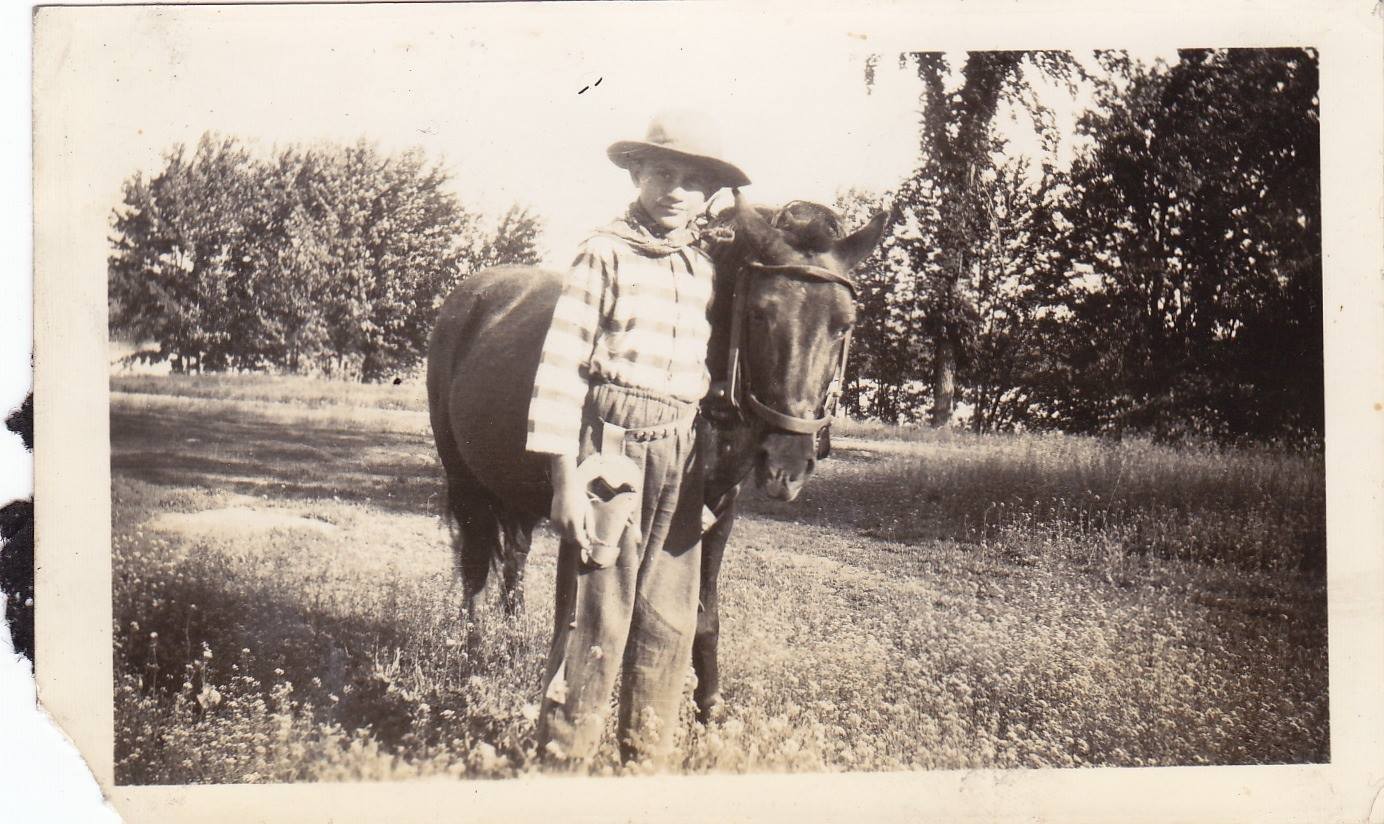
Yesterday was Father’s Day.  My sister posted a photograph of our dad, 10 or 12 years old or so, on Facebook.   My dad was born in 1926, so the photo had to be taken some time in the late thirties.  I haven’t seen many photos of my dad as a child, and I hadn’t seen this one before.

In the photo he’s with his horse and dressed as a cowboy, complete with a hat, kerchief, and a holstered pistol on his belt.  I remember him telling stories about his horse and the time and adventures they spent together.  I recognize where he is standing, in the driveway to the old farm house he grew up in, with the Chippewa River flowing behind him.  And when I look close I can recognize him, my dad, the same slight smile, a hint of sadness coupled with an unshakable and almost defiant  confidence, and the same dark eyes through which he saw a world where wonder and humor always trumped grief and sorrow.

What I know about my father’s childhood is that it wasn’t easy.   At some point, he was seriously ill.  He was the only boy with three sisters, and his relationship with his father was complex and difficult, and he was the victim of physical and psychological abuse.  He also saw his share of tragic and unexpected death close up, death by fire, by motor vehicle accidents, and by drowning.

dad and horse

But my Dad was strong.  That’s what is remarkable and revealing about this photo. Despite the harshness of the reality he was exposed to at so young an age, he was strong and defiant enough to believe in cowboys and horses and adventure, and he was strong enough to emerge from all of this a good and happy and funny man.  He was a great father to his children and a devoted husband to my mom.  The photo shows the same strength and sensitivity that would define him as a man was always there inside him.  It was what made him such a rare and special and unique human being, and it’s what I loved so much about him.

“The Sanded Down Moon in a Tar Paper Sky”


The thing about memories is they’re flat.  They’re like movies playing in our heads, two dimensional projections of moments from our past.

When you leave a part of your life behind, in your mind, that place stays constant and unchanging.  It remains forever as you last experienced it.  In reality we all know that’s not the case and the things we leave behind go on without us and change and evolve.

I left my job as an I.T. Manager in the Renal division of Baxter Healthcare more than three years ago.   When I look back at my days there, or try to imagine what my former co-workers are up to, I always go back to my office in the lowest level of the Renal building in McGaw Park, even though I know that Baxter has completely vacated and moved out of the McGaw Park campus, and the Renal division no longer exists, at least not as a separate entity.  All of that has happened without me, and as my memory recalls a place that no longer exists, so it is that I don’t exist in the world that has taken its place.

Memories of places are memories of people, too.  There are certain people who are part of the foundation of the worlds memories preserve.  Without these people, the place wouldn’t be the place.

Kathy C. was one such person.  She was on the periphery of my work, a member of the Quality Assurance department while I was a manager in I.T.  For thirteen years, her and I worked together, she making sure me and my team had followed all of the requirements and procedures for designing and developing validated systems, me asking her for guidance and interpretation.   Our relationship was often times adversarial and contentious, as she’d catch on to those instances where I tried to take shortcuts in the process, and other times where I’d argue that there was room for interpretation in certain steps, and that overly rigid adherence to the procedures only added unnecessary time and cost to the process.  Eventually, a mutual respect grew and deepened and a friendship developed.  We never completely buried the hatchet, as arguments would still ignite from time to time, but we knew and respected where the other was coming from; we knew each other well enough that we understood what made the other tick.  She learned that I wasn’t just a loose cannon looking to cheat and circumvent, and I learned that there was reason and intelligence behind her outwardly rigid façade.   Above all, we learned that each of us had a sense of humor, and we were able to make each other laugh.

I just found out that about a week ago, she passed away.  I didn’t even know she was sick.  Apparently, she’d been diagnosed with stage four pancreatic cancer in March.  That’s all I know, and I don’t know how accurate even that is.  I just know that she is dead, and that a part of the foundation of my memories of working at Baxter has crumbled.

I wish I had known.  I wish I could have talked to her one last time, that I could have told the story about the time I told her new boss that Kathy was the quality “pro to call” (which is a hysterical joke if you understand the nuts and bolts of developing a validated system) one last time,  and shared one last laugh.  I wish I’d had the opportunity to tell her how much I respected her.

But that’s the case with every death.   We bury the dead and with them all of our unarticulated wishes, all of the things we left unsaid.  And we bury a little piece of those worlds we inhabited together.

As I write this, I’ve got music on.  Lucinda Williams is singing a Randy Crowell song, and the lyric “the sanded down moon in a tar paper sky” echoes in my head.  Maybe that’s all that memories are.  Maybe that’s why they can make us ache like they do.  Time is sanding us down.  The night sky of our memories may as well be made of tar paper, because we can’t feel it, we can’t walk out into it and feel its dew on our bare feet.

All we can do is squint and look out into those misty worlds and find the people and places that were important to us, and if we look hard enough, we’ll see them as they were, and understand why they were important.   And that’s the thing – what was important to us once will be important again.

It’s important that we remember this.

http://www.youtube.com/watch?v=SI0SpyEzEwY


Sentencing


On Facebook last night, I was presented with yet another link to one of those lists, this one the “greatest sentences in all of literature.” It was interesting, and lead me to compile a list of some of my personal favorite sentences or passages from literature.  I’m not as well read as I should be, as you will be able to tell from my selections, and these aren’t all the greatest sentences, some of them are just cool opening lines that have stuck with me, and others were passages I remembered liking that I had to look up to get right, while a handful of them I remembered verbatim. Anyway, this should make for a pleasant diversion from the usual drivel I post here.  I’d be interested in some favorite sentences or passages anyone reading this might have, so feel free to leave comments.   Here goes:

All this happened, more or less.  – Kurt Vonnegut, Slaughterhouse Five

I’ve wanted life to be easy for you. Easier’n ’twas for me. A man’s heart aches, seein’ his young uns face the world. Knowin’ they got to git their guts tore out, the way his was tore. I wanted to spare you, long as I could. I wanted you to frolic with your yearlin’. I knowed the lonesomeness he eased for you. But ever’ man’s lonesome. What’s he to do then? What’s he to do when he gits knocked down? Why, take it for his share and go on.   – Marjorie Kinan Rawlings, The Yearling (this passage was so important to me I built a key scene in my novel Ojibway Valley around it) 

I give you the mausoleum of all hope and desire…I give it to you not that you may remember time, but that you might forget it now and then for a moment and not spend all of your breath trying to conquer it. Because no battle is ever won he said. They are not even fought. The field only reveals to man his own folly and despair, and victory is an illusion of philosophers and fools. –  William Faulkner, The Sound and the Fury

“She would have been a good woman,” The Misfit said, “if it had been somebody there to shoot her every minute of her life”  – Flannery O’Connor, A Good Man is Hard to Find

Nick’s heart tightened as the trout moved.  He felt all the old feeling.  – Ernest Hemingway, Big Two Hearted River

 And as the moon rose higher the inessential houses began to melt away until gradually I became aware of the old island here that flowered once for Dutch sailors’ eyes—a fresh, green breast of the new world. Its vanished trees, the trees that had made way for Gatsby’s house, had once pandered in whispers to the last and greatest of all human dreams; for a transitory enchanted moment man must have held his breath in the presence of this continent, compelled into an æsthetic contemplation he neither understood nor desired, face to face for the last time in history with something commensurate to his capacity for wonder.

Gatsby believed in the green light, the orgastic future that year by year recedes before us. It eluded us then, but that’s no matter—tomorrow we will run faster, stretch out our arms farther. . . . And one fine morning——

So we beat on, boats against the current, borne back ceaselessly into the past.  – F.Scott Fitzgerald, The Great Gatsby

I was a-trembling, because I’d got to decide, forever, betwixt two things, and I knowed it. I studied a minute, sort of holding my breath, and then says to myself: “All right then, I’ll go to hell”—and tore it up.   – Mark Twain, The Adventures of Huckleberry Finn

But we could hear her, because she began just after we came up out of the ditch, the sound that was not singing and not unsinging. “Who will do our washing now, Father?” I said.   –  William Faulkner, That Evening Sun

Rented a tent, rented a tent, rented a rented a rented a tent.  – Kurt Vonnegut, The Sirens of Titan

I stood by and held the door for him, and my best friend walked right past me, just like that, leading the way out and into the wet, wrecked night. – Patricia Ann McNair, Just Like That, from The Temple of Air

The light of a firefly is the size of a teardrop.  We cannot defeat the cosmic wind.  We are not magnificent.  But, by God, we try. – Michael Perry, Visiting Tom

I get the willies when I see closed doors.  – Joseph Heller, Something Happened

This was her, Mick Kelly, walking in the daytime and by herself at night. In the hot sun and in the dark with all the plans and feelings. This music was her—the real plain her. This music did not take a long time or a short time. It did not have anything to do with time going by at all. She sat with her arms around her legs, biting her salty knee very hard. The whole world was this symphony, and there was not enough of her to listen… Now that it was over there was only her heart beating like a rabbit and this terrible hurt. – Carson McCullers, The Heart is a Lonely Hunter 

It was a quiet morning, the town covered over with darkness and at ease in bed.  Summer gathered in the weather, the wind had the proper touch, the breathing of the world was long and warm and slow. You had only to rise, lean from your window, and know that this indeed was the first real time of freedom and living, this was the first morning of summer.  – Ray Bradbury, Dandelion Wine

There is an ecstasy that marks the summit of life, and beyond which life cannot rise. And such is the paradox of living, this ecstasy comes when one is most alive, and it comes as a complete forgetfulness that one is alive.
This ecstasy, this forgetfulness of living, comes to the artist, caught up and out of himself in a sheet of flame; it comes to the soldier, war-mad in a stricken field and refusing quarter; and it came to Buck, leading the pack, sounding the old wolf-cry, straining after the food that was alive and that fled swiftly before him through the moonlight.  – Jack London, The Call of the Wild

How wrong Emily Dickinson was!   Hope is not “the thing with feathers.”  The thing with feathers has turned out to be my nephew.  I must take him to a specialist in Zurich  –  Woody Allen, Selections From the Allen Notebooks


Story Time


“I write to make sense of the world” – Chris Deguire

“The job of the artist is to make the audience care about his obsessions” – Martin Scorsese

Hanging on the wall in my cabin are three photographs of me and the guys I used to play poker with.  We’d play every month on a Friday night, and once a year, the annual Wisconsin World Cup Poker Bowl would take place over a long weekend at my cabin and property in northern Wisconsin.  Over the course of the three and a half days, we’d drink, play poker, drink, fish, play poker, drink, ride ATVS, drink, play poker, see bears, drink, frequent local establishments, drink, play poker, walk around in the woods, drink, shoot clay pigeons, drink, and play poker.  We’d also drink and play poker.

That was a few years ago now, and most of us have gone our separate ways.  Although once or twice a year we still get together for a local poker night, the monthly games are gone, and the Wisconsin World Cup Poker Bowl hasn’t convened for a few years now.  But it sure was fun when it lasted, and every time I look at those photos a different memory returns, a different story, and I can’t help but smile.   The most recent photo, from one of the last of the Wisconsin World Cup Poker Bowls, shows us sitting at the picnic table outside of my cabin, with red plastic cups and near empty bottles of Maker’s Mark and Crown Royal and bottles of Rolling Rock, and big grins on everybody’s faces.  Looking at it now makes me remember the story of Russell the Unbluffable, or the story of the Italian moon over the city of Madison, Wisconsin, or the story of the bear that nearly caved in the locked front door, and it makes me think that had we been Cro-Magnons dwelling in caves in the south of France, the photographs would be drawings on the cave walls.  Looking at the photographs, I am struck by two things:  one, how little at least this group of men has advanced since their cave dwelling ancestors, and two, by how elemental story telling is and has always been to being human.

Story telling is what sets us apart from the animal kingdom.   It’s how we communicate, it’s how we relate, it’s how we connect with each other.  When our spouse gets home from work, the first thing we ask is, “how was your day?” In other words, “tell me the story about what happened to you today.”   In answering, we use all of the tools we’ve mastered over the years.   We use language, gestures, vocal inflections, rhetoric, exaggeration, understatement, humor and irony.

Why is telling stories so important to us humans?   I think there are many reasons, but the most obvious and primal reason is the knowledge of our own mortality.   We put stories down, whether ink on paper, paintbrush on canvas, whatever, as a means of reminding others that at this point in time, I was here, and this was important to me.   We have at our disposal the collected articulations and attempts to make sense of the universe and our place in it of all those who came before us, and as the universe and our world changes, art will be there to tell the stories of these changes and what they mean.  It’s vitally important to our continued survival as a species, and to our continued evolution as individual complex organisms.

A few years ago, when cell phones were still proliferating, they came out with the first models with cameras embedded in them.  I remember thinking, what a dumb idea, phones and cameras, it makes no sense.  Another example of what a brilliant cultural visionary I’ve always been.  It finally hit me when one night, at an after work function at a microbrewery in the northern Chicago suburbs, none other than Michael Jordan and a couple of his friends came in and sat at the table next to us.  Appropriately star struck, I eventually looked back at the rest of the crowded restaurant to see nearly everyone holding their phones up, snapping pictures , and it hit me.  They could call home and not just tell their families that they had seen Michael Jordan, they also had photographic proof.  It had to be similar to when the printed word was first developed and later the printing press.  Suddenly we had more than the oral tradition to record stories and hand them down and remember them.

Now, with the internet still relatively open and free, we are living in a golden age of expression.  Anybody with the motivation and where with all can post their stories on web pages, just like I do on this one.  Although this results in a tremendous amount of crap and drivel (this sight not excluded)to wade through, we should enjoy and treasure this brief period for as long as it lasts, as there is little doubt that once the powerful determine how to limit and censor these expressions they will.  Art and freedom of expression have always been in the crosshairs of those who wish to manipulate and control, of those who want to impose their will on us.  Every time you hear about a book being burned or banned you’re hearing an assault on the very essence of being a human being.

But no matter how much they try to control and limit us, corruption and cynicism will never triumph.  As long as men and women can draw a breath, they will tell stories, stories of love and truth and beauty, of justice and injustice, of hope and dreams, of  happiness and misery, of joy and agony, of moments stolen and preserved for all of time.  It’s how we’ve always responded in times of oppression and brutality. It’s what we do.  This is the story that all the trillions of stories told since the dawn of the human race combine to tell – that we are living and aware, and that each one of us matters.

Mea Culpa, But You’re an Idiot


When I was in junior high school, the movie that all the girls went gooey eyed over was a wretched piece of schmaltz called Love Story.   It starred the cutie pies of the day, the very young versions of Ryan O’Neal and Ali McGraw.  It was most famous for the insipidly bad line, spoken by McGraw, “Love means never having to say you’re sorry.”

I find it somehow satisfying that in the years since, O’Neal went on to become one of the biggest sleaze balls  in recorded history, a major cocaine and sex addict who, at his long-time partner Farrah Fawcett’s funeral, didn’t  recognize his own daughter, Tatum, as he made crude sexual advances toward her.  Oops.  An “I’m sorry” might have been called for at that time.

In order for apologies to be effective, they have to be sincere, and they have to be timely.  In 1995, Robert McNamara, Lyndon Johnson’s secretary of defense during the Vietnam War, publicly apologized for his part in plunging us deeper into that nightmare.  Given that it was about thirty years after the fact, and the enormous toll that war extracted from us in terms of lives lost and ruined and the damage to our collective psyche, an “I’m sorry” from one of the men most responsible comes across as too little too late, ineffective at best and insincere at worst.  If McNamara was worried about how he’d be remembered going forward, he’d have been better off just keeping his mouth shut and hoping he’d be forgotten.

There’s always a controversy whenever it’s suggested that we as a nation apologize to the many groups we’ve wronged over the years.  Whether it’s slavery, the internment of Japanese Americans during World War Two, the genocide of the indigenous Americans who were here first, or for taking “The Six Million Dollar Man” off the air, there’s a lot we have to apologize for.  There is value in formally recognizing the wrongs we’ve done and acknowledging our mistakes.  But like all apologies, they’re worthless unless they are sincere, unless they are accompanied by changes in behavior.

On a personal level, apologizing to someone for something you’ve done can be one of the most difficult things to do.  Admitting you were wrong, taking blame for your own actions, acknowledging the hurt you’ve caused, and serving time in a darkened prison cell with a demented ex-football player turned mass murderer named Leon, are never easy.    It can be just as difficult to accept an apology, because you have to let go of the pain and anguish that was caused to you and loudly sqauwk like a bird.

There are different forms of apologies.  The most simple, and the most sincere, are the two words, “I’m sorry.”  This is much preferred to the expression that somehow became popular in the past twenty years or so, “my bad.”  If someone says “my bad” to me, I’m always tempted to demand an apology for such a feeble attempt to apologize.

“I’m sorry” is actually only the beginning of an apology.  It has to be followed by an explanation, such as “I’m sorry.  I didn’t mean to cut your nose off with my weed whacker,” or, “my throwing you through a plate glass window was just an unfortunate accident.”   If these examples sound insincere, it’s because most apologies are insincere, and usually occur only after the apologist was caught doing something they shouldn’t have been doing. “I’m sorry, I didn’t mean to break into your safety deposit box and steal all of your valuable papers and scan them and post them on the internet.”

Then there are those apologies, like McNamara’s, that are motivated by a guilty conscience, and a desire for forgiveness.  These apologies usually end with the phrase “can you ever forgive me?” and put the pressure on the recipient of the apology.  For example, “I’m sorry I stole you car and kidnapped and lobotomized your wife so that she became my sex slave.  I was high on crack cocaine at the time.  Can you ever forgive me?”    If the offended party replies, “No!” he risks being perceived as shallow and insensitive and guilty of holding a grudge.

.Some of history’s most famous apologies:.

A very young George Washington to his father:  “Father, I cannot tell a lie. It was I who chopped down your Cherry Tree.  But it was little Tommy Jefferson who found your stash of Colonial Girls Gone Wild videos.”

The philosopher Socrates upon being sentenced to death:  “So you have deliberated and come to the conclusion that I must die.  Well, excuuuuuuse meeee!”

Nathan Hale prior to being hanged:  “My only regret is that I have but one life to give for my country.   If I had three or four, Hell, even two lives to give for my country, I’d be in heck of a better mood, and I probably wouldn’t have wet myself.”

Jesus of Nazareth, on the cross:  “Father, forgive them, for they know not what they do.  Besides, is it really that big of a deal if they put ketchup on a hot dog?”

President Bill Clinton on the Monica Lewinsky affair:  “My deepest regret is that as leader of the free world and the most powerful man on earth, I couldn’t do any better than Monica Lewinsky.   John F. Kennedy had Marilyn Monroe, for cripes sake!  I’ll try to do better in the future.”

A woman in a Chinese Laundry service:  “My husband, some hot shot.  Here’s his ancient Chinese secret …”

Beyond Belief


I am, by nature, a skeptic.  I like scientific proof of things.   This doesn’t mean that there aren’t fantastic  things I’d like to believe in.  For example, I’d love for bigfoot, or here in Wisconsin, the beast of Bray Road, to turn out to be real, that nature could keep such things secrets for so long.  The skeptic in me, of course, reminds me that the odds of there being such things are thousands to one.  I put my trust in math and science, and although it’d be cool to discover that sasquatches do actually exist, the skeptic in me says, “don’t be ridiculous.” Yesterday, the New York Times reported that two separate teams of NASA scientists have determined that the west Antarctica ice sheets are in irreversible decline, and that in the upcoming centuries, ocean levels are going to rise three to ten feet, putting millions of coastal residents in jeopardy.   The science is, if you read the papers, mature and indisputable.  Yet there are a large number of people who remain convinced that climate change and global warming are monumental hoaxes, part of a vast conspiracy perpetrated by the left.  These people choose to believe the nonsensical ravings of right wing radio hosts and ignore near unanimous scientific consensus. It’s always fascinating to talk to the extremists from both sides.  The ultra conservative, tea partiers repeat verbatim the gospel that is espoused over the air waves.  Global warming and climate change are conspiracies intended to stifle capitalism.  Big corporations need more tax relief because they are the “job creators,” yet recent history shows that successful corporations have consistently used tax breaks to eliminate or move jobs and line their officers’ pockets. Welfare cheaters and labor unions are to blame for our economic woes, even though the amount spent on welfare is a fraction compared to the amount paid to subsidize successful corporations, and labor unions have been weakened to the point of near inconsequence.   Perhaps the most bizarre and fractured logic is the belief that more guns make us safer, and don’t, as reason and statistics tell us, result  in more gun deaths. The left isn’t immune from ideological idiocy, either.   The political correctness it’s foisted upon society has resulted in a hyper sensitivity and ridiculous euphemistic language.  “Used cars” are now “pre-owned vehicles,” an “illegal alien” is an “undocumented worker,” “swamps” are “wet lands.” So people believe in whatever idiotic things they want to.  What’s the big deal?  Isn’t it their right?  Being stupid isn’t illegal.  It doesn’t hurt anybody if I believe in bigfoot, or trickledown economics or UFOs or any other such nonsense. Well, it usually doesn’t hurt anyone.  But then there are those instances of extremism that are just wrong, like the nut jobs of the Westbro Baptist Church protesting gay rights at the funerals of American soldiers, or the Sandy Hook “truther” who recently stole a memorial dedicated to one of the victims of the shooting, and then told the mother that her murdered daughter  never existed.  What could make a person so dedicated to and entrenched in their beliefs to behave in such a hurtful manner?  When does believing in something become fanaticism? There’s an older guy who comes to my door about once a month and discusses his beliefs as a Jehovah ’s Witness with me.  He’s a nice guy, and so are the people who come with him.  They are always pleasant and polite and respectful.  I try my best to be the same.  I explain to them that when it comes to religion, I am very much a skeptic, and they try to explain to me why I should believe. They hand me the latest issue of the Watchtower, their monthly publication, and read selected verses from the Bible.  I’ve explained to them that I don’t believe the Bible is the literal word of God, and that I think it was written by men, and they reply “It was written by men.  Forty men, to be exact, who were selected by God to put down his words.” Yesterday, on my front porch with the man and one of his fellow believers, I was in a slightly more argumentative mood than I usually am.  They began by telling me there is only one God to believe in, and that if you believe in false prophecies, you will pay the price.  The example they gave was the Heaven’s Gate cult that committed mass suicide in 1997, believing it was the mechanism for them to be granted access to a UFO that was flying in the wake of the comet Hale-Bopp. We then discussed the bible again.  They insist on a literal interpretation of the book.  I asked about Noah’s Ark, how did they get all the animal species in the world on the ark, how did they all fit, and what of animals in North America, which hadn’t been discovered yet.  They had answers for all of my questions and more, including why the lions didn’t eat the lambs on the ark – apparently God injected all of the creature’s brains with an infusion of tolerance that suspended the lions’ meat eating instincts, and that for the year on the Ark the lions, like all the other animals, ate straw.   I asked why did God cause the flood in the first place, and the answer was that he was so upset with man and the violence he perpetuated that he was going to kill all living things, save for those on the Ark.  I then asked, as logic would dictate, why God didn’t just infuse everybody’s brain with the same level of tolerance he infused the animals on the ark with, if he could make the lion and the lamb live in harmony, couldn’t he make all the people live in harmony.   I didn’t get a good answer on this one.  Then I asked, how old is the earth, and the one man confidently shot back, “between three and six thousand years.”  I left this one alone, sensing where the conversation would take us, and instead accepted the latest issue of the Watchtower and Awake! publications.  The man asked if it was okay if he stopped by again next month and I said, sure, feel free to. After they left, I thought about it and felt kind of bad about telling the guy he could come back.  He’s such a nice guy, and he’s completely sincere and honest in his beliefs.  The sad truth is that he will never convert me – to me, the ideas of two of each animal in the world boarding an Ark and that the world is only 6,000 years old are just as crazy as committing mass suicide to gain entry to a heaven-bound UFO  – and I’m not going to convert him to a more reasonable, scientific view of the universe.  The truth is, I have no desire to convert the man. He is polite, courteous, and carries himself with decency.  I have no doubt that he is a good man. So I continue to struggle with this one.  I know what I believe in and what I don’t.  That part is easy.  The difficult thing is what do I do with these beliefs?  Do I try to convince others?   How do I respect the different or conflicting beliefs of others, even when I am convinced they are wrong?  And how do I keep an open enough mind to really listen when my beliefs are challenged?   What if I’m wrong? The only answer I can come up with is what is at the core of my beliefs, the most fundamental belief of all, and that is, respect.  I believe that every human being has, deep inside, the capacity for goodness and the ability to love.  The best I can do is to try and remember this, and treat everyone, no matter what they believe or don’t believe in, with the respect they deserve.  It sounds simple but it’s not.  I’ve fallen short more times than I can count.  That doesn’t make me wrong, or stop me from trying to do better going forward.

More Race, More Judgement


Racism is in the news again, and everybody is outraged.   Some multi-millionaire idiot by the name of Donald Sterling, owner of the Los Angeles Clippers NBA franchise, said some stupid things to his mistress, of all people, who recorded his verbal idiocy on a hidden tape recorder.   The remarks were released to the press, and all Hell broke loose. Adam Silver, the new commissioner of the NBA, acted swiftly and boldly, and, per the powers granted to him in the bylaws of the NBA constitution, banned Sterling for life and recommended that the remaining 29 owners act quickly to force Sterling to sell the team.

A few months ago I wrote an essay in reaction to Paula Dean’s use of the “n” word and the uproar that followed.  ( https://djgourdoux.com/2013/07/17/race-to-judgement/  )That was at the same time some redneck idiot from a “reality” show called “Duck Dynasty” got a lot of attention for some similarly stupid remarks.  Now we have the latest episode in what has become an on-going American phenomenon, the self congratulatory denouncing of idiotic public figures and the insensitive things they say.  In other words, the destruction of easy targets.

I should mention that I am a fan of basketball and the NBA in particular.   After a few years in the nineties and early 2000s in which the quality of play was mediocre at best, the past few seasons have given us some of the best and most exciting basketball I’ve ever seen in my more than forty years as a fan.  So far, this year’s playoffs, still just in the first round, have been amazing.  The level of competition, the athleticism, and the heart and soul being poured into each game have been exhilarating to watch.  The product that the NBA is putting out has never been better.

So in reacting to Silver’s decision about Sterling, there are a couple of key factors that have to be taken into consideration.  First is the makeup of the league, which is predominantly African American, and second is the role the league plays in the African American culture.  Because of these key constituents, Silver had little choice but to do what he did.

Were Sterling’s rights violated?   This is a complicated question.  The first answer is no.  As its leader, Silver is responsible for the product and public image of the NBA.  It is not only within his rights but part of his job description that he protects that image.  Imagine for a second that Sterling was the owner of a Subway sandwich franchise in Harlem and made the same racist comments.  It would certainly be within Subway’s rights to replace Sterling in order to protect its brand. I don’t think anyone would argue this point.

But here’s where things get a bit more complicated.  Suppose a restaurant in the Deep South refuses to serve African Americans, on the basis that they would lose their white clientele, and their business would suffer. Suppose the restaurant owners can prove that in their racist community, 80% of the whites would stop frequenting the place if it served African Americans.    In the Silver/Sterling example, it’s okay to punish racism because in the case of the NBA it’s bad for business.  But what of the instances where a business profits from racism or racist attitudes?   And don’t give me the moral high ground of it’s wrong to profit from racism – that may be true, but it happens each and every day.  We can deny this all we want, but the simple truth is that the vast majority of Americans have become very comfortable with the systemic racism that we all know is embedded within the structure of our society.

All of the commotion and uproar over Sterling’s remarks shows that we still aren’t ready to seriously discuss the role of racism on our society.  A stupid millionaire makes some stupid remarks to his stupid mistress about millionaire athletes, and everybody is up in arms, demanding retribution and justice.  Yet when we look at this situation, who is really getting hurt?  Is it the players?  Not one NBA player is going to lose any money as a result of Sterling’s rants.  Is it the fans?  Both players and fans can be very good at looking the other way.  It’s difficult to gauge the hurt sensibilities of either when an NFL franchise named the Washington Redskins still exists

Meanwhile, while we get hysterical about the idiotic babblings of a high profile moron, institutionalized racism continues unabated.  In the past year or so, the Supreme Court has ruled against the Voting Rights act and Affirmative Action.   A number of states have passed voter registration laws that are thinly veiled efforts to suppress the African American vote.   Racial profiling was all but legalized when New York City passed and began enforcing laws that empower policemen to stop and frisk “suspicious” looking individuals without probable cause.

Even in Sterling’s own past, there are more troubling incidents.  As far back as 2003, he was the target of a discrimination lawsuit for his practices as a landlord.   Recorded testimony shows remarks and behavior much more outrageous than anything he said this time. He deliberately refused to rent to African Americans and Latinos and invaded the privacy and harassed existing African American and Latino tenants.  Remarks he made that surfaced in that case are incredibly offensive.   He settled out of court for 2.7 million dollars, yet admitted no wrong doing or guilt.  Denying access to housing based on race seems much more severe than telling his mistress who she can be seen with.   So where was the outrage then?

Equally damning for the NBA is Sterling’s treatment of one of its all time greatest players, hall of famer Elgin Baylor, who was the general manager of the Clippers.  Baylor bought age and race discrimination lawsuits against Sterling in 2009, alleging even more outrageous behavior by Sterling.  Sterling beat the age discrimination charges and Baylor dropped the race charges, but one wonders, as one of its greatest players and after a lifetime of distinguished service, and given the 2003 lawsuit and what we know now, why the media and the NBA were so silent in Baylor’s case. In his press conference yesterday, Silver issued an apology that mentioned by name several all time great African American players, including Bill Russell and Magic Johnson. The absence of Baylor’s name is damning.

The point of this all is, just like Paula Deen or the guy from “Duck Dynasty,” it’s easy for us to feign moral outrage when some stupid public figure says something stupid.  It becomes a media frenzy, everybody eagerly jumping in to condemn the insensitive and moronic sentiments, whipping themselves up into a self righteous fervor.  It’s easy, because there is a face and a name to direct our outrage at.  It’ll last for a few days, and everybody will pat themselves on the back, satisfied that such hatred and intolerance has no place in our society, and congratulate themselves on their enlightened views.

Then, a week or two from now, Donald Sterling will be forgotten, and we’ll continue to turn our heads and pretend we don’t see the daily victims of our country’s systemic and institutional racism.

Unending


She’s sitting next to me. The windows are rolled down and the wind is flowing through her hair. My arm is around her, her left hand is resting on the inside of my right thigh.  It’s the late afternoon of a brilliant summer day.  I’m driving on a remote patch of state highway.  Everything is green and warm.

A moment later we’re waking up with sunlight streaming through the window shades.  We’re lying on our right sides and my left arm is wrapped around her waist. My head is buried in her brown hair that’s spread across her pillow.

Then we’re driving down another county highway.  It’s snowing, big flakes, starting to come down hard, the March landscape a dreary mosaic of grays and browns.  She’s looking out her window, her eyes big and sad.  I’m driving, we’re headed for home, the only sounds the blowing of the defroster, the humming of the tires on the pavement, and the echo of the neurologist’s words in our heads.

She’ll be there again tonight, I think to myself.  Everything else can change, the rest of the world can crumble and fall apart, but come the night, come the dark, she’ll be there, like she is every night, and together we’ll navigate the landscape of dreams, and for a few hours wrap ourselves in each other, beyond the reach of the cold and unfeeling grip of disease.

Spring Thaw


This weekend, I attended the 25th annual Writer’s Institute conference in Madison, Wisconsin.  It was my second time, and the first since self publishing my first novel, Ojibway Valley.  It also felt like the beginning of spring after what was a long and brutal winter, in more ways than one.

In the prior months, as the winter progressed, I could feel my Parkinson’s disease symptoms worsening.   There were balance problems, including a couple of falls (nothing serious, fortunately), increased issues with my speech, and an overall decrease in stamina.  The combination of these symptoms and the solitude of being locked up in my house while outside the snow was deep and the air was frigid lead to feelings of isolation and depression.  The result was, even though I had lots of time to do nothing else, I got very little writing done, particularly on my second novel. Bottom line, I was in a rut.

In addition, after self publishing Ojibway Valley in January and seeing some early modest sales, by the time March arrived, sales had completely dried up.  I knew I wasn’t marketing very aggressively, and I knew I was in this thing for the long haul, and that huge numbers of sales were never important to me, but it was still disappointing. I had registered to be a part of a book sales / book signing event at the conference, but given the funk I was in, and per my general neurotic nature, I expected depressing results, having visions of sitting alone at a table with copies of my book, being ignored and humiliated.

So as I drove to Madison on Thursday night, my expectations and enthusiasm for the conference were low.  I got there late, checked in to the Madison Concourse hotel, where the conference was held, and tried to start writing a short story I had an idea for, but after a clumsy hour of trying to plow through the disjointed words and phrases that passed through my constipated brain, I gave up and went to bed.

I woke up Friday morning, took my meds and a shower, and made my way downstairs to the conference.  I looked for an acquaintance, Thomas Cannon, a fellow writer from Oshkosh, who had also just self published his first novel, The Tao of Apathy. He wasn’t hard to find, as he must be about 6’8”, and towered above everyone else.  We talked in the hallway between sessions, and met up and ate lunch together in the hotel restaurant.

Friday morning, I attended an excellent session about independent publishing hosted by the independent author Kimberli Bindschatel, who’s first novel, A Path to the Sun was a quarterfinalist in Amazon’s breakthrough novel award. Her presentation was great, and gave me some much needed confirmation that I’d taken the correct path in self publishing Ojibway Valley.

The topic of the next session was writing about home and included a writing exercise.  I was able to put aside the self consciousness I felt about my voice to step up to the microphone and read a passage of my writing, feeling completely at ease and comfortable.  This was a big moment for me, as I’ve always had a morbid fear of speaking in public, heightened by the speech impediments Parkinson’s has imposed on me.

By the time Thomas and I met for lunch, I became aware that I was feeling good.  Really good. I was enjoying the conference more than I expected to, and I felt the dark cloud of the funk I’d been in being lifted.  It occurred to me that I was in my element, surrounded by people with the same passions.

Saturday morning kicked off with a panel discussion in the grand ballroom with local booksellers, including Joanne Berg, owner of the Mystery to Me bookstore in Madison and John Christensen, manager of Arcadia Books in Spring Green, Wisconsin.  They lead a very entertaining and informative discussion about the future of independently owned and operated book stores, and how they can’t compete with the price and convenience of buying books on-line.  What they have to offer is the bookstore experience; the magic of walking off of a busy street into the hushed presence of fully stocked bookshelves, the feel and the scent of a new book in your hands, the difference between discovering and searching.  Google can return things searched for, but it can’t discover things the way you can wandering through the aisles of a bookstore.

Then it was time for the keynote address, “Writing From the Heartland,” delivered by New York Times best-selling author and Wisconsin favorite son, Michael Perry.   Perry is one of my favorite writers and something of a hero to me, coming from and writing about the same landscape I wrote about in Ojibway Valley.   I had the great pleasure and privilege last year to interview him via e-mail for the 2nd First Look website; later I had the opportunity to meet him in person, at a book signing event in Chicago.  His address was outstanding, funny and personal, and when he talked about how he loved the act of writing more than anything else and how lucky he was to get to do it, it resonated with the whole room.  For me it perfectly articulated what the conference had already done for me, and reminded me of how much I love to write.

Afterwards, it was time for the book signing event, and as I lingered outside the ballroom for instructions on where to go to set up, I stumbled upon Perry.  I said “Hi, Mike,” and as he looked at my name tag, a spark of recognition lit in his eyes and he smiled and said “Hey.”  I told him it was as usual a great presentation, and he smiled a “thanks,” and I let him go.

About a half hour later, I was assigned a table to sell my book from, and I saw Perry setting up at a table not too far away.  I was eager to show him Ojibway Valley and get some reaction, maybe some advice, but I was hesitant to approach him, fearing that I’d come across as Kathy Bates to James Caan in Misery.  However, emboldened by our earlier exchange of pleasantries, I went up to him anyway. I took a copy of his latest book, From the Top, a collection of essays he wrote for the NPR show he hosts, Big Top Radio, and leafed through it, regaling him with my memories of two of my favorite episodes, one that featured Rickie Lee Jones, with Perry’s essay on being cool, and the episode featuring Steve Earle, where Perry’s essay included a mention that he knew the names of all of Earle’s ex-wives, which Earle (sarcastically) thanked him for later in the show.  I commented that I doubted that Earle remembered all the names himself, to which Perry replied, “I’ll bet his accountant remembers.”  We talked like that for a couple of minutes, and it felt like I was talking to an old friend, the exact way I feel when reading his books (even though on some level I felt like Chris Farley on Saturday Night Live interviewing Paul McCartney – “Remember when you were with the Beatles? That was cool.”).  I appreciated this, and decided against thrusting Ojibway Valley in his face, that it would be an intrusion on his good nature.

The book signing event was much bigger than I thought it was going to be, with dozens of authors peddling their wares.  All the nervousness I felt beforehand quickly faded away, and as we waited for the doors to open to the public, I went from table to table, talking to each author, asking about their books and how they published and so on.   It was great, there were a lot of great books and writers, and I felt like I was one of them, like I belonged, and that all the cold winter nights I spent alone in my office trying to tap out something coherent weren’t a waste of time after all.

Then the event began, and the public entered.  All told, in about two hours, I sold and signed four books.  That doesn’t sound like much, but when it’s four more than I was expecting to sell, it felt like I’d made the New York Times best seller list.  It was the conversations I had with people more than anything else, conversations about the book, about the cover (for which I received so many nice comments), about why I wrote it, about where they were from and what they did there.  I had several people take my business cards, so maybe some will visit my web page, and maybe a couple more of them will buy my book on-line.

Near the end of the session, feeling brave, I took a copy of Ojibway Valley and approached Joanne Berg, owner of the Madison bookstore and panelist from the morning’s session.  “Wouldn’t this look great on the shelves of Mystery to Me?”  I asked.  She politely took down my name and contact information, and as I thanked her and walked away, I saw her fellow panelist and owner of the Spring Green Arcadia Books, John Christensen, leafing through the copy of my book I had left with her.  A couple of minutes later, after I’d returned to my table, John approached me and told me he thought my book might do well with his clientele, and gave me his business card, saying that maybe we could schedule an event at his store.  I tried to project a cool and calm exterior as inside I was saying, “Yes, yes, yes!”

Later in the afternoon, with my Parkinson’s fatigue catching up with me, Thomas Cannon and I went to one last session, on “Demystifying Marketing,” again hosted by Kimberli Bindschatel.  It was another great session, instead of the usual “have a web site, use social media, establish a platform,” focusing on understanding yourself, your customers, and the content of the messages you deliver.  It gave me lots to think about, things I’ll be working on in the next few days.

Saturday night, I stayed in my room, stiff and exhausted, and watched the Badgers heartbreaking loss.  I slept well, and woke up and packed my bags, deciding to get an early start home.  Before I checked out, I took what remaining books I had down to the basement parking lot and put them in my car.  On the way back to the ninth floor, the elevator doors opened, and there, standing in front of me, was my “old friend”, Michael Perry.  “Hi, Mike,” I said, and he said, “Oh, you’re going up?  I’m going down.”  We waved to each other and the doors shut.   I went back to my room, got the rest of my bags, and returned to the lobby to check out.  I got to the front desk just as Perry was leaving.

We smiled and waved good bye to each other, just two writers going their respective ways.

Thanks to Laurie Scheer and everyone else at UW-Madison’s Writers’ Institute for a great conference!