Pie Story


This is such a stupid story that it’s hard to believe it’s been told and retold in my family for over 30 years now.

I was 18 years old and living on my own for the first time, in a small efficiency apartment on the third floor of the Gerard Hotel in Ladysmith, working in the Norco Windows factory 20 miles away in Hawkins.  Being new to independence, there was much I didn’t know, but I knew this much:  I liked pie.

I’d discovered, in the frozen foods section of the local IGA, frozen chocolate crème pies.   You just took them home, thawed them out, cut a slice or two and ate, returning the rest to the refrigerator to be consumed later.  They were delicious, and as they required no cooking or preparation, they were perfect.

In early November, I turned 19, and the IGA started stocking Thanksgiving specialties.   Among the seasonal foods were boxes of pumpkin pies, right next to the chocolate crème pies in the frozen food sections.   Being the pie fan I was and remain pumpkin pie is right up there at the top of my list of favorites.   Having had such a rewarding experience with the chocolate crème pies, I didn’t hesitate to pick up a box.

I got home, let it thaw out a little, and dug in, removing a spoonful from the pie’s center.  It looked delicious.  However, shortly after that first spoonful, I realized something was horribly wrong.  Looking at the box, I discovered directions for heating and baking the pie.   Turns out you had to put it in the oven!   Disgusted by the false and misleading packaging (it looked just like the packaging for the chocolate crème pies, and they didn’t require an oven), I put the pie in the center of my spacious refrigerator, where it sat next to a couple cans of soda and a jar of jelly.

A couple of days later, with deer hunting season beginning, my dad and my brother stopped by to pick me up and take a look at how this neophyte was adjusting to bachelorhood, how he was getting by in his first apartment.  It didn’t take long for my Dad to open the refrigerator and see the raw pumpkin pie with one bite taken out of the middle.   I explained that I didn’t know you had to bake it, and they got a big laugh at my expense, confirming their suspicions that I was too much of an idiot to adequately manage independent living.

A few weeks later, back home in southeast Wisconsin at Christmas, with the larger family gathered together, my Dad told the story of me and the pumpkin pie for the first time, explaining how he opened the refrigerator and there was nothing but a pumpkin pie with a hole out of the middle in it.  Everybody had a good laugh, including me, excusing the slight exaggeration of the empty refrigerator (there were a couple of other items in it, but it was a small point, and made for a better story, so I excused his embellishment).

Sometime later, my Dad told the story again.  This time there were two pies, each with a hole in the middle.  Then, the next time, there were three pies.  Years later, when telling my children, his grandchildren the story, the number continued to rise, until, shortly before his passing last year, it was a “refrigerator full” of pies, all with a single hole eaten out of the center.

Debate has raged whether he deliberately exaggerated the number of pies for effect or if time and the act of telling the story so many times actually modified his memory, and he really thought there was a refrigerator full of pies, if he came to actually believe his own story.  It was hard to tell, because he always told the story with a straight face.

So some perspective is required.  I remember the refrigerator being of your average, run of the mill, full-sized model.  I have no idea what the capacity of the typical empty full sized refrigerator would be for storing nothing but pies.  Lets for the sake of argument say the refrigerator could have held 15 pies.   That means, if he really believed his own story, that I did one of two things:  I either went to the IGA one time and bought 15 pies, or I made 15 separate trips, buying one pie each time.  Either way, I opened 15 packages, took a single bite out of the center, and returned them to the fridge.  To believe his story as told he’d have to believe that his son was engaging in behavior that at best was extremely quirky but more likely psychotic.

I think I tried pointing this out to him more than once, but it never got through, and sure enough, at the next family get together, we’d hear him start telling the story again, knowing it all by heart except for how many pies there would be this time.

Of all the stories my dad told, and re-told, the mysterious pies with the center eaten out of them may be the stupidest, but we couldn’t wait to hear it, and I of course loved being the butt of the joke.  When my wife and now grown children gather together, we still retell the story, and we all speculate how many pies my Dad would be up to if he were still alive.

As many times as I heard it, I’d give anything to have him here right now and hear it one more time.  No one could tell a story, especially a stupid story without much of a point, like my Dad.
Worn in the USA


This is getting bad.

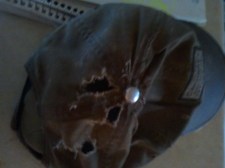
I don’t know when or where I purchased the brown baseball cap, with the words “Carharrtt  manufacturer Detroit-Mich” printed in brown lettering inside a small fading yellowish box bordered by dark brown.    I have no idea what I paid for it.  It’s just a cap, plain and unassuming.  I call it Cappy.

I like plain and unassuming.  I don’t like calling attention to myself.  I typically don’t like wearing clothes that have printing on them, that advertise something, some product or person or philosophy.   I’m not sure why, I have no problem with anyone else wearing anything like that.  I don’t sit and make judgments on anyone’s fashion taste, although I’m sure there are fashion conscious people out there who make judgments on my fashion sense.  Again, I don’t really give a rip, let them judge me all they want.  Odds are they are right.

I dress to be comfortable.  I typically wear blue jeans and a plain colored Champion t-shirt.  The only thing inscribed on the shirts is the Champion logo, which is pretty small.   I like them because they seem to be fairly durable, they are big enough that they are comfortable – they stretch out enough that they don’t hug my middle aged paunch.  I hate the other shirts I have in my drawer that I’ve outgrown that hug my pot belly – I am shallow enough that I’d rather hide that.

I have several plain denim shirts, either blue or brown, that I wear over my Champion t-shirts.  Add in white tube socks and dirty sneakers, and you have a picture of what I wear probably 85% of the days of the year.

I started wearing caps a long time ago, after I started going bald, although being follicly challenged never really bothered me.  The thing about new caps is that they are stiff, and they haven’t had a chance to adapt and conform to the shape of your head.  Then there is the bill, which at first is straight and stiff, and you need to bend it and put a crease in the middle, so it shades your eyes, and makes you look like a mysterious and tough dude.   There is nothing that makes you feel more like a dweeb than wearing a brand new cap, stiff and clean and sitting too high on your head.   There is a required period of breaking in a new cap that you have to put up with in order to eventually get the maximum effect.  Once a cap is broken in, it becomes an extension of your head, and not only is it so comfortable that you forget you are wearing it, others recognize it as a part of you.

Cappy has been my steady companion for the past several years, and we’ve become very close.   There are acquaintances I’ve made who’ve never seen me without Cappy.   He is by far the best cap I’ve ever owned.  And believe me, I’m not one to get overly sentimental about clothing.

A couple of weeks ago, my wife made the comment that Cappy has to go.  I was shocked and stunned.  We’ve been married for over 31 years, but my first impulse was to reply, maybe you have to go.   I added that being jealous of a cap is evidence of insecurity and other serious character flaws.   That may be so, she said, but it doesn’t change the fact that it’s falling apart, it’s rotting.

Cappy

After she left the room, I took Cappy off and took a long look at him.  What I saw shocked me.  There were two small holes worn through the cloth top, and the edges of the bill are frayed.  In the two weeks since, the holes have gotten bigger, and I’ve also become aware of a slightly unpleasant odor.   In short, Cappy is decomposing before my very eyes.

I still wear Cappy but I know his days are numbered.  I don’t like to think about it, we’ve been together so long.   But even caps fade away and die.   At some time I’m going to have to break down and stop wearing him.   I’m thinking of purchasing a glass case where I can stow Cappy and look at him forever more, but that seems a bit weird.  Besides, he never was much to look at – he was meant to be worn.

I suppose someday I’ll buy a new cap, but I don’t like to talk about that while I’m wearing my trusty Cappy.   Cappy, please know, that even after you are gone, there can never be another to replace you, and you’ll always live on, if not on my head, then in my heart.

Veteran’s Day


Veteran’s Day.  We drop a line on Facebook for all our ”friends” to see.   We pay tribute to them as our heroes.  We even write a couple of paragraphs on our web pages, so everyone can see how caring and appreciative we are.  We wave the flag and “support our troops” and congratulate ourselves for our sensitivity and patriotism.  Then we go about the rest of our day, and the next day, and the next, and they are removed from our thoughts, those who fought in Europe and Asia in World War Two, in Korea, in Vietnam, in Iraq, and even those who are still fighting and dying in Afghanistan.

For us civilians, for those of us who never served, Veteran’s Day is just a day, and it makes little difference if we remember it or not.

We watch the news through whatever political lens we view the world, and we listen to the talking heads briefly discuss surges and deadlines and drones and IEDs and which party or politician stands to gain or lose, before they move on to the more “important” issues, like the economy and taxes and contraception and abortion.  To those of us who’ve never experienced it, war is a distant and incomprehensible concept.   I don’t know but I’m guessing that the main thing that we who haven’t fought in a war can’t understand is what it feels like to have people trying to kill you, and what it feels like to be asked to kill other people.   Veterans are the ones for who war is a reality, who survived, the ones who are expected to come home and return to normal, as if nothing ever happened.   It’s easy to identify heroism on the battlefield, the Medal of Honor winners, the courageous acts in extraordinary circumstances.  It’s a little more difficult to recognize heroism in the every day.

This Veteran’s Day I’m thinking of a guy I used to work with who fought in Vietnam.  We worked together for eleven years, and we had a ball.  He is one of the funniest people I’ve ever met, with a wonderful ability to laugh at himself.  He is kind and caring and gentle and unassuming.  He is a good father and husband.  To me, he’s always been a good friend, one of the best.  We worked close enough for a long enough time  that he  shared some of the nightmare he experienced over there, and some of the problems he had adjusting to coming home.   I can’t even begin to imagine.

I’ll never know what it felt like to be over there, and I’ll never know how difficult the burden of those experiences has been to carry all these years.   I just know that he is a kind and decent man and a good friend, and that he’ll always be a hero to me.

God’s Birthday


A late October day
a morning thick with frost
Alone on a country road
dead leaves scattered and tossed
While walking in the bright early morn
beneath a blue and cloudless sky
past the dead and dry and uncut corn
I heard a baby cry
then a crow announced it
plain and forlorn
that God Himself had just been born
 
He had just been born
all shiny and new
somewhere in the woods
hidden from my view
and his naked body glistened
bathed in the morning dew
and the trees bent in deference
to the western winds that blew
 
Who’ll take care of him
when the chill wind blows
when the night gets dark
in the cold December snows
Who’ll protect him
from the known and unknown
He’s just a baby
in a world as hard as stone
He’s all being and He’s all powerful
and He’s all alone
 
Who’ll stand and watch guard for
the priests and prophets and the worst
of the saints and the martyrs
the blessed and the cursed
with their sin and their faith
and their bibles and prayers
and their unquenchable taste
for his blood and flesh and hair
 
Now every year when I find myself
under the late October sky
I walk down that country lane
and I listen for his cry
but I hear nothing
in the air cold and gray
Then the clouds pass by
and the sun lights the day
and the cold wind sighs
that it’s God’s birthday

Outrage


I’ve made a point not to get political on this site.   This is not a political post.    Those who know me know which way I lean, but that is neither here nor there.   I have no intention of swaying anybody.

I respect our constitutional right to free speech as perhaps the most sacred of our rights.   But sometimes, when that right is exercised in a careless and hurtful manner, I feel compelled to exercise my right to express the outrage I feel.

Near the local post office today, a couple set up a table with some literature and some signs facing traffic. The signs were of the anti-Obama variety.  There is nothing wrong with this.  These people are actively engaged in the political process.   They have every right to denounce the president, whether on his handling of the economy, foreign policy, or social issues.   They even have the right, despite all evidence to the contrary, to believe he wasn’t born in the United States, or that he is a Muslim.

It was one of the signs that sparked my outrage.  The sign said that if elected, Obama would start World War Three.   Again, I have no problem with anyone believing that.  What I do have a problem with is that the sign included a photo of Obama, with a Hitler moustache painted on.  This is what set me off.

A reminder of who Hitler was.   He exterminated more than six million jews, and he started a war that killed over 60 million people, or 2.5% of the world population.  More than 416,000 American troops were killed in World War II.

You may disagree with Obama’s policies and his beliefs, but it is careless and lazy to compare him to one of the biggest monsters the world has ever known, and one of our country’s most despised enemies.  Above all, it is disrespectful, not only to Obama and the office of the presidency, but also to all those who died at Hitler’s command, to the generation that sacrificed so much, sacrifices that have allowed subsequent generations to survive and prosper.   Such a comparison trivializes the horrors of the holocaust and the heroism of those who fought so hard and gave up so much to defeat evil at its most powerful.

I understand that in a tightly contested race, emotions run high on both side.  Rhetoric is used carelessly by all sides.   Exaggeration and hyperbole are symptoms of passion.   In the past, I have let emotions get the best of me, and made outrageous statements.  So I don’t intend to come across as holier than thou.

I know it is only a moustache painted on a sign, and the intent may have been satirical or ironic, but I’m, sorry, it doesn’t come across that way.  Not to me.  For me, this crosses a line, a line that is painted in the blood of innocent victims and heroes who deserve more than to be trivialized to make a cheap political point.

He Took a Shining to Shining


In 1939, with the Nazi occupation of Poland imminent, Leopold Stowski, the brilliant and famous chemist, tried to flee to the United States, but the U.S. had recently enacted strict immigration laws, taking in only individuals who could claim physical or economic hardship.  Fearful for his life and desperate to get out, Stowski  posed as a crippled polio victim, confined to a wheelchair, and assumed the identity  Joseph Paski.   Friends at the State department helped him produce the required documentation, and soon Stowski was on a steamer to New York as Paski.

Once in New York, life was difficult for a crippled immigrant, and times were hard.  The only work he could find was shining shoes in the street.  Never the less, thankful for having saved his life, he enthusiastically embraced his situation, and went about shining shoes with great zeal.   As the days went by, he found that, after a good rain, he was shining the same shoes he had just shined before it rained.   The commercial shoe polishes he was using didn’t hold up to moisture.   Being the brilliant chemist he was, he went to work, in his dingy one room apartment, and soon he was able to invent a shoe polish that was completely resistant to moisture, and, in fact, came out of the rain shinier than before.  He quickly patented the invention, and sold the technology to the U.S. military.  Dwight Eisenhower, in fact, attributed a great deal of the success of the Normandy Beach landing to the polish, saying “Without the worry of our combat boots losing their luster on the amphibious landing, our soldiers were able to focus on the task at hand and ultimately triumph.  The whole nation owes the inventor of this substance a great deal of gratitude.”  So it was that the crippled polish immigrant Joseph Paski  became rich and famous, the inventor of what was now known as the “Polish Polish.”

Paski was suddenly wealthy and a national hero.   He moved into a palatial estate in Hollywood, his secret still undiscovered.  No one had ever seen him out of his wheelchair.   Then, one day, the FBI received an anonymous tip that Paski was really Stowski, and was in fact a fraud.  This taped conversation from the FBI archives shows agents Ham and Cheese discussing the tip while undercover at the local Tastee Freeze:

HAM:   So Paski isn’t really Paski?

CHEESE:  That’s right, Paski is Stowski.

HAM:  Pask is Stowski?

CHEESE:   You got it.

HAM:  And he’s not really a cripple?

CHEESE:  Nope, that’s all an act.  He’s a fraud, he’s not valid.

HAM:  He’s not valid?

CHEESE:  Nope, he’s invalid.

HAM:  So he’s an invalid invalid.

CHEESE:  That’s right.

HAM:   Then we’d better arrest him.  Make sure he gets his just desserts.  Done with your ice cream?

CHEESE:  Yeah, but I’m still hungry.  Do they sell lunch here?

HAM:  No lunch, just desserts.

Time went on and Ham and Cheese moved in on Paski, monitoring his every move, giving him no breathing room, on his back night and day.   The stress was wearing Paski down, until one very hot day, while visiting the circus, he turned to the men and asked, “Why you no leave Paski alone?   Why must you be so pesky to Paski?  What are your names, anyway?”

“We’re federal agents Sam Ham and Jack Cheese,” Cheese replied.

“Sam Ham?”  Paski asked.

“That’s right,” Cheese replied.

“And Jack Cheese?”

“That’s enough,” Ham interrupted.  “It’ll do no good to pepper Jack Cheese with questions.”

Paski couldn’t take the stress and lashed out.  “I’m so sick of you two, I can’t stand it.  It’s always with one of you on each side of me.  It’s as if I was in a Ham and Cheese sandwich.  Please, leave me to my Polish Polish.”

“We will, if you confess that you aren’t really crippled, that you are in fact an invalid invalid, and that you aren’t Paski, you are Stowski, we’ll try and go light on you.”  Cheese said.

Ham, who suffered from a nervous stomach, asked to be excused.

“Why?” Cheese asked.

“It’s so hot here at the circus,” he said, sweat pouring off his brow.

“You do look like you’re baked, Ham,” Cheese observed.

“I am.  In tents, the heat gets really intense, and my stomach feels just like that time on the flight to Chicago.”

“You mean when you …”

“That’s right, “ Ham replied.  “ Like that time I flew with the flu.”

Cheese excused Ham, but Ham fainted.  Cheese grabbed him, and Paski got out of his wheelchair and helped him lean Ham against the wall.

“Thanks,” Cheese said, then said, “hey wait a minute.  You helped me lean Ham.”

“Yes, so whatski?”  Paski was standing next to Ham.

“You’re out of your wheelchair!   You are an invalid invalid!”

“Oh,” Paski said, realizing the jig was up.

Paski was arrested, and the story became big news.   The press grilled Ham and Cheese.  Paski was exposed to be Stowski, and his reputation was ruined, his fortunes squandered.  He was no longer a national hero.  In the lowest depths of shame, he went to Niagara Falls, intent on jumping over and ending his own life.  Once he got there, though, he was overwhelmed by the sheer beauty of the rock formations and was unable to go through with it.

You might say that it was the gorgeous gorges that saved the invalid invalid, the inventor of the polish polish.

Home Team


My house stands on a dead end street on land that was once part of a large farm.  In the late 1940s, a chunk of the farm was divided into two and a half acre parcels and sold off.  One of the parcels, just south of the original farm house, part of an enormous apple orchard, was purchased by a young married couple.   He was an electrician, and in 1948 they built a small home, no bigger than a one bedroom cottage, less than 700 square feet, and started a family.

They quickly outgrew the original structure and added on three bedrooms, converting the cottage to a 1,200 square foot ranch.   They also added an attached single car garage, and later, an additional unattached two car garage.  They had three children.   The handprints of each family member along with their names and the date are still visible in the hardened cement of the unattached garage’s floor.

They lived in the house for 36 years, raised their children and finished their careers.   Ready for retirement, they sold the house in 1984 and moved to Arizona.  On Saturday, November 3rd, 1984, my wife and I moved in to the house.

We’d been married for three years.  Having lived through the inflation of the late 70s and the recession of the early 80s, buying a home of our own was a dream we never expected to come true.  But it did, and the house was perfect for us, it fit us like a glove.   I remember that first night, I slept so sound.  It immediately felt like home.

Soon we started a family, our first son born in 1985, our second in 1989, and our daughter in 1994.  When our first son started kindergarten, he was the only child waiting at the bus stop where the dead end street began.   The rest of the street was occupied by older people who had already raised their children.   We were the young couple.  Soon, they began moving out, and gradually more and more young families moved in, and more and more kids would show up at the bus stop.

In 1996, we decided we’d outgrown the house, too, and built an addition of our own, a second floor, essentially doubling our living space.  The street had changed, as more and more of the 2 ½ acre parcels were split up and additional homes were added.

Then, as our kids grew and started college, the number of kids at the bus stop started to dwindle.  Soon a subsequent generation of kids started to show up at the corner.   We were no longer the young couple on the street.  Now, 28 years after moving in, we are one of the oldest couples.

It was 64 years ago that the original structure was built.  Only two families have lived here in all that time.  I look at the date the hand prints in the cement of the second garage were made.  Without revealing the year, it was October 8th, exactly two days before my wife was born in a naval hospital in Norfolk, Virginia.  So my garage is essentially the same age as my wife.  What that means I’m not sure, and I’ll resist the temptation to remark how well built both are.

But I know this much:  I’m an excellent builder.   Right now, those who know me well, who have witnessed my ridiculously limited carpentry skills, are laughing hysterically.   But it takes more than a hammer and nails to build things like a marriage, a family, a home, and a lifetime.  It takes work and love and commitment, and, more than anything, to do it right, it takes a partner, a soul mate, someone who is willing to stand beside you in the rain and snow and the heat and cold.  The world my wife and I built has been strong enough to weather the storms of time, and our love remains unchanged by the corrosive forces of fate and circumstance.

Accomplishment


Last Saturday, September 22nd, 2012, I finished the last chapter to my novel.  Since then, I’ve been going back over it, to see if it’s readable, if it’s sequenced correctly, if it’s properly paced, and looking for major inconsistencies in character placement and chronology and setting and so forth.  Then I’ll have to go back through it with a keener eye and start editing, looking for the grammatical and stylistic shortcomings that are all too often overlooked whenever one reads his own manuscript.  In short, there’s still a lot of work to be done before I dare submit it anywhere.

That being said, I still feel a tremendous sense of accomplishment and pride.  Not that it’s a great book or anything, but I did it, I’ve written a novel, even if it is only a rough first draft.   This is something I’ve dreamed of doing all my life, and about the fourth time I’ve tried.  The other three attempts were undertaken at various points in my life and were miserable failures.  I’d  get about  50 to 100 pages written and realize that what I was writing was crap and was going nowhere.    More than anything, I didn’t have the will to stick with it, to get rid of the crap and salvage the scraps that were good.  I was unwilling and unable to learn from the process.

I’ve always been able to write.  In school, it was one of the few things I did well, and I was able, with a minimum amount of effort applied, to consistently have my papers read aloud by my teachers.  I recognized that I’d been born with some talent.  It came easy for me.

That was the problem.  Soon after I was out of high school, I tried to sit down and write, some short stories and my first attempt at a novel.  I quickly found that, gift or no gift, writing, when not given a specific assignment and a deadline, is damned hard work, and requires discipline and determination, two things that I had no concept of, two things that quickly sucked any joy out of the endeavor.

So any dreams I had of writing were put on a shelf somewhere in the dusty attic of my mind.  I went to school, focusing on the more economically viable and growing field of Information Technology, and started a career and raising a family.  I grew fat, dumb, and happy – seriously happy.  I loved my life as a husband and a father, and found both roles to be extremely gratifying.    For the most part, I enjoyed and took great satisfaction from work.

Still, from time to time, while putting other things away, I’d stumble across those musty attic shelves and blow the dust off my writer dreams and attempt another go at a novel, the memories of praise from high school teachers and my mom serving as inspiration.  It didn’t take long for me to realize that trying to impress your mom isn’t a good enough reason to write, especially when you realize she’s your mom, and is pre-disposed to liking anything her child produces.   Mainly, I still wasn’t ready for the perspiration, the hard work required.

Then in early 2005 I was diagnosed with Parkinson’s disease.  Not long after my diagnosis, I began to suffer from serious sleep irregularities.  I found myself up in the middle of the night, unable to go back to sleep for hours at a time.  One night, tired of playing the sports simulation games I normally passed the time with, I opened up Word and started writing.  I started by writing descriptions of vivid dreams and childhood memories that had recently been flooding my mind.  I went on from there to write essays describing my experiences with Parkinson’s.  It occurred to me that maybe my children would someday find value in knowing what their old man was going through, what he was thinking and feeling and what he was doing in the middle of the night.  I finally had a reason to write, and more importantly, a desire to get better at it.

I joined a local writers group (the Kenosha Writer’s Guild), not knowing what to expect.   It was the best thing I’ve ever done.  They were kind and generous and supportive in receiving my work.   More importantly, I found amazing and diverse talents in the group.  I’ve learned so much from their support and critique of my work, I’ve learned even more reading and critiquing theirs.

I wrote a series of essays and tried to get a collection of them published as a memoir focusing on my experiences with Parkinson’s.  I had a couple of feelers from a couple of literary agents, but they both eventually turned me down.  I could see why; I knew what I was lacking, and that I just didn’t have it in me to fix them yet.  It’s not that I wasn’t willing to put in the work, it was more a realization that the story I wanted to tell wasn’t ready yet.  This plus the fact that I was growing bored with the subject of the memoirs – me – lead me to, almost two years ago now, start work on a novel.

At first, the thought of writing fiction, especially a long work of fiction, was daunting.  I’d become very comfortable with the essays and memoir material, learning to some degree how to craft personal experience into something a bit more universal, how to articulate my view and experience of the universe in a way others could see and relate to.  In fiction, it seems you have to create the universe first.  I’d have to articulate what I imagine, and that seems much more personal than the fact-based world of memoirs.

But that quickly went from daunting to liberating.  It was the realization that in fiction, you can still describe what is important to you, but you are no longer limited by the constraints of experience.  If you strongly believe something but you don’t have fact based experience to support it, you can just make something up to fill in the gaps.

Still, I knew nothing about writing a novel.  When I started, I had a setting that I wanted to write about, and a handful of characters, but I really didn’t have a story.  So I dove into it, and soon a story began to reveal itself.  I followed it for a while, but I quickly found it wasn’t going anywhere I was interested in.  I still liked the setting and most of the characters.  So I started off on a second storyline.   Like the first, it wasn’t going anywhere.

What I had at this point was a setting and some characters and some random, disconnected stories about each of the characters, but still nothing to connect them.  I then decided, screw it, I’d write one of the stories and see what happened.  The story was about a middle aged woman who is married to a man with one leg and has an affair with a second one legged man.   I wrote the story, and when it was done, I thought, this is the best fiction I’ve ever written, there has to be something there.   I then wrote another story, with one of the main characters from the first, and I liked the second one even more.

At about the same time, I read the book,  “The Temple of Air”, by Patricia Ann McNair, a collection of loosely connected short stories about a Midwestern community.  It’s a great book, it knocked my socks off, and for a while, I thought, that’s what I’ll do – I had all these story lines and characters, I’ll just keep writing the stories and see what happens.

Eventually, though, I was able to find the thread that connected the stories, and wrote several chapters that were strictly transitional – so it seems I have a novel after all.

Now I have to tweak it and get it ready to submit.  I am realistic enough about my own talents and the nature of the market place to know that publication is unlikely.   That probable frustration still waits – for now, I am going to enjoy and take pride in the sense of accomplishment of actually getting a first draft done!

The Good, the Bad, and the Crummy


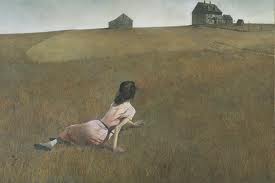
One of my favorite paintings is Christina’s World, by the great American artist, Andrew  Wyeth.  For years now, a reproduction of the painting has hung on my living room wall.  The subject of the painting is a middle aged woman, crippled by polio, who Wyeth observed crawling to her neighbor’s field.  The painting always had an impact on me, the composition that Wyeth uses to dramatically heighten the vastness of the landscape, the absence of trees, the empty sky and the weathered buildings, and the woman, somehow both small and large, dominated by and dominating the landscape at the same time, with her withered arms and twisted feet and faded pink dress.

These days, when I look at the painting, I am reminded of my own experiences with Parkinson’s Disease.  I don’t mean to imply that I am anywhere close to the severity of Christina’s polio.  But I recognize the position Wyeth stages her in, leaning on her side, her arm bent under her, as the same position I find myself in when trying to roll myself over in bed, particularly in the morning, when it has been several hours since I last took my meds.  Everything is slow, from getting dressed to eating to taking the garbage out, and is only getting slower.  So I can relate to crawling across an open field.

If I had to summarize my current condition, I’d divide the days into three categories:  The good, the bad, and the crummy.

The good days are still the vast majority.  On the good days I feel pretty good most of the day.  The “off“-periods (times during which the effectiveness of my medications is wearing off) are four or more hours apart, and when they hit, they aren’t too bad.  On good days, my episodes of daytime fatigue aren’t too bad, usually hitting in the late morning, and a half hour or so sitting in my recliner, awake or asleep, seems to adequately re-charge me.

The bad days are the days when the wearing off occurs more frequently, sometimes as frequent as every three hours, and are more severe.   At their worst, my entire body is overtaken by a discomforting rigidity, or stiffness.   At these times I shuffle more than walk, and at the very worst, every movement, no matter how minor, is very difficult.   This is how I wake up most mornings, and getting dressed, particularly bending over and putting socks on, can take several minutes.  If I’ve eaten too much or the wrong things since I last took my meds, my wearing off periods are accompanied by stomach nausea and/or severe acid reflux.  On the bad days, the fatigue persists, and becomes incapacitating.  The bad days typically occur a day or two after doing something physical, after overdoing it.  There is also a greater likelihood of loss of balance during these times.  I’ve had four falls during the last month.

I built a wooden compost box for my wife’s flower garden, to generate good planting soil.  She puts yard waste, coffee grounds, egg shells, etc. A few days ago, while moving the new box into place next to our barn, I leaned too far forward and fell over the side and right into it. It took me about five minutes to get myself up and out. Another time, about two weeks ago, I was in a public men’s room at a gas station, urinating, when, as the trickle slowed down, I moved forward a bit and apparently had my head bent too far forward. I felt myself falling forward, right over the toilet – fortunately, my head broke the fall, smacking loudly into the wall – I put a small dent in the drywall but didn’t break through.

The scariest fall happened the day before yesterday.  I was carrying an armload of dirty laundry down the basement when I lost my balance and fell hard down the last three steps.  The scary thing about these falls is you can feel yourself losing your balance, it’s like it’s in slow motion, but you can’t get your arms or hands up quick enough to brace yourself.   I was lucky in that I only wrenched my right knee, it could have been a whole lot worse.  But, of course, the next day not only did my knee hurt, but the off-periods were more intense because of it.

I’d estimate that currently the good days outnumber the bad days by about three to one.

Then there are the crummy days.  A good day or a bad day can also be a crummy day.  Crummy days are the days when I think about my condition, days when I realize how bad the bad days are, and days when I realize that even the best good days aren’t as good as the most average run of the mill days prior to my diagnosis were.  The crummy days are the days when I realize how much I’ve declined, and how much worse it’s going to get.  I also feel, on the crummy days, an incredible sense of isolation, and that I am, like Christina in the painting, a solitary figure in an empty landscape.  In short, the crummy days are days when I feel sorry for myself.

I don’t have too many crummy days.  I normally try to stay positive and keep them at bay.  But I’d be dishonest if I said they didn’t exist.   I think it’s important to do whatever one can to minimize the crummy days, and I think it is equally important to recognize they can’t be completely avoided.  I think it’s important not only that I understand this, but that the people close to me do, too.

I’ve written a great deal about the new perspective I’ve gained since having Parkinson’s and the new found appreciation of every day miracles I never noticed before.  These things are true and real, and they bring me comfort, but in the end, one thing above all remains true:

It sucks to be sick.

If Al Pacino Was My Dentist


(I’m a big Al Pacino fan.  I love the moment that occurs in almost all of his movies where, after being on edge for so long, he finally loses it and explodes – whether it’s “Dog Day Afternoon” or “Scent of a Woman” or “Scarface.”   Nobody explodes like Al Pacino.

For some reason, frequently after watching a Pacino movie on television, I fall asleep and have the same recurring dream where Pacino is my dentist.  It goes something like this ….)

Pacino:  So how have you been?  Any problems with your teeth?

Me:        I’m fine.  No problems with my teeth.

Pacino:  Okay, we’re just going to do a cleaning today and a quick check-up.   Open wide.   That’s good.  (Starts poking around, stops, hits a nerve on the uppers, middle right side.)  Does that hurt?

Me:   (water in my eyes)  Just a little.

Pacino:  There’s some decay in that tooth.  (Pulls his hands out of my mouth and sits back) Have you been flossing?

Me:         Flossing?   Um, yeah, every day.

Pacino: (slowly and softly)  Every day.

Me:        Yep, that’s right.

Pacino:  (slowly and evenly, building)  You’ve been flossing ever day.   Every day.  Yet when I look in your mouth, I’m up to my ELBOWS IN PLAQUE.  AND I’M SUPPOSED TO BELIEVE THAT YOU’VE BEEN FLOSSING EVERY DAY?

Me:         Did I say every day?  I may miss a day or two now and then.

Pacino:  (Calmly) Tell me, Dave, how long have I known you?

Me:        I’m not sure …

Pacino:  How long have I been your dentist?

Me:        Well, let me see now, it’s probably been five or six years.

Pacino   (pulling out my file):  Why don’t you try SEVENTEEN YEARS!   SEVENTEEN YEARS I’VE BEEN YOUR DENTIST.  AND FOR SEVENTEEN YEARS, I’VE BEEN ASKING IF YOU’VE BEEN FLOSSING, AND I ALWAYS GET THE SAME ANSWER.

Me:        I might have overstated the frequency a bit.

Pacino:  WHO DO YOU THINK YOU’RE TALKING TO?   WHY DO YOU THINK YOU CAN LIE TO ME?

(The hygienist enters)

Hygienist:  Doctor, the x-ray machine seems to be out of order.

Pacino:   THE X-RAY MACHINE?  THE X-RAY MACHINE IS OUT OF ORDER?   ARE YOU KIDDING ME?  THIS WHOLE OFFICE IS OUT OF ORDER!

Me:        Maybe I should come back some other  ….

Pacino:   YOU AIN’T GOING NOWHERE.  I’M JUST GETTING WOUND UP!  Now, when was the last time you flossed?

Me:  (nervous)  The last time?

Pacino:  (wielding a drill) Just answer the question.

Me:   (sweat on my brow)  Oh, I guess, a week or two ago.

Pacino (revving up the drill):  SAY HELLO TO MY LITTLE FRIEND!

Me:   Ok, not a week or two.   I confess!  I’ve never flossed!   I don’t even know how to hold the stuff! (Suddenly a defense mechanism kicks in and in the dream, I turn into Jack Nicholson)

Pacino:   Okay, that’s better.  Now let’s take a look at that bad tooth.  Open wide.

Me (Nicholson):  Sorry, Al, no can do. All work and no play makes Al a dull boy.

Pacino:  I said, open wide.  I need to LOOK AT THAT TOOTH !

Me (Nicholson):  THE TOOTH?  THE TOOTH?  YOU CAN”T HANDLE THE TOOTH!

(At this point I wake up with an overwhelming urge to rinse)