A Bun Named Amy


Last night, the writing group I belong to, the Kenosha Writer’s Guild, had one of its regularly scheduled extended critique meetings.  I submitted an excerpt from the novel I’ve been working on.  In the excerpt, there’s an early morning scene in a hospital where the main character encounters a new, minor character that I introduce with the following sentence:

At that point, one of the nurses, a thirtyish woman with thick glasses and black hair all tied up in a bun named Amy, walked past in the hallway.

Forget for a moment that the sentence’s first clause, “At that point,” adds nothing and serves no purpose.  The main problem with the sentence is that I named the bun, and not the woman.

This was pointed out to me by one of my fellow writer’s group members at last night’s meeting. We had a good laugh at my expense, and although I was slightly embarrassed, I wasn’t surprised.

I’d read through the piece many times before the meeting, and made a lot of corrections.  But for some reason, glaring as it might be, I never saw the bun named Amy.  This is consistent with my experience, that no matter how diligent I might think I am in self-editing, I always miss things.  This hasn’t been true for only my creative writing, it was also true when years ago, in a previous life as a computer programmer, I’d always miss bugs in the code I was writing or testing.  There is a natural inclination in both forms of writing to glance over what you aren’t worried about, those little pieces of housework that are simple and unambiguous, and focus on the more complex content, the parts where you put in more work.

For what it’s worth, given that it’s coming from the author of a bun named Amy, my advice to other amateur writers out there is to join a writing group as soon as possible. Not only does a writing group provide you with a mechanism to have your work reviewed by fresh eyes, more importantly, it gets you away from your desk and out with people who share your passion, who understand what it is to be driven to tell stories.

A couple of years ago, I was at a big weekend writers’ conference in a hotel in downtown Madison.  One night, I was in the hotel bar, where I met a couple of other writers.  One was a quiet young guy in jeans and a black t-shirt, in about his mid-twenties, who’d written a sci-fi/fantasy novel.  The other guy was a sharply dressed lawyer by day who’d self-published three crime novels by night.  The lawyer asked us what we thought about writing groups.   The young guy responded that he had no opinion, that he’d never belonged to one.  I started to explain that I found mine to be extremely valuable, when he interrupted me.

“I think they’re a complete waste of time,” he said.

“Why’s that?” I asked, as if I had any reason to believe he wouldn’t tell me if I didn’t.

“Because all they do,” he said, “is tell you how great you are. I need more than that.”  He then proceeded to spend the next two hours telling me how great he is, pontificating on everything writerly, from rules about dialogue to why the big time agencies and publishing houses were too screwed up to recognize his greatness.  At some point, the younger guy somehow escaped, as I looked up from my beer to his empty chair, while lawyer-writer guy droned on and on and on.

Finally, the guy shut his mouth long enough to take a sip from his goblet of wine, and I was able to excuse myself and go back to my room. The guy was a pompous ass and a fatuous bore, but a part of me understood what he said about writing groups.  They can be too nice. They can be too busy being supportive when what you might need is some harsh and blunt criticism.

But then I thought about it, and I realized how wrong the douchebag was.  The thing with writing groups, at least my writing group, is that you get different levels of writers writing in wide and diverse genres and styles, not to mention skill levels. You get so many different perspectives.  The only common denominator is a love of and shared passion for writing.  It’s people who have full lives with work and family, but are still driven by the need to express themselves, to put something down.

Critiques tend to be respectful because most of the members respect one another, and respect the investment of time and emotion that goes into creation of each piece. It’s the creation of art at its most basic and pure level:  nobody is getting paid for their work, and each member is driven to write what they write by something that’s moved them. They may be inspired by a specific artist or genre, or by events in their lives, or any number of things. The point is, nobody forced them to write what they choose to write, or to even write in the first place.  The quality of their output is secondary – that they’ve been moved to put something down is worthy of admiration and respect.

Learning to understand this is the main reason to join a writing group.  Once understood, you realize that you are not alone, that maybe this strange thing you have inside isn’t as unusual as you thought it was.  Once you learn to respect these things in others, you start to respect it in yourself. This is after all why we write – to better understand not only the world around us, but to better understand ourselves, who we are.  This not only helps us make sense of the world, it makes us better – better readers, better writers, better people.

Left and Right, Right and Wrong


A couple of questions that have been bothering me for some time now:

Why do the Democrats so consistently lose elections?  Why are Republicans in control of both sides of Congress, and why do they have a good chance of winning the Presidency in 2016?

Well, I’m certainly not an expert. I’m no political scientist. But this is still America, and I’m still allowed to have opinions, no matter how unqualified I might be.

So here’s what I’ve come up with …

In a fight, the surest way to get your ass kicked is to underestimate your opponent. The second surest way to get your ass kicked is not having a plan of attack.  It doesn’t matter how much bigger or stronger you might be, do these two things and you’ll likely lose.  And this is where the Democrats consistently fail.

The Republicans have more money and power behind them, although the Democrats have been more effective in raising money in recent elections, narrowing the gap.  The Democrats have a larger base and their values are more in step with more Americans.

So here we are, at the beginning of the 2016 Presidential campaign, and the front runner for the Republicans is Wisconsin governor Scott Walker, while for the Democrats, the front runner is former First Lady, Senator, and Secretary of State Hillary Clinton.

On the surface, and in the current poll numbers, it doesn’t seem to be much of a match.  Walker is relatively unknown outside of Wisconsin, has an unexceptional record and limited experience, is a college drop-out, and a rookie on the national political stage.  Clinton is currently clobbering Walker in the polls.

But the last thing Democrats should do is feel comfortable and relax.

Over the past thirty years or so, the Democrats have lost their largest and most powerful demographic, the white working class, to the Republicans.  How did this happen? On the surface, it doesn’t make sense. Republican policies enacted over the past thirty five years have resulted in their loss of income, higher unemployment, greater debt, unprecedented class erosion, and diminished individual rights.  Yet this constituency has become the heart and soul of the Republican Party, aligning with the very same corporate masters and tycoons who have taken these things from them.

So why has the white, working class become more conservative?  Democrats struggle to understand this and until they do, they’ll be unable to adopt an effective plan to reverse it. One thing is clear: this demographic is not stupid, apathetic, lazy, or racist, as liberals too often tend to dismiss them.  This only feeds into the Republican portrayal of the left.

The conservative movement has effectively depicted the Democrats as upper class, elitist, arrogant, permissive, and immoral.  The right makes emotional appeals based upon this and drives home the point that they are being threatened, that liberals want their guns, that immigrants want their jobs, that minorities want preferential treatment. They’re told that conservatives share their values of hard work, self-determination, and morality, and that all of these things are under siege from the left.

Elements of pop culture are held up as examples.  Rap music reinforces the image of inner city African Americans as violent gangsters to be feared.  Hollywood is portrayed as elite and promiscuous and immoral, promoting reckless values of gay rights and graphic sexuality and violence.

These messages are driven home daily by what Hillary Clinton accurately referred to nearly twenty years ago as a “massive right wing conspiracy.”  The air waves are filled with the vitriol of Rush Limbaugh and Sean Hannity and Fox “News.”  It’s amazing how consistent these talking heads are in message and how strongly they stay on point, driving home whatever their corporate commanders have deemed to be the talking points of the day.

The overall unifying message paints a picture of the world drawn in black and white, without the colors of nuance or subtlety or complexity. People buy into this message because it is constantly hammered into their brains, and it installs and intensifies primal fears. Fear has no room for ambiguity.

The reaction to the film American Sniper (which I confess I haven’t seen yet) is an illustration in point. The conservative view is that Chris Kyle was a hero, that through his killings he was saving countless other American lives, and that he suffered from the trauma of war.  These are not simplistic or unsophisticated views. What seems to be lacking in any serious discussion of the movie or Kyle is any deeper ambiguity related to questioning why we over there in the first place, or what the culture of war and militarism does to the psyche of individuals and groups, or to even suggest a level of discomfort in the counting of the confirmed number of kills of human beings.  To the conservatives, to even raise these issues is to question the heroism of Kyle, and to lump you in with the bleeding heart whiners who don’t appreciate the sacrifices of our troops.  To be clear, I haven’t seen the movie, and once I have, I might feel that these issues are moot.  But I can’t help but feel that by simply wanting to have an honest discussion about them would be worth exploring, but the right immediately shuts down at the mere suggestion of deeper complexity behind these concepts.

But the right isn’t the only side that shuts down and resorts to labeling.  I’ve seen, in disagreements about other issues, left leaning people lump intelligent and thoughtful people on the right in with the radical and hysteric tea partiers, and write them off as uneducated gun toting religious fanatics.

This is where the left fails – it doesn’t take its opposition seriously. Walker goes to London and gives non responses to questions about evolution and the left eviscerates him for it.  Then, Rudy Giuliani makes some ridiculously stupid and offensive remarks about President Obama, and Walker gives “no comment” type of replies.  The left then goes nuts about Walker, and Walker replies that he’s not going to waste any more energy responding to such nonsense, and that he prefers talking about the issues, about his bold ideas and plans.

It’s an ingenious strategy, and illustrates how the Republicans are better organized and tougher than the Democrats.  Giuliani, who is even less relevant these days than Sarah Palin, takes one for the team, and throws himself under the Walker campaign bus.  Walker stays above the fray, looking serious and presidential. The bigger the fuss the left makes about Giuliani’s idiocy and Walker’s non-committal responses, the more Walker benefits.  My recommendation would be that the left forget about Giuliani and discuss what Walker pretends to want to discuss:  the “real” issues.

But before we get to the issues, let’s take a look at what seems to be the biggest component of Walker’s strategy:  union busting. Nothing is more at the core of Walker’s platform than standing up to corrupt union bosses and the “powerful” special interests of organized labor.  Never mind that it’s an easy target – organized labor has never been weaker and union membership has never been lower.  Those union bosses and special interests have been on life support since the 1980s, since President Reagan fired the air traffic controllers, and since President Clinton signed the North American Free Trade Agreement (NAFTA) into law.

But that doesn’t mean organized labor won’t go down without a fight. And trust me, Walker is counting on it.  It’s another example of how the Republicans have learned how to turn opposition into opportunity.  When Walker faced recall over his removal of collective bargaining rights to public employees, he used the demonstrations in Madison to his advantage, portraying the protesters as an angry mob. In his memoir, Unintimidated, clearly written to frame him as a presidential candidate, he exaggerates threats from the protesters to a degree that would make Brian Williams blush.  It’s no coincidence that now, as he begins his presidential campaign, he proposes a state budget with insane cuts to education.

Walker and the organized right are counting on two things: loud and chaotic protests from the opposition that he can “heroically” stand up against, and the left’s usual disorganized underestimation of the right.  Both serve to energize the conservative base.  Too often the left counts on their own presumed intellectual superiority, and you’ll hear, “I can’t believe that so many people are stupid enough to vote for Walker.” The left has to stop this and recognize not only that the right is just as smart as they are, but that such comments are incredibly destructive.

So if the right is just as smart as the left, why would they vote for an idiot like Walker?  And make no doubt about it, when it comes to the issues, Walker is a complete idiot.  His bold ideas consist of a couple of shallow Koch brother talking points, and when he is forced to explain them in depth, his intellect is as exposed and shriveled as a naked man’s privates in the February Wisconsin air.

When it comes to issues, the Republicans have been extremely effective at framing discussions to twist and distort their intentions.  A few examples:

  • “Right to Work” laws: This term has come to be accepted for the union busting laws being pursued across the country, when in fact they are intended to take away worker rights; primarily, the right to collective bargaining.
  • “Job creators:” At the heart of the Republican unending faith in trickle-down economics is the premise that over burdensome taxes and regulations imposed upon corporations are impacting profits and preventing their leaders from creating more jobs. The truth is increasing corporate deregulation and lower tax rates have resulted in epic job losses, as the increase in revenues has been funneled to dividends, shareholders, and obscene bonuses paid to the CEOs and Boards of Directors. The typical mantra of any CEO is “We have to deliver value to our shareholders by doing more with less.” I’ve never heard of a CEO who said, “Our goal is to hire more workers.”
  • “Big Government:” This has become an excuse for further deregulation and more corporate autonomy.  It’s been very effective, and with the current dysfunctional, do-nothing congress being so inconsequential and incompetent, it’s become a self-fulfilling prophecy. But the alternatives to “big government” have already proven disastrous, with banking deregulation leading to the “too big to fail” collapses and bailouts. What is really needed is “effective government,” government that serves people and not corporations (which, no matter what the Supreme Court says, are two disparate entities with conflicting interests).
  • “Liberal” and “Patriot:” Republicans have effectively changed the meanings of these two incendiary words. “Liberal” has come to be associated with “un-American”, and “Patriot” is associated with Christian conservatism. These words are used to define a narrow value structure that reinforces the divisive rhetoric in the messages broadcast from party headquarters.  Look at Giuliani’s comments about President Obama this week – he claims he’s never heard Obama express a love of America (not a “patriot”) and that Obama was raised by Communists (he’s “an un-American liberal”). What’s interesting is that these ridiculous allegations have been raised for eight years now, and continue even in a Presidential campaign Obama will not be a participant in. The reason isn’t that Giuliani actually believes these things, or that they are remotely relevant to anything, but that they give an opportunity for Walker to portray himself above the fray, even as old attitudes and prejudices are reinforced.

So how do the Democrats win back the base they’ve lost? I don’t know.  I’m really not very smart.  The best I can come up with is this – the Democrats need to take the fight to the Republicans, and not stay on the ropes taking punches.  The Republicans have been very effective at making the Democrats play defense.  In 2004, they “swift boated” John Kerrey, questioning his service in Vietnam, deflecting attention from the miserable failure that was George W. Bush’s incomplete service in the Air National Guard.

I observed a local example of this a weekend or two ago on Milwaukee television, on a Sunday morning panel talk show hosted by local conservative radio personality Charlie Sykes.  The topic was related to Walker and his budget proposal to cut more than $300 million from the state university budget while at the same time proposing $220 million in new taxes to support the financing of a new arena for the NBA franchise the Milwaukee Bucks. A couple of weeks earlier, after receiving pressure from the powerful Potawatomi Indian tribe, owners and operators of a large casino in Milwaukee, Walker announced his determination to deny a proposed casino that would be managed by the Menomonee Indians in nearby Kenosha, citing concerns about increased taxes on Kenosha residents.  The Menomonees responded by offering to pay the $220 million to finance the Bucks’ stadium in return for Walker reconsidering his decision, thus eliminating a glaring inconsistency in Walker’s budget.  Walker refused to even consider the Menomonee offer, fueling speculation that his decision against the Kenosha casino was in deference to the Potawatomi rather than concern for the Kenosha tax payers. When the subject of the Menomonee offer came up on Sykes’ talk show, Sykes and the rest of the panel quickly dismissed it, saying the Menomonee offer was insincere and that Walker was correct not to entertain it.

This struck me as incredibly disingenuous, because normally, there is no quicker knee jerk reaction from Republicans than when new taxes are proposed. Imagine if the governor were a Democrat instead of Walker – Sykes and his panel would have been out of their seats and through the ceiling with righteous indignation that the tax and spend liberals refused to even consider the proposal.  But instead, with a Republican governor with presidential ambitions, their principles suddenly evaporated, and the issue was quickly swept under the rug.

And here’s where the Democrats, as usual, dropped the ball.  In the ensuing days, their silence on Walker’s willingness to tax and spend on a basketball team at the expense of the state’s education system, despite an offer from the private sector to alleviate the public burden of funding the new arena, was deafening. It was the sound of another opportunity to point out the inconsistency and insincerity of the Governor’s actions being dropped and squandered.

The Democrats need to avoid engaging the Donald Trumps, Sarah Palins and Rudy Giulianis who are designated to stir things up and distract, and call the Republicans on their lies and inconsistencies. They need to hold the Republicans accountable.  They need to play some offense from time to time.

More than anything, Democrats need to illustrate how harmful Republican policies have been to this core constituency.

On an individual level, I know from experience that it’s extremely difficult to change even one person’s mind.  It’s downright impossible if you insult or personally attack his character or intellect. But that’s what happens when we discuss politics – it almost always becomes emotional and personal.  As StevenVan Zandt once said, “what’s more personal than your politics?”

Here are some ideas on how to effectively engage someone you don’t see eye to eye with in a political discussion:

  • Show a little respect. Recognize that most of the people voting Republican are kind, decent and caring, and love their families and their country just as much as you do.  Make them understand that we all want a better world for our children, and we are more alike than different.
  • Don’t take the bait – try not to engage in the emotional divisiveness from the Limbaughs and Hannitys. Don’t make things personal. You’ll just waste time and energy and punch yourself exhausted long before you get to the final rounds.
  • Stay on point – the key is making people understand how the policies advanced by the Republicans will harm them. In Wisconsin, for example, make them understand that we have one of the best education systems, at all levels, in the country, and that Walker’s proposed budget will decimate that, and how our children and their children will suffer real and long term intellectual and economic consequences.
  • Be informed. Don’t just scratch the surface of issues, go a little deeper, and check sources. Snopes is a good resource for checking propaganda generated from both sides.
  • Be capable of objectivity. It’s highly unlikely that any individual will agree 100% with everything liberal and disagree 100% with everything conservative. Be open minded. You can’t change anyone’s mind until you’re willing to change your own.
  • Remember who we’re fighting against – it isn’t the ditto head in the next cubicle who spends his lunch hour listening to Rush – even when he spews Limbaugh’s hateful rhetoric verbatim. The enemy isn’t him, it’s the rhetoric – so don’t attack him personally.  Respectfully disagree and calmly describe what you find offensive about the remarks.
  • Be patient and strong – our opponent is bigger, stronger, and better organized than we are. We’re going to have to take a few punches and stay on our feet. Nothing demoralizes a fighter more than taking their best punch square on the jaw and standing unflinched. Be tough and hang in there.  Have a little faith.

In This Corner


One of the books on the bookshelf in my office is Dempsey, the autobiography (as told to Bob Considine and Bill Slocum) of the great heavyweight boxer Jack Dempsey.  On the inside front cover, in black ink, my grandfather wrote, “Nov. 5 1971 – To my grandson David.  I would not want you to be a prize fighter. But you should learn to defend yourself. One never knows.  Chris Gourdoux.”  Since November 5, 1971, was the day after I turned thirteen years old, I can only assume the book was given to me as a birthday gift. One of the things I remember about my grandfather was that Jack Dempsey was a hero of his.  I seem to remember a story about my grandfather meeting Dempsey once, but I can’t for the life of me remember any details.

My grandfather was born late in the nineteenth century (I can’t remember if it was 1896 or 1899), and as a young man, for a period of time, he was a boxer.  How good of a boxer he was, we can only speculate. I found him in the Boxing Records site (boxrec.com). His name is misspelled (Chris Gourdaux), but the date and being from Flambeau, Wisconsin make it unmistakably him. They have a record from only one fight, a six round draw with someone named Joe Blake from Birchwood, Wisconsin, on December 9, 1921, although I know the records are incomplete, that he had more fights than that.

Sometime after the Joe Blake match, he took over the family farm, and his fighting days were over. When I knew him, he was older and retired from both ventures, but, like we all do when we grow older, he spoke with a fondness for those days as a fighter, the days when he was young. He came to visit us in the summer of 1971. I remember asking him what he thought of the first fight between Joe Frazier and Muhammad Ali, which had just taken place, and I remember him saying that he thought Ali was a better boxer, but Frazier was a stronger puncher. I also remember one warm morning stepping out on our front porch and hearing loud snorting sounds coming from the garage.  I looked in to find my seventy five year old grandfather shadow boxing, working up a good lather, and loudly breathing and snorting through his nose, still enlarged and flattened from fights that took place fifty years earlier.

My grandfather died in 1984. What has me thinking about him is a workout regime I recently started at “Go the Distance Fitness,” a small gym here in Kenosha, Wisconsin.  “Go the Distance Fitness” specializes in training boxers, and providing workouts that use boxing training methods. A friend made my wife and I aware of a report on NPR about how a gym in Rhode Island is using boxing training as a method of fighting the onslaught of Parkinson ’s disease. http://www.npr.org/blogs/health/2015/02/02/381937503/fight-back-against-parkinsons-exercise-may-be-the-best-therapy   It’s the latest example of how exercise can help fight the advancement of the disease, and appealed to me immediately, as I have no patience for the treadmill or stationary bike in my basement.  I try, and within minutes I am bored to death, and thinking about that leftover burrito in the refrigerator.

The workout is called circuit training, and consists of two minute rounds at various stations.  There are curls done with weighted balls, there are various punching bags (including a speed bag and a big bag), there are crunches and medicine balls, there’s just enough to work up a good sweat and get you breathing.  It’s all go at your own pace, so if your old and out of shape like myself, you start at lower levels and expend less energy until you’re ready to pick it up a pace.

It’s perfect for me because it gets me out of the house, it isn’t too demanding, it’s fun, and it’s short enough not to become drudgery.  It seems to really help with my Parkinson’s symptoms – I’m noticing already improvements in my balance and posture after working out.  To be clear, this training isn’t designed for Parkinson’s and it’s not considered physical therapy.  It does, however, seem to be similar to other regimes, like music and dance therapy, that have been successful in helping PD patients.  The little bit I understand about the theory behind exercise and Parkinson’s is that people with Parkinson’s have a shortage of dopamine, that their brains are not producing and transmitting enough dopamine to its receptors.  What certain types of repetitive exercise do is establish a rhythm that the brain can adjust to in place of the natural rhythm of the transmission of dopamine that the disease has disrupted.  This is why dance therapy has proved so effective, and why working the speed bag, for example, should also be effective.  This is also why, I believe, that writing has been so therapeutic for me – in addition to giving voice to my anxieties, there is a cadence to writing that when you get on a roll can be downright euphoric.

In my previous post, “The Other Side of the Coin,” I was having a bad day, the combination of Parkinson’s and cabin fever having gotten to me. So far, working out at Go the Distance has helped on both counts, getting me out of the house and making me feel better.  Most importantly, it’s given me back a sense that I can fight this disease, and maybe, if I can’t beat it, like my grandfather against Joe Blake, maybe I can work my way to a draw.

My grandfather wrote, “But you should learn to defend yourself.  One never knows.” I understand now that I need to defend myself against my own willingness to give up.Putting on a pair of gloves a few times a week seems like a good place to start.

“Go the Distance Fitness” is located in Simmons Plaza at 7707 Sheridan Road in Kenosha. It is owned by Dan and Carol Ouimet. Their phone number is 262-654-2741.  Visit them on the web at  http://www.gothedistance-fitness.com/

The Other Side of the Coin


My wife and I went to Menard’s this morning, to pick up a few things for some work needed around the house.  We got there, and as we walked through the parking lot to the store, I noticed a middle aged guy walking with a limp, sliding his right leg along with him as he walked.  Inside the store I noticed another guy, this one with a facial tic that made his head bob and jerk uncontrollably.

Then I noticed another guy, around thirty years old. There was nothing unusual about him, but our eyes met, only for a moment, and I recognized that he was looking at me like I was looking at the other broken people, and I became aware that my rigidity was showing in my walk.

So I’ve joined the corps, the ranks of the broken brigade, the random and anonymous people I’ve so often times noticed in the past. I never imagined that I’d become one of them.

I’m down. I don’t have many days like this, but when I do, they’re a living Hell. I wallow and mope. I am aware of how much my rigid body aches, and the usual coping mechanisms fall short.

On days like today, I tell myself that this wasn’t part of the deal, the aching, the rigidity, the drooling, the losses of balance, the fatigue. I never asked for any of this. All the things I usually tell myself feel like bald faced lies. On better days, I always remind myself that there are any number of people out there who have it a whole lot worse, who’d give anything to trade places with me. But today that argument falls flat, and I can only see myself like I could have been, like I was supposed to be, if not for this fucking disease. The accumulation of things lost becomes overwhelming.

It’s winter and there isn’t a whole lot to do outside. The ground is covered with several inches of snow that drifts up to a couple of feet in some areas, making just walking around the yard a dicey proposition with my impaired sense of balance.  During the weekdays I am alone with my dogs in the house. Cabin fever is definitely setting in.

My fear on days like today is that it’s not me. I look in the mirror and I don’t recognize the pathetic loser staring back at me. There’s no spark of resistance, no fight in his eyes. This is what scares me the most – that eventually, days like this will become the norm and not the exception, and I’ll have given up, admitting defeat.

But, in the immortal words of Scarlett O’Hara, “tomorrow is another day.” It may sound corny and naïve, but sometimes, corny and naïve are all you’ve got.

My Poor Befuddled Ass


There are many things that I just don’t understand.

Several years ago, on a cold and rainy day in late February, I was driving through the small town of Mundelein, Illinois.  As I made my way down Main Street, stopped at a traffic light, I saw, out my windshield on the right side of the road, the statue of liberty, standing in the pouring rain, waving to me.

Well, I said to myself, I wasn’t expecting to see the statue of liberty this morning. I quickly went back over the events of the morning, and was able to determine that no alcohol had been consumed.  No controlled substances of any sort were coursing through my veins. I pinched myself and the resulting pain indicated that I was in fact awake and not dreaming.  I blinked my eyes hard, and when I reopened them the statue of liberty was still there, on the right side of my car, in the pouring rain, waving to me. It wasn’t a hallucination.

Finally, it occurred to me that this statue of liberty wasn’t very tall, well under six feet in fact.  I don’t care how high she held her torch, she wouldn’t make much of a beacon for anybody.  Then I realized it was a person standing in a statue of liberty costume, which, in hindsight, probably shouldn’t have taken so long to figure out.

liberty tax service

But here’s the part that I still haven’t figured out.  Why?  Why would anybody stand in the freezing rain in a statue of liberty costume, waving to the traffic that passed by?  It didn’t take me long to see the sign on the building behind lady liberty that said, “Liberty Tax Service.”

Since that day, I’ve noticed every year in whatever town I happen to be driving through in “tax season,” at least every town that has a Liberty Tax Service office, there’s some poor schmuck in a statue of liberty costume waving to the cars.

And every time I see it, I ask myself, why?  So far, I haven’t come up with a good answer, so it looks like I’m going to have to ask someone else.  Here’s what I’ve been able to determine so far:

  • The decision to advertise Liberty Tax Service with a live person standing in traffic while wearing a Statue of Liberty costume had to come down as a directive from corporate headquarters, because all branches seem to have not only their own statue of liberty costume but also their own poor schmuck.
  • For some reason, this has been determined to be effective marketing strategy, because every year the poor schmucks are trotted out.

This is what baffles me.  There had to be a meeting at the corporate office. Here’s the only scenario that I’ve come up with that makes any sense:

(The scene:  A corporate boardroom.  All of the functional vice presidents are present. The last one to arrive is Chet Campbell, VP of Marketing.  Unlike the impeccably dressed and groomed other V.P.s with their neat stacks of papers and portfolios, Campbell is disheveled and unshaven and empty handed.  His shirt is wrinkled and untucked.  He takes his seat and buries his head in his hands. The other V.P.s whisper to each other in scandalous tones:  it’s obvious that Campbell hung one on the night before.  Just then, the C.E.O., an impressive looking guy named Richard Richards, enters the room and takes his seat at the end of the table as a fearful silence overtakes the room.)

RICHARDS:  I’m going to cut to the chase and get right to the point. Things don’t look well. Our earnings are down and we’re getting clobbered by our competitors. With tax season rapidly approaching, the very survival of our company rests on a new and effective marketing campaign.  I’ve asked Campbell to give us his idea for the new campaign this morning. Campbell, the floor is yours.

(Campbell is still resting his head in his hands.  At first, he is unresponsive)

RICHARDS: (raising his voice) Campbell.   CAMPBELL!!

CAMPBELL: (waking up) Huh?  Yeah?

RICHARDS:  The new marketing plan!  Out with it!

CAMPBELL:  Huh?  Oh yeah, the new marketing campaign.  Yeah, well uh, the thing is …

ROCHARDS: Out with it! Let’s have it!

CAMPBEL:  Okay, okay, um, (obviously making things up as he goes), okay, um, what’s the name of our company again?

RIHCARDS:  Liberty Tax Services

CAMPBELL:  That’s right, I knew that.  And we’re what, we’re an American company, right?

RICHARDS:  (growing impatient) Yes, that’s right.

CAMPBELL:  So that means most of our tax customers are Americans, right?   (Richards nods) Well, what do most Americans think of when they hear the word, “liberty?”

RICHARDS:  The statue of liberty.

CAMPBELL:  The statue of liberty, ooh, that’s a good one.  I was thinking of puppies, but the Statue of Liberty is even better …

RICHARDS:  Campbell, do you even have a campaign?

CAMPBELL:  Yes, yes, of course I do.

RICHARDS:  Then out with it!

CAMPBEL:  Well, here’s my plan.  We take, uh, some poor schmuck – we should have at least one in every office – and we, uh, we buy him a statue of liberty costume and make him stand in traffic outside of the store.

RICHARDS:  That’s it?  He just stands there?

CMAPBELL:  No, he doesn’t just stand there in traffic!  That would be ridiculous!

RICHARDS:  So what else does he do?

CAMPBELL: He, uh, he waves.

RICHARDS:  He waves?

CAMPBELL:  Yes, he waves to the cars as they go by.

RICHARDS:  Then what?

CAMPBELL:  Then, he waves again.  Until the day is over, he stands there and waves.

RICHARDS:  That’s it?

CAMPBELL:  Yes, sir, that’s the new marketing campaign.

RICHARDS:  I’m speechless.  Anybody else want to comment?

JENKINS:  As the Vice President of human relations, do you mean to tell me that we’d be asking our employees to stand in traffic while wearing a Statue of Liberty costume?”

CAMPBELL:  Yes.  Why?

JENKINS:  Don’t you think there’s a safety concern?

CAMPBELL:  Well, it wouldn’t be just any employee. It’d be just the poor schmucks.

(A murmur of disbelief and laughter runs through the board room.  Finally, Richards calls the meeting back to order)

RICHARDS:  Okay, enough is enough.  Campbell, in all my years, I’ve never heard such a, a ….

CAMPBELL:  I’ll go clean out my …

RICHARDS:  I’ve never heard such a brilliant plan!!  It’s so simple!  It’s beautiful in its simplicity!  Jenkins, I want a listing of every poor schmuck working for us from every branch office.  Wilson, order us a statue of liberty costume for every store. And Campbell, effective immediately, you are here by promoted to my job!

CAMPBELL:  But what about you, sir?

RICHARDS:  I have no choice but to let myself go.

CAMPBELL:  Huh?

RICHARDS:  I’m firing me, because I didn’t come up with your brilliant plan. You are the one, the only one who can save this company from collapse.

(Then the scene shifts, to the inside of a car.  A man and wife are driving through town and talking …)

WIFE:  So who are we going to get to do our taxes this year?

HUSBAND:  I don’t know. With the capital gains, the inheritances we received, and the complications with our LLC, they’re going to be incredibly complicated.

WIFE:  So we’ll have to find someone who is very good, a very advanced and senior tax accountant.

HUSBAND:  Yes, it’ll have to be someone we can trust ex … wait, what’s that?

WIFE:  Why, it looks like the statue of liberty!   What is she doing?

HUSBAND:  She’s waving!

WIFE:  Yes, she’s waving to us!  Look, there’s a Liberty Tax Service office!

HUSBAND:  Well, problem solved!  I guess we know who’s doing our taxes this year …

HUSBAND AND WIFE TOGETHER: Liberty!  Liberty Tax Services, that’s who!

I’ve Been There, Too


I’ve been a die-hard Green Bay Packers fan for almost 50 years now, starting in 1967, which was the year of Bart Starr and the “Ice Bowl,’  Vince Lombardi’s last year as the Packers’  coach, and the year they accomplished what was never done before and hasn’t been done since – winning the third of three consecutive NFL championships.  I turned nine years old during that season, and became a lifetime fan, despite the fact it would be twenty nine years until their next championship.

Twenty nine years filled with mediocrity, incompetence and disappointment.  Then, in the 1990s, we were treated to the Mile Holmgren and Brett Favre years, years in which we won one Super Bowl but were contenders almost every season, with the most exciting player in football leading us.  Then Favre was gone and replaced by Aaron Rodgers, who unbelievably is actually better than Favre, and who, in the 2010 season, with Mike McCarthy as head coach, lead us to another Super Bowl win.

Through the years, there have been more disappointments than triumphs, and some historically bad losses.  There was the game early in the 1981 season, against the Atlanta Falcons, that the Packers went into the fourth quarter with a 17-0 lead before self destructing and losing, 31-17.  There was the 1997 Super Bowl, against an inferior Denver team with John Elway where the Packers couldn’t stop Terrell Davis and Holmgren abandoned the run in a frustrating 31-24 loss, there was the “4th and 26” playoff game against Philadelphia in 2003 when Donovan McNabb completed a 28 yard pass to Freddie Solomon on said down and yardage to put the game in overtime, which Favre promptly ended by lobbing up an interception to Brian Dawkins, and there was the 2007 NFC championship game at Lambeau, which again ended with Favre throwing a first possession interception in overtime that lifted the New York Giants instead of the favored Packers to the Super Bowl

But none of those compare to this year’s debacle, the incredible choke job the Packers executed to lose the NFC championship to the Seattle Seahawks.  There were about ten plays that the Packers inexplicably screwed up on, any one of which having been run properly would have ensured a Packer victory.  Each of these had an individual, either a player or a coach to point at.  But none was as glaring as the on-side kick.

By now, you’ve seen the play.   I don’t have to describe it.  There was just over two minutes left in the game.  All the Packers had to do was recover the kick and they’d win.  Game over. So it came down to a little used, third string tight end named Brandon Bostick, who had caught two passes for three yards ALL SEASON.  It was his moment, with the eyes of all the world on him, and in that moment, he tried to catch the kick, even though he had been instructed to block the Seahawk who ended up with the ball, so star receiver Jordy Nelson could do what he is one of the very best  at – catch the  ball.  But Bostick panicked in that moment, and leaped up to catch the ball, only for it to deflect off of his helmet into the Seahawk’s hands.   Put in simple terms – he screwed up.

After the play, after Bostick came back to the sideline, television cameras showed the Packers’ special teams coach in Bostick’s face, screaming at him.  The Packers went on to blunder their way through the rest of regulation and overtime, losing the game and the chance to play in another Super Bowl.

After the game, Bostick, who probably didn’t talk to a single reporter all season, found himself in the eye, the center, of the press hurricane.  He patiently listened to the questions and straight forwardly answered them, pulling no punches, accepting complete responsibility for the screw up, acknowledging the teammates, the coaching staff, and all the fans he’d let down for simply not doing his job.   He spoke softly, and the hurt in his eyes revealed a bruised soul.

With age comes maturity.  In my younger days, I’d brood about a painful packer loss for days.  Now I still get disappointed, but it’s rare that I yell at the television.  I find that, shortly after the game is over, I’m able to move on, and find some perspective.  The sun will still rise in the morning, and the world will continue spinning, and whatever other cliches you can find for life going on.  It’s only a game. This is easy for me to recognize.  But for Bostick, it’s made hazier by the fact that this is his job, this is what he does for a living.  Not only does he have family and fans, he has his teammates, his co-workers, depending on him to do his job.  And he’s let them all down.

Looking at Bostick as he answered the reporters’ questions, I recognized the look in his eyes.  It was the look of eyes that know sleep won’t come easy, that feel the weight of anxiety, that question the daily assumptions one makes about one’s self.  I recognized in his eyes the same story that I’ve lived, the same pressures and self doubts and anxieties I’ve felt in times that I screwed up.

It’s hard enough to face friends, co-workers and family and admit that you’ve failed them.  The most difficult thing is, in the dark of a sleepless night, to stare down your own fears and anxieties and self perceptions and admit failure to yourself.  It’s the unavoidable truth that keeps you awake and exposes the lies and illusions we tell ourselves that most nights go unchallenged.  We make mistakes every day, but normally they are unimportant and undetected, and by the time we close our eyes in sleep at night they are long forgotten, as is the fact that we’re all human and all capable of making that critical mistake at that critical time.

Then comes the day when we make that critical mistake at the critical time, when our fallibility is exposed.  How do we get through times like these?  How do we reconstruct ourselves, our self-esteem, out of the shattered pieces that lie scattered before us?  How do we ever find “normal” again?

The answer is through the grace and understanding of the very people we’ve let down – our friends, family, co -workers.  We gain strength through their caring and understanding.    The same things that make failing them so disappointing are the things we gain strength from.  It’s the bonds of love and respect and lived experience.  It’s the shared and pulsating heart of humanity.

It’s not forgiveness that Brandon Bostick needs right now, it’s recognition.  If we look into his sad and haunted eyes, we’ll recognize our own reflection, and we’ll understand.

Channel Z


Normally I’m pretty good about observing important anniversaries (never forget a birthday or my wedding anniversary) but yesterday one almost slipped by me.   Which is surprising, since I literally can’t get it out of my head.

Yesterday, at about 10:00 or so in the morning, was exactly five years since I had electrodes installed in my head as the first part of my Deep Brain Stimulator (DBS) procedure.  I woke up in an operating room  in Northwest Memorial Hospital in Chicago with my neurosurgeon, the amazing Dr. R., literally in my head, listening to the sound of my brainwaves amplified on what looked like a pretty impressive sound system that played nothing but static.  I had to be awake as Dr. R.’s team talked to me and bent my elbow and listened to the sounds of the static to make sure they were accessing the correct parts of my brain.  Every now and then, Dr. R would turn a knob or something and the static would get louder and my leg would start to shake.  I’ve chronicled the experience in greater detail previously here:  https://djgourdoux.com/2012/01/23/happy-deep-brain-day/

This was me after the procedure:

dbs 5 years

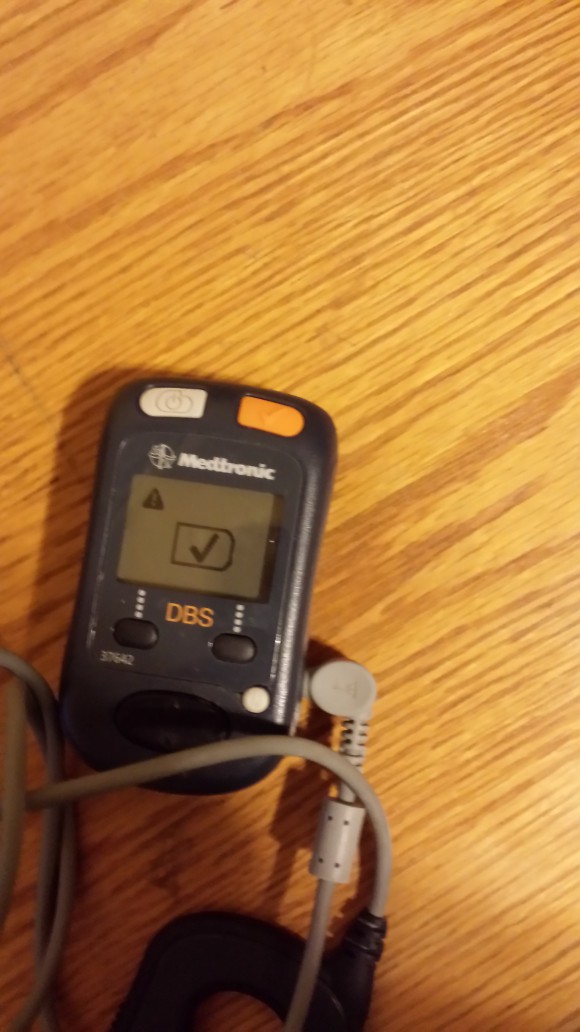
When they were complete,  Dr. R. visited my wife in the waiting room and handed her this device,

20150115_232700

saying, “here’s the remote control to your husband.”

It was two weeks later that Dr. R. completed part two, the second  surgery, while I was asleep, when he installed a neuro-transmitter in my chest and ran the wires from it up my neck and to the electrodes installed in part one.   It’d be about a month later before my new Movement Disorders Specialist, Dr. Z, configured and turned on the transmitter, programming it to send impulses to my brain to trick it into thinking it’s getting the dopamine that Parkinson’s has taken away.  Since then Dr. Z has taken excellent care of me, tweaking and adjusting the settings of the transmitter according to what I am experiencing at the time.

About a year ago, Dr. R. was back, to perform a simple, out-patient procedure to replace my transmitter’s old battery with the new one.  Once again, I was awake and lucid as Dr. R and his team went about their business, answering Dr. R’s trivia questions as he played classic rock on the sound system, correctly identifying Ringo Starr as the drummer on Tom Petty’s “I Won’t Back Down.”  They must have had me on some pretty good happy anesthetic, because I remember enthusiastically singing along to that and other songs, which the two other people in the world who have ever heard me sing know I only do when under the influence of extreme amounts of alcohol , and that these two people carry with them deep emotional and psychological scars from the experience.  So my apologies to those in the operating room who had to suffer so – may your therapy be swift and effective.

Five years later I know what DBS has and hasn’t done for me.  It was never intended to be a cure for Parkinson’s, and it hasn’t alleviated the need for medications.  I still wear on and off, just less frequently and to a lesser degree than before.  There have been side effects, such as impaired speech and handwriting and balance; these are adjustable by changing the settings on my “remote control” device.  Essentially, if I turn the voltage down, the side effects are minimized while the wearing off periods increase in frequency and severity, turn the voltage up, and the peaks and valleys of the meds cycle is largely flattened out, while the side effects worsen.  I’ve learned how to balance these, and there should be sufficient voltage capacity and tweaking that Dr. Z can do to effectively manage these symptoms for a long time, even as the disease progresses.

Last October, I participated in a three day clinical study designed for PD patients with DBS installed.  For parts of the study, I had to go varying times with the transmitter turned off, and for most of these times, my PD symptoms were unbearable.  It served as a sobering reminder of what life would be like without having had this wonderful chunk of hardware installed in me.


“Gentlemen, we can rebuild him – we have the technology.”  Aside from the occasional involuntary hop whenever the toaster pops, or the overwhelming urge to walk backwards when I hear the beeps from nearby construction sites, my DBS experience has been overwhelmingly positive.  I want to thank the incredible team of doctors and specialists and nurses at Northwest Memorial, in particular Dr. Z. and Dr. R., for the care and attention they have devoted to me.  I am lucky and blessed that my experience with this rotten disease is navigated by such brilliant and good people.


Beyond


(I wrote this over the span of a couple of dark nights about three and a half years ago)

When I was a kid, as I lay in the hushed dark before sleep, I’d wait for the comforting sound of the furnace blowing warm air through floor vents, or for the familiar rumbling of a train in the distance. If I was lucky and tired enough, one of these sounds would come to me, and I’d fall asleep before they reached their conclusion.  If not, they’d be replaced by the murmuring voices of the nocturnal people who came to life in the silence of the night. From my bed I could hear them, unseen and distant, from under the floorboards and from inside the impenetrable blackness. I could never make out what they were saying, but I knew it was something dark and mysterious.

I didn’t like the voices. I’d pull the blankets up over my head and shut my eyes so I wouldn’t see any of them. As I listened, I’d convince myself that if I were to pull back the covers and open my eyes, they’d be there, standing motionless in the dark in my room, next to my bed, waiting for me to see them, and then they’d know, they’d know that I hear them, and neither they nor I could pretend the other didn’t exist anymore.

The voices would start out as a barely audible whisper, coming from the other end of the house. Uninterrupted by the sound of the furnace or a distant train, they’d gradually get stronger, from a soft murmur to a dull drone, steadily getting closer and louder, until they were in my room, above and around me. What syllables I could make out sounded like a strange and ancient foreign language, like they were speaking in tongues.

Eventually I’d fall asleep and the voices would be forgotten until the next night. This went on for a few years until I outgrew them and learned to put a chain on my imagination, until I learned to distinguish between the real and the unreal.

                                                            . . .

September 1981: Driving south on I-94 in my 1978 Chevy Nova, already rusting out from the big dent in the rear passenger side panel, with the setting sun painting the western sky shades of red and pink, I pass County Line road, highway KR; then highway E, before taking the off-ramp on Highway 142 and heading east toward Kenosha. I make my way to and then through the intersection with Green Bay Road, through the lights on 39th and 30th Avenue, until the red light forces me to stop and wait for the green left turn signal on the intersection with 22nd Avenue.  But I can’t wait; I haven’t been able to wait for over the past hour, from the time the last delivery truck finally pulled into the Open Kitchens loading dock off of Highway 20 in Racine. I couldn’t wait for that stupid truck to finally get in, and I couldn’t wait to finish unloading it, and I can’t wait now, as the left turn green arrow finally comes on. I make my turn, and then, as I turn left on 43rd street, the clock on the dashboard and the vanishing pink rays of twilight in the west and the headlights of the oncoming traffic and the streetlights that came on at some point between 39th and 22nd avenue all tell me it is about 7:00, and that September is nearly over.

We’ve been married now for about a month and a half, and she is waiting for me, like she is every night, and when I finish climbing the back stairs to our apartment and open the door, she’ll be there, with that indestructible smile and her open arms, and we’ll embrace. I feel a smile of my own form on my face. I am only 22 years old, but as my heart pounds out the exhilarating anticipation of coming home to her, I wonder if I can really be this deliriously happy, and I am aware of how ridiculously innocent and corny our love is, of how completely lost in her I have become, and I don’t care, because no matter how hard the cynic in me tries to point out how whipped I have become, I know it is real, more real than anything I’ve ever felt before, more real than the darkness, the loneliness,  the hunger, and the aching ever were.

. . .

March 18, 2011: It’s been a crazy day, on the phone with company lawyers and retrieving data for hours, making sure the test and quality environments are nailed down in time for UAT to begin on Monday, and that we have a strategy for implementing the vendor patches for the IRT application. At about 3:30, suddenly everything falls into place, all the fires are extinguished, and I take a breath for the first time all day. I clear my mind and read through those e-mails I haven’t had a chance to yet, and I feel myself relaxing. It is near the end of the day, but more than that, it is Friday.

Next thing I know, it’s a quarter past five.  I’m feeling pretty good, and I decide, with the office almost empty now, that it’s a good time to pack up some of my things. I go about gathering the old mementos, books, and knick knacks I’ve accumulated over the past almost 13 years. I go through old files and photographs. I don’t feel a lot of emotion – no sadness, no loss, no pain – rather I feel the warm and pleasant tug of nostalgia. I make a couple of trips out to my car, and I tell myself, I’m getting down to it, in a few days I won’t be seeing any of this anymore.   I won’t be walking up this stairwell to the back entrance, I won’t see the labyrinth of first floor cubicles, I won’t see the late afternoon sunlight on the parking lot and the pond. I tell myself this is all ending, I should be feeling stronger emotions, but I don’t. I can’t work myself into an emotional tizzy no matter how hard I try. Even though I have only four working days left, and even though this is the last Friday, somehow it still doesn’t seem real.

. . .-

August 1, 2011:  I take inventory of my physical limitations. My handwriting is no longer legible. My speech has deteriorated to the point that unless I am reading from a script and intensely concentrating, people have difficulty understanding me. When I am stressed or tired, tremors in my right hand and arm frequently occur, making it temporarily impossible to type on my keyboard or navigate a mouse. My meds are wearing off now about every four hours, and for about an hour, or about a quarter of the time, I suffer from the same stiffness and rigidity that occupied about half of my time before my DBS surgery.  I sleep on an average of four to six hours a night, still better than before the DBS but not the seven hours I was consistently getting a year ago.  I am off of work now, and take about an hour’s nap every afternoon.  I often stay up late, and do most of my writing at night, but I am always up before my wife leaves for work in the morning.

What the future holds, despite my constant speculation and conjecture, is beyond my ability to fully grasp.  I appreciate this, because I know that eventually it is going to get real bad.  When I try to imagine what it will be like, I try to imagine myself trapped inside a marble statue, unable to move or speak, and I can never really get myself there.  When my meds wear off and my living rigor mortis starts to set in is when I come closest to getting it, but even that is always temporary, and I can’t wrap my head around what it will be like when it becomes permanent, when the off periods finally overtake and eliminate the on periods, and what it will be like when the good days are all spent and gone.

I’ve been aware, maybe too aware, of the limited number of good days still left, and I’ve made many pledges and promises about how I’d spend them. I’ve tried my best to honor these pledges, but old habits are hard to break, especially when the old habit is life itself.  Life remains about 80% routine and tedium, the same routine and tedium that it’s always been.  It’s true that there is beauty and wonder in that tedium, and it’s true I have been able to see that more frequently since my diagnosis, but the nature of tedium is such that it just occurs, and that’s how it has to be, because it’s the tedium that gets us from day to day, and if we were to always stop and savor and celebrate the miracles in it all, well, we’d never get a damn thing done.

Now I am just a few months shy of my 53rd birthday, and it’s been over four months since I stopped working. Tonight I’m thinking about those invisible nighttime voices I heard when I was a kid. I write them off as the product of a child’s overactive imagination.

But if those voices weren’t real, I ask myself, what else have I imagined? What is real?  Did I really have a career as an I.T. Manager? Were all of those projects and deadlines and all that work and stress and all the triumphs and failures real? Or did I imagine it all? My wife is upstairs sleeping. Considering the mathematics of infinite time and space, did I really meet and love and marry my perfect soul mate? And she loved me, too? This is all getting pretty far fetched. The odds are incalculable.

Maybe Parkinson’s is the only thing that is real. Maybe in fact the thing I can’t imagine, the eventual imprisonment of my mind and soul in the statue my body will become, has already happened, and maybe everything I’ve experienced has occurred within my imagination. Maybe those voices I heard when I was a kid were the last echoes of the real, outside world, and maybe everything else, all the pain and suffering, all the love and beauty, the incredible and the trivial, has taken place inside my head, a rationalized universe of my own creation to get me through the nightmare that is reality. This would explain the combination of the unlikely and unreal that has been my life so far.

Maybe beyond the horizons of this world, beyond the walls of infinity, a catatonic middle aged man sits alone in a wheelchair in the dusty corner of an institution for the insane and demented. Doctors and nurses shine bright lights in his eye, and see no activity, no hint of recognition. But a flashlight can’t illuminate the universe, or the infinity that lies behind and beyond those eyes.

In the end I’ll have no choice but to let Parkinson’s take me wherever it will take me. As it progresses, as I deteriorate, all I am and all I know will fade away, and I will be taken beyond – beyond the physical, beyond the emotional, beyond the boundaries of sanity and imagination, beyond death.

And when I am taken away from my friends, my family, and especially my wife, I will be taken beyond this Heaven, real or imagined, that I have been blessed to spend all my days in.

Finding the Right Words


Daylight was fading as he wandered the unending streets of Word City alone.  He didn’t want to go home.  He lived alone in a cheap one room apartment on the seventeenth floor of a decaying tenement high rise.  The thought of spending another night alone there with no heat or electricity, waiting for the phone to ring, depressed him too much.  He didn’t want to fall asleep again to the sounds of sirens blaring and glass breaking.  Instead, Idiolectal kept walking.  From the park he could see the brilliant high rises and architectural wonders of the east side, where the rich and powerful, the commonly used words, lived and exercised their power.   Words everybody knew and used, like it, this, be, from and they, lived in these towers, behind gated walls, and basked in their importance, knowing how indispensable they were to anyone trying to put together even  a few sentences.

Idiolectal could only imagine what it must have felt like to be that self confident, to be that important.  The best he could hope for were the end of college semesters, when students in linguistic classes had to finish term papers.  He could count on being used a handful of times, and for the week before finals, he was actually able to eat moderately well.

He felt the scorn, the superiority with which nouns and verbs looked down on him with.  He was merely an adjective, and a very specific one at that, A few adjectives, like good and new, had gained acceptance in the main stream and crossed over, and lived quite comfortably.  But the majority of adjectives still struggled to be taken seriously.  Only adverbs, crude and uneducated, occupied a lower rung on the word social latter.  Some adverbs embraced and exploited their vulgarity and made a decent living on the poorly written papers of sophomoric students or the messy novels of novice writers, but they were unable to crack the old world high society of long established verbs and nouns.

Night had fallen on Word City.  Idiolectal walked the streets, hunger gnawing at him.  He reached into his pocket and felt his last two dollar bills.  He could get a candy bar, or a small bag of chips, that would have to hold him until someone wrote him into a story or an essay or whatever, he didn’t care, he just needed work.  Stepping into the convenience store, he almost tripped over the bulk of another word, laying there passed out in the doorway.   The form rolled over to reveal itself, and, to Idiolectal’s surprise, a noun, a female noun lay looking up at him.  She was beautiful, even in her rags, and Idiolectal instantly fell in love.

Her name was Ostinato, and like Idiolectal, she suffered the poverty of neglect.  The two shared a common misery and began an intense romance. Ostinato told Idiolectal all of her  secrets, how she was defined as “a musical figure repeated persistently at the same pitch throughout a composition.”  Idiolectal told her how he was  “the language or speech pattern of one individual at a particular period of his life.”  They shared sound in common, and Idiolectal explained how, being born an adjective, he was destined to enhance a noun.

They married in the spring.  Nine months later Ostinato gave birth to a child, a preposition they named With.  With became wildly successful and made a fortune for the small family.  Together, the three words lived happily ever after.

The moral of the story:  anything is possible with love.

Isn’t That Remarkable?


One of my favorite moments in all of literature is the scene in Arthur Miller’s Death of a Salesman where Biff Loman finally breaks down and breaks through a lifetime of lies and delusions and makes his father, Willy Loman, understand that he loves him.  It’s the same scene where Willy famously exclaims “I am not a dime a dozen, I am Willy Loman …” Willy’s response to the breakthrough is three simple words:  “Isn’t that remarkable?”

I’ve read only a handful of great American plays, but one theme that seems to consistently run through them is illusion versus the truth.   The Glass Menagirie, by Tennessee Williams, opens with the following speech from Tom, the younger brother of the play’s main character, Laura:

“Yes, I have tricks in my pocket, I have things up my sleeve. But I am the opposite of a stage magician. He gives you illusion that has the appearance of truth. I give you truth in the pleasant disguise of illusion.”

The entire play is about the struggle between truth and illusion, responsibility versus escape.   It’s a theme Williams continues in his most famous play, A Streetcar Named Desire, which becomes an all out war between the cold and violent truth, represented by Stanley Kowalski, and the fragile dream world of illusion represented by Blanche Dubois.

We also see the same conflict in Eugene O’Neill’s The Iceman Cometh, about a group of drunken dreamers who are awaiting the annual arrival of their friend Hickey, the iceman.   Hickey arrives, but he is sober, and honest, and he confesses to the murder of his wife.  The harshness and violence of Hickey’s sober truth shatters the shallow dreams of the drunks.   Truth is again shown to be harsh and violent and destructive, while illusion is shown to be weak and wasteful.

These themes continue in almost all great American plays.  Edward Albee’s Who’s Afraid of Virginia Woolf  is  about a night with an alcoholic married couple playing a twisted game of  deception and lies on their young guests until the light of dawn reveals the tragic truth they’ve been trying to hide.

Why does this theme show up so often in American theatre?  I think it might be because it’s at the center of our history, the core of who we are and who we wish we were.  The illusion of America is that it’s that shining city on the hill, where all men are created equal, and where life, liberty and happiness are guaranteed to all, and where anyone willing to roll up their sleeves and work hard can make it.  These illusions cover up an uglier truth of genocide and corruption that have, since the beginning, been at the core of our history.  It took the Pilgrims who landed on Plymouth Rock in 1620, who came to this country to escape religious persecution, less than four generations before they were burning “witches” at the stake.  While the ink was still wet on Thomas Jefferson’s self evident truth that “all men are created equal,” slavery was a major part of our economy and would remain so for another eighty nine years.  Our westward expansion wiped out the natives who’d been here for hundreds of years, through a combination of disease, pestilence and war.  It was actually documented government policy to exterminate the great herds of buffalo that roamed the great plains, thus crippling the primary source of food and clothing of tens of thousands of native Americans.

The illusions and the truth of America continue to this day.  The land of the free is also the country with the largest percentage of its population incarcerated.  The gap between the rich and the rest of the country is widening to cavernous proportions, shattering any idea that all men are created equal.  There are sharper racial and class divides and deeper wounds to our psyche.  We are the most violent developed country in the world.

But we still hang on to the illusion, to its ideals, and every now and then, we make the illusion reality.  It was the illusion that allowed us to join together in World War Two and defeat the most powerful evil the world has ever known, it was the illusion that landed a man on the moon, it was the illusion that granted women and minorities the long overdue right to vote, it was the illusion that has allowed men and women throughout the country to marry who they love, regardless of sexual orientation.   Every now and then, we hold up our ideals to the mirror of reality and shame ourselves into action.  The ugliness of the truth cannot disfigure the beauty of the dream.

Isn’t that remarkable?